

D 2h =C 2v ffi C s , D 2h =C 2v ffi C 2 , D 2h =C 2v ffi C i :
ð17:31Þ
In turn, we express direct-product groups as, e.g.,
D 2h ¼ C 2v C s , D 2h ¼ C 2v C 2 , D 2h ¼ C 2v C i :
Example 17.3 Figure 17.9 shows an equilateral triangle placed on the xy-plane of a
three-dimensional Cartesian coordinate. An orthonormal basis e 1 and e 2 are designated as shown. As for a chemical species of molecules, we have, e.g., boron
trifluoride (BF 3 ). In the molecule, a boron atom is positioned at a molecular center
with three fluorine atoms located at vertices of the equilateral triangle. The boron
atom and fluorine atoms form a planar molecule (Fig. 17.10).
A symmetry group belonging to D 3h comprises twelve symmetry operations such
that
D 3h ¼ E, C 3 , C
0
3 , C 2 , C
0
2 , C
00
2 , σ h , S 3 , S
0
3 , σ v , σ
0
v , σ
00
v
È
É
,
ð17:32Þ
where symmetry operations of the same species but distinct operation are denoted by
a “prime” or “double prime.” When we represent these operations by a matrix, it is
straightforward in most cases. For instance, a matrix for σ v is given by M yz of
(17.15). However, we should make some matrix calculations about
C
0
2 , C
00
2 , σ
0
v , and σ
00
v .
To determine a matrix representation of, e.g., σ
0
v in reference to the xy-coordinate
system with orthonormal basis vectors e 1 and e 2 , we consider the x’y’-coordinate
system with orthonormal basis vectors e
0
1 and e
0
2 (see Fig. 17.9). A transformation
matrix between the two set of basis vectors is represented by
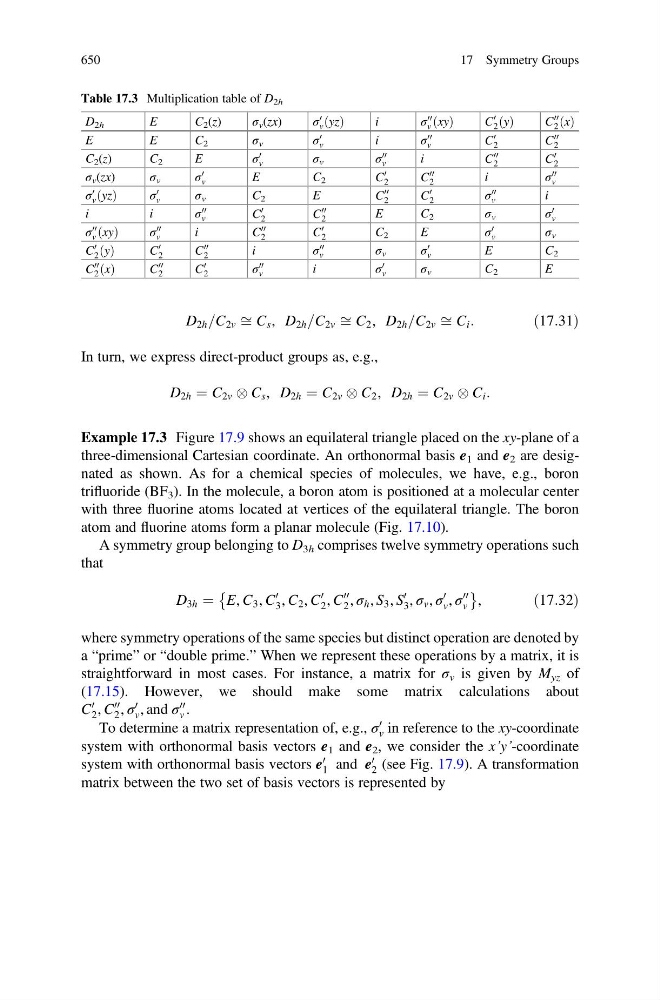
Table 17.3 Multiplication table of D 2h
D 2h
E
C 2 (z)
σ v (zx)
σ
0
v yz
ð Þ
i
σ
00
v xy
ð Þ
C
0
2 y
ð Þ
C
00
2 x
ð Þ
E
E
C 2
σ v
σ
0
v
i
σ
00
v
C
0
2
C
00
2
C 2 (z)
C 2
E
σ
0
v
σ v
σ
00
v
i
C
00
2
C
0
2
σ v (zx)
σ v
σ
0
v
E
C 2
C
0
2
C
00
2
i
σ
00
v
σ
0
v yz
ð Þ
σ
0
v
σ v
C 2
E
C
00
2
C
0
2
σ
00
v
i
i
i
σ
00
v
C
0
2
C
00
2
E
C 2
σ v
σ
0
v
σ
00
v xy
ð Þ
σ
00
v
i
C
00
2
C
0
2
C 2
E
σ
0
v
σ v
C
0
2 y
ð Þ
C
0
2
C
00
2
i
σ
00
v
σ v
σ
0
v
E
C 2
C
00
2 x
ð Þ
C
00
2
C
0
2
σ
00
v
i
σ
0
v
σ v
C 2
E
650
17 Symmetry Groups