

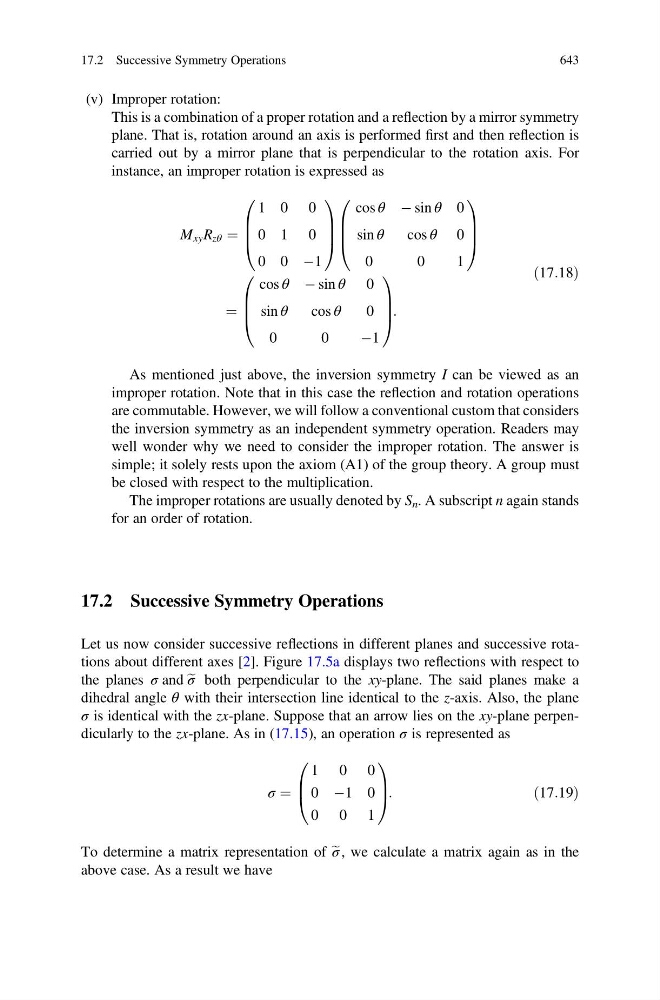
(v) Improper rotation:
This is a combination of a proper rotation and a reflection by a mirror symmetry
plane. That is, rotation around an axis is performed first and then reflection is
carried out by a mirror plane that is perpendicular to the rotation axis. For
instance, an improper rotation is expressed as
M xy R zθ ¼
1 0 0
0 1 0
0 0 À1
0
B
B
@
1
C
C
A
cos θ À sin θ 0
sin θ
cos θ 0
0
0
1
0
B
B
@
1
C
C
A
¼
cos θ À sin θ 0
sin θ
cos θ
0
0
0
À1
0
B
B
@
1
C
C
A :
ð17:18Þ
As mentioned just above, the inversion symmetry I can be viewed as an
improper rotation. Note that in this case the reflection and rotation operations
are commutable. However, we will follow a conventional custom that considers
the inversion symmetry as an independent symmetry operation. Readers may
well wonder why we need to consider the improper rotation. The answer is
simple; it solely rests upon the axiom (A1) of the group theory. A group must
be closed with respect to the multiplication.
The improper rotations are usually denoted by S n . A subscript n again stands
for an order of rotation.
17.2 Successive Symmetry Operations
Let us now consider successive reflections in different planes and successive rotations about different axes [2]. Figure 17.5a displays two reflections with respect to
the planes σ and e σ both perpendicular to the xy-plane. The said planes make a
dihedral angle θ with their intersection line identical to the z-axis. Also, the plane
σ is identical with the zx-plane. Suppose that an arrow lies on the xy-plane perpendicularly to the zx-plane. As in (17.15), an operation σ is represented as
σ ¼
1 0 0
0 À1 0
0 0 1
0
B
@
1
C
A:
ð17:19Þ
To determine a matrix representation of e σ , we calculate a matrix again as in the
above case. As a result we have
17.2 Successive Symmetry Operations
643