

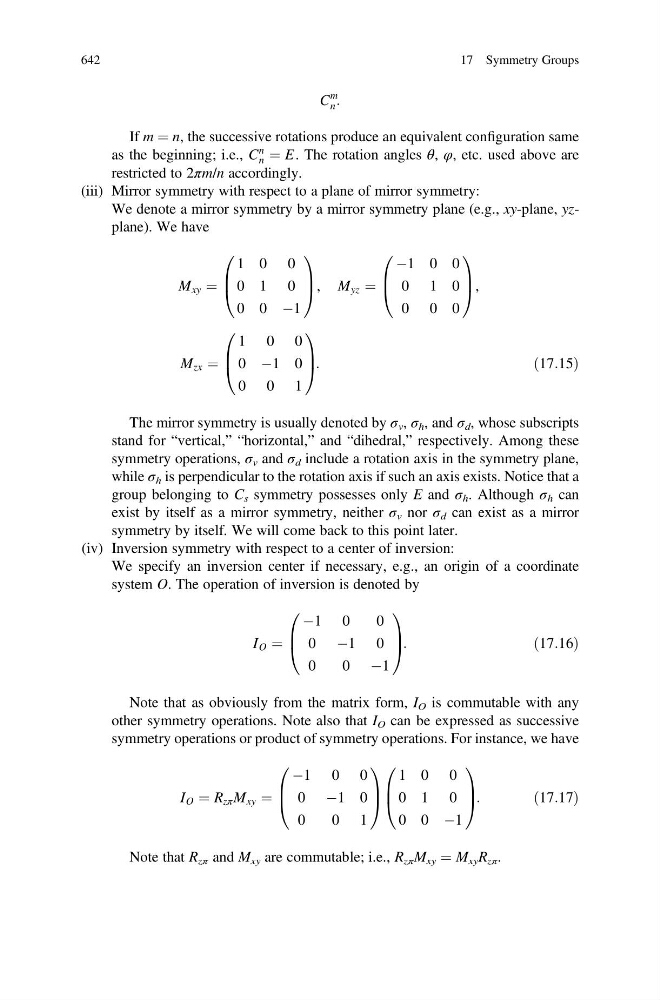
C
m
n :
If m ¼ n, the successive rotations produce an equivalent configuration same
as the beginning; i.e., C
n
n ¼ E . The rotation angles θ, φ, etc. used above are
restricted to 2πm/n accordingly.
(iii) Mirror symmetry with respect to a plane of mirror symmetry:
We denote a mirror symmetry by a mirror symmetry plane (e.g., xy-plane, yzplane). We have
M xy ¼
1 0 0
0 1 0
0 0 À1
0
B
@
1
C
A, M yz ¼
À1 0 0
0 1 0
0 0 0
0
B
@
1
C
A,
M zx ¼
1 0 0
0 À1 0
0 0 1
0
B
@
1
C
A:
ð17:15Þ
The mirror symmetry is usually denoted by σ v , σ h , and σ d , whose subscripts
stand for “vertical,” “horizontal,” and “dihedral,” respectively. Among these
symmetry operations, σ v and σ d include a rotation axis in the symmetry plane,
while σ h is perpendicular to the rotation axis if such an axis exists. Notice that a
group belonging to C s symmetry possesses only E and σ h . Although σ h can
exist by itself as a mirror symmetry, neither σ v nor σ d can exist as a mirror
symmetry by itself. We will come back to this point later.
(iv) Inversion symmetry with respect to a center of inversion:
We specify an inversion center if necessary, e.g., an origin of a coordinate
system O. The operation of inversion is denoted by
I O ¼
À1 0
0
0 À1 0
0
0 À1
0
B
@
1
C
A:
ð17:16Þ
Note that as obviously from the matrix form, I O is commutable with any
other symmetry operations. Note also that I O can be expressed as successive
symmetry operations or product of symmetry operations. For instance, we have
I O ¼ R zπ M xy ¼
À1 0 0
0 À1 0
0
0 1
0
B
@
1
C
A
1 0 0
0 1 0
0 0 À1
0
B
@
1
C
A:
ð17:17Þ
Note that R zπ and M xy are commutable; i.e., R zπ M xy ¼ M xy R zπ .
642
17 Symmetry Groups