

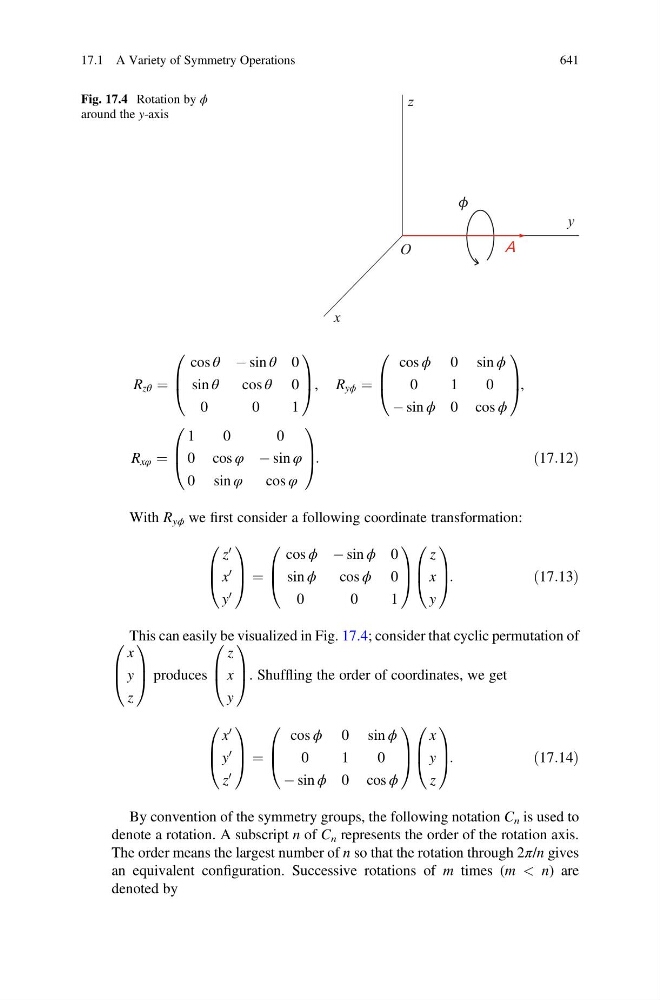
R zθ ¼
cos θ À sin θ 0
sin θ
cos θ 0
0
0
1
0
B
@
1
C
A, R yϕ ¼
cos ϕ 0 sin ϕ
0
1
0
À sin ϕ 0 cos ϕ
0
B
@
1
C
A,
R xφ ¼
1
0
0
0 cos φ À sin φ
0 sin φ
cos φ
0
B
@
1
C
A:
ð17:12Þ
With R yϕ we first consider a following coordinate transformation:
z
0
x
0
y
0
0
B
@
1
C
A ¼
cos ϕ À sin ϕ 0
sin ϕ
cos ϕ 0
0
0
1
0
B
@
1
C
A
z
x
y
0
B
@
1
C
A:
ð17:13Þ
This can easily be visualized in Fig. 17.4; consider that cyclic permutation of
x
y
z
0
B
@
1
C
A produces
z
x
y
0
B
@
1
C
A. Shuffling the order of coordinates, we get
x
0
y
0
z
0
0
B
@
1
C
A ¼
cos ϕ 0 sin ϕ
0
1
0
À sin ϕ 0 cos ϕ
0
B
@
1
C
A
x
y
z
0
B
@
1
C
A:
ð17:14Þ
By convention of the symmetry groups, the following notation C n is used to
denote a rotation. A subscript n of C n represents the order of the rotation axis.
The order means the largest number of n so that the rotation through 2π/n gives
an equivalent configuration. Successive rotations of m times (m < n) are
denoted by
y
x
z
O
$
Fig. 17.4 Rotation by ϕ
around the y-axis
17.1 A Variety of Symmetry Operations
641