

x
0
y
0
¼
cos θ À sin θ
sin θ
cos θ
x
y
:
ð17:11Þ
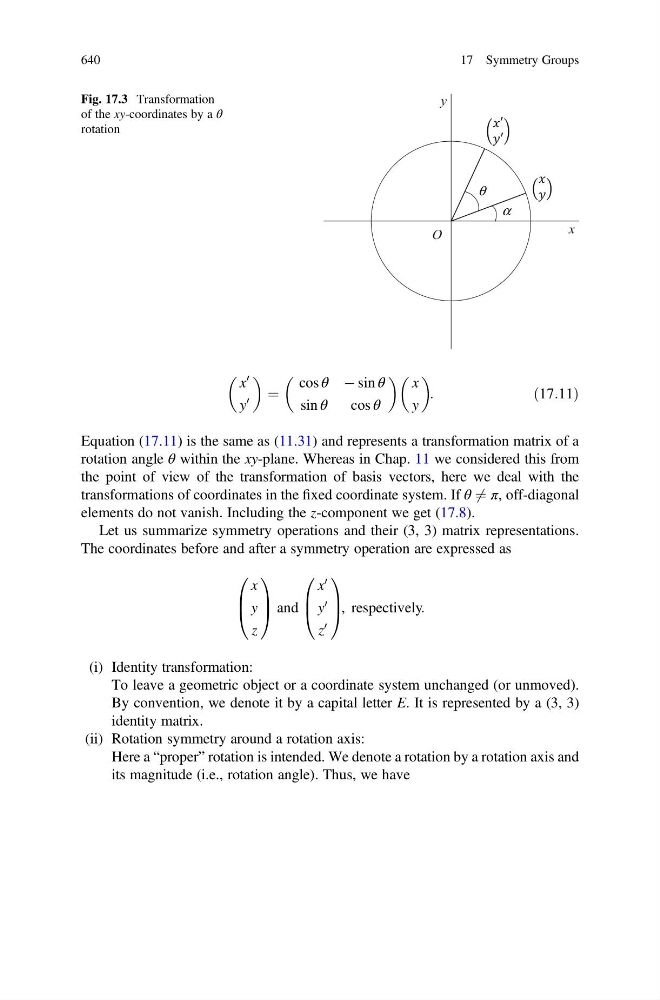
Equation (17.11) is the same as (11.31) and represents a transformation matrix of a
rotation angle θ within the xy-plane. Whereas in Chap. 11 we considered this from
the point of view of the transformation of basis vectors, here we deal with the
transformations of coordinates in the fixed coordinate system. If θ 6 ¼ π, off-diagonal
elements do not vanish. Including the z-component we get (17.8).
Let us summarize symmetry operations and their (3, 3) matrix representations.
The coordinates before and after a symmetry operation are expressed as
x
y
z
0
B
@
1
C
A and
x
0
y
0
z
0
0
B
@
1
C
A, respectively:
(i) Identity transformation:
To leave a geometric object or a coordinate system unchanged (or unmoved).
By convention, we denote it by a capital letter E. It is represented by a (3, 3)
identity matrix.
(ii) Rotation symmetry around a rotation axis:
Here a “proper” rotation is intended. We denote a rotation by a rotation axis and
its magnitude (i.e., rotation angle). Thus, we have
y
x
α
′
θ
O
Fig. 17.3 Transformation
of the xy-coordinates by a θ
rotation
640
17 Symmetry Groups
0
y
0
¼
cos θ À sin θ
sin θ
cos θ
x
y
:
ð17:11Þ
Equation (17.11) is the same as (11.31) and represents a transformation matrix of a
rotation angle θ within the xy-plane. Whereas in Chap. 11 we considered this from
the point of view of the transformation of basis vectors, here we deal with the
transformations of coordinates in the fixed coordinate system. If θ 6 ¼ π, off-diagonal
elements do not vanish. Including the z-component we get (17.8).
Let us summarize symmetry operations and their (3, 3) matrix representations.
The coordinates before and after a symmetry operation are expressed as
x
y
z
0
B
@
1
C
A and
x
0
y
0
z
0
0
B
@
1
C
A, respectively:
(i) Identity transformation:
To leave a geometric object or a coordinate system unchanged (or unmoved).
By convention, we denote it by a capital letter E. It is represented by a (3, 3)
identity matrix.
(ii) Rotation symmetry around a rotation axis:
Here a “proper” rotation is intended. We denote a rotation by a rotation axis and
its magnitude (i.e., rotation angle). Thus, we have
y
x
α
′
θ
O
Fig. 17.3 Transformation
of the xy-coordinates by a θ
rotation
640
17 Symmetry Groups