

A, B, and C itself, respectively. The said group is commutative (Abelian) and said to
be a four group [1].
Meanwhile, we have a number of noncommutative groups. From a point of view
of a matrix structure, noncommutativity comes from off-diagonal elements of the
matrix. A typical example is a rotation matrix of a rotation angles different from zero
or nπ (n: integer). For later use, let us have a matrix form that expresses a θ rotation
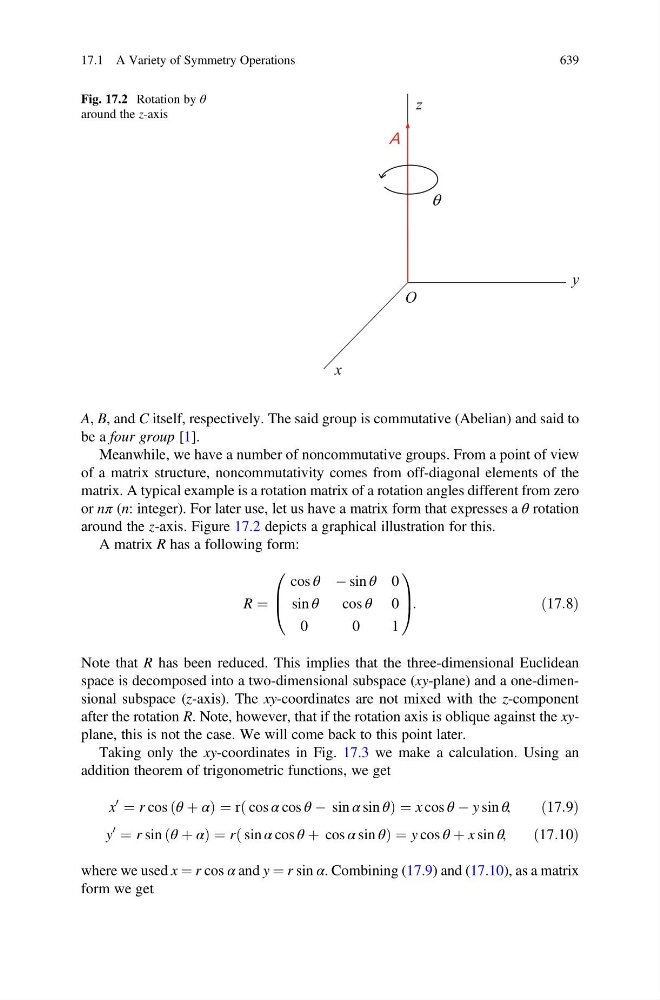
around the z-axis. Figure 17.2 depicts a graphical illustration for this.
A matrix R has a following form:
R ¼
cos θ À sin θ 0
sin θ
cos θ 0
0
0
1
0
B
@
1
C
A:
ð17:8Þ
Note that R has been reduced. This implies that the three-dimensional Euclidean
space is decomposed into a two-dimensional subspace (xy-plane) and a one-dimensional subspace (z-axis). The xy-coordinates are not mixed with the z-component
after the rotation R. Note, however, that if the rotation axis is oblique against the xyplane, this is not the case. We will come back to this point later.
Taking only the xy-coordinates in Fig. 17.3 we make a calculation. Using an
addition theorem of trigonometric functions, we get
x
0
¼ r cos θ þ α
ð
Þ¼r cos α cos θ À sin α sin θ
ð
Þ ¼ x cos θ À y sin θ,
ð17:9Þ
y
0
¼ r sin θ þ α
ð
Þ¼r sin α cos θ þ cos α sin θ
ð
Þ ¼ y cos θ þ x sin θ,
ð17:10Þ
where we used x ¼ r cos α and y ¼ r sin α. Combining (17.9) and (17.10), as a matrix
form we get
y
x
z
O
$
θ
Fig. 17.2 Rotation by θ
around the z-axis
17.1 A Variety of Symmetry Operations
639