

successive symmetric operations a, b, c is associative; i.e., a ⋄ (b ⋄ c) ¼ (a ⋄ b) ⋄ c.
(iii) The set H contains an element of e called the identity element such that we have
a ⋄ e ¼ e ⋄ a ¼ a with any element a of H. Operating “nothing” should be e. If the
rotation is relevant, 2π rotation is thought to be e. These are intuitively acceptable.
(iv) For any a of ℊ, we have an element b such that a ⋄ b ¼ b ⋄ a ¼ e. The element
b is said to be the inverse element of a. We denote it by b a
À1 . The inverse element
corresponds to an operation that brings the disposition of a geometric object back to
the original disposition. Thus, H forms a group. We call H satisfying the above
criteria a symmetry group. A symmetry group is called a point group as well. This is
because a point group comprises symmetry operations of geometric objects as group
elements and those objects have at least one fixed point after the relevant symmetry
operation. The name of a point group comes from this fact.
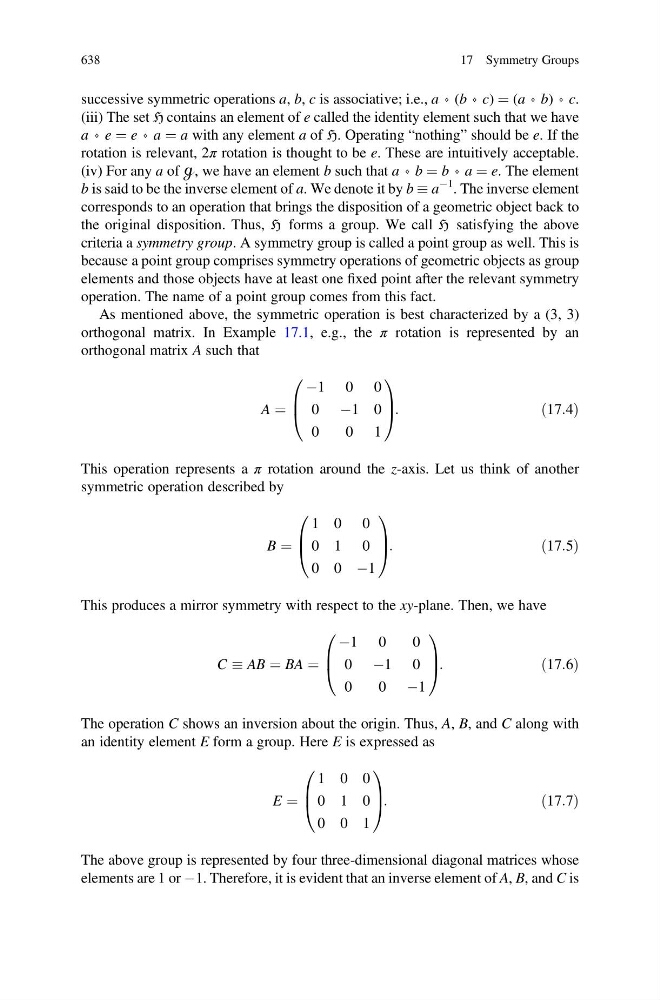
As mentioned above, the symmetric operation is best characterized by a (3, 3)
orthogonal matrix. In Example 17.1, e.g., the π rotation is represented by an
orthogonal matrix A such that
A ¼
À1 0 0
0 À1 0
0
0 1
0
B
@
1
C
A:
ð17:4Þ
This operation represents a π rotation around the z-axis. Let us think of another
symmetric operation described by
B ¼
1 0 0
0 1 0
0 0 À1
0
B
@
1
C
A:
ð17:5Þ
This produces a mirror symmetry with respect to the xy-plane. Then, we have
C AB ¼ BA ¼
À1 0
0
0 À1 0
0
0 À1
0
B
@
1
C
A:
ð17:6Þ
The operation C shows an inversion about the origin. Thus, A, B, and C along with
an identity element E form a group. Here E is expressed as
E ¼
1 0 0
0 1 0
0 0 1
0
B
@
1
C
A:
ð17:7Þ
The above group is represented by four three-dimensional diagonal matrices whose
elements are 1 or À1. Therefore, it is evident that an inverse element of A, B, and C is
638
17 Symmetry Groups