

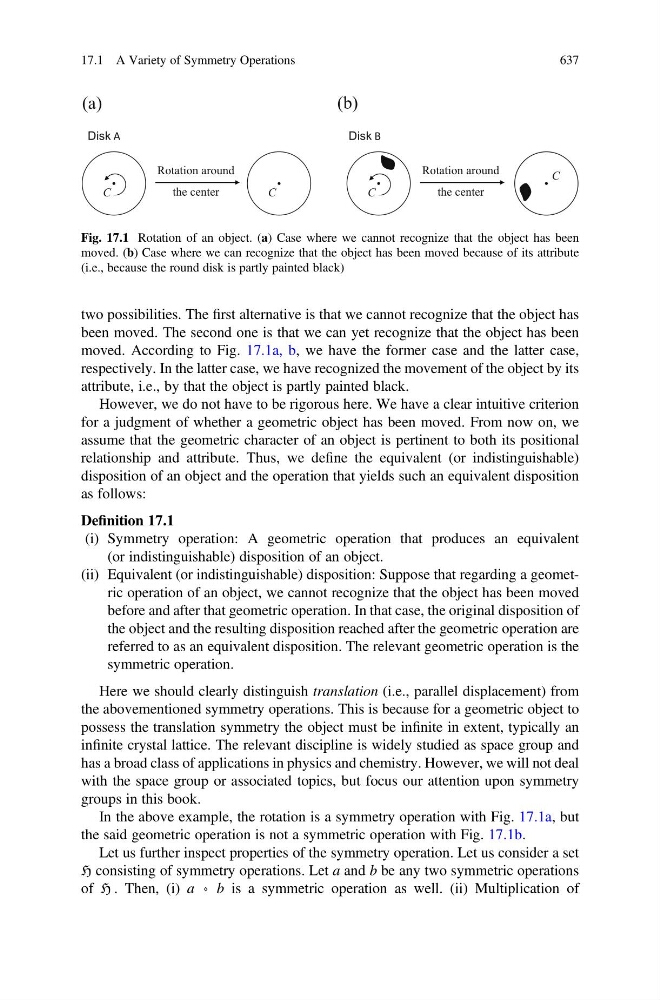
two possibilities. The first alternative is that we cannot recognize that the object has
been moved. The second one is that we can yet recognize that the object has been
moved. According to Fig. 17.1a, b, we have the former case and the latter case,
respectively. In the latter case, we have recognized the movement of the object by its
attribute, i.e., by that the object is partly painted black.
However, we do not have to be rigorous here. We have a clear intuitive criterion
for a judgment of whether a geometric object has been moved. From now on, we
assume that the geometric character of an object is pertinent to both its positional
relationship and attribute. Thus, we define the equivalent (or indistinguishable)
disposition of an object and the operation that yields such an equivalent disposition
as follows:
Definition 17.1
(i) Symmetry operation: A geometric operation that produces an equivalent
(or indistinguishable) disposition of an object.
(ii) Equivalent (or indistinguishable) disposition: Suppose that regarding a geometric operation of an object, we cannot recognize that the object has been moved
before and after that geometric operation. In that case, the original disposition of
the object and the resulting disposition reached after the geometric operation are
referred to as an equivalent disposition. The relevant geometric operation is the
symmetric operation.
Here we should clearly distinguish translation (i.e., parallel displacement) from
the abovementioned symmetry operations. This is because for a geometric object to
possess the translation symmetry the object must be infinite in extent, typically an
infinite crystal lattice. The relevant discipline is widely studied as space group and
has a broad class of applications in physics and chemistry. However, we will not deal
with the space group or associated topics, but focus our attention upon symmetry
groups in this book.
In the above example, the rotation is a symmetry operation with Fig. 17.1a, but
the said geometric operation is not a symmetric operation with Fig. 17.1b.
Let us further inspect properties of the symmetry operation. Let us consider a set
H consisting of symmetry operations. Let a and b be any two symmetric operations
of H . Then, (i) a ⋄ b is a symmetric operation as well. (ii) Multiplication of
(a)
(b)
C
Rotation around
the center
Rotation around
the center
C
C
C
Disk A
Disk B
Fig. 17.1 Rotation of an object. (a) Case where we cannot recognize that the object has been
moved. (b) Case where we can recognize that the object has been moved because of its attribute
(i.e., because the round disk is partly painted black)
17.1 A Variety of Symmetry Operations
637