

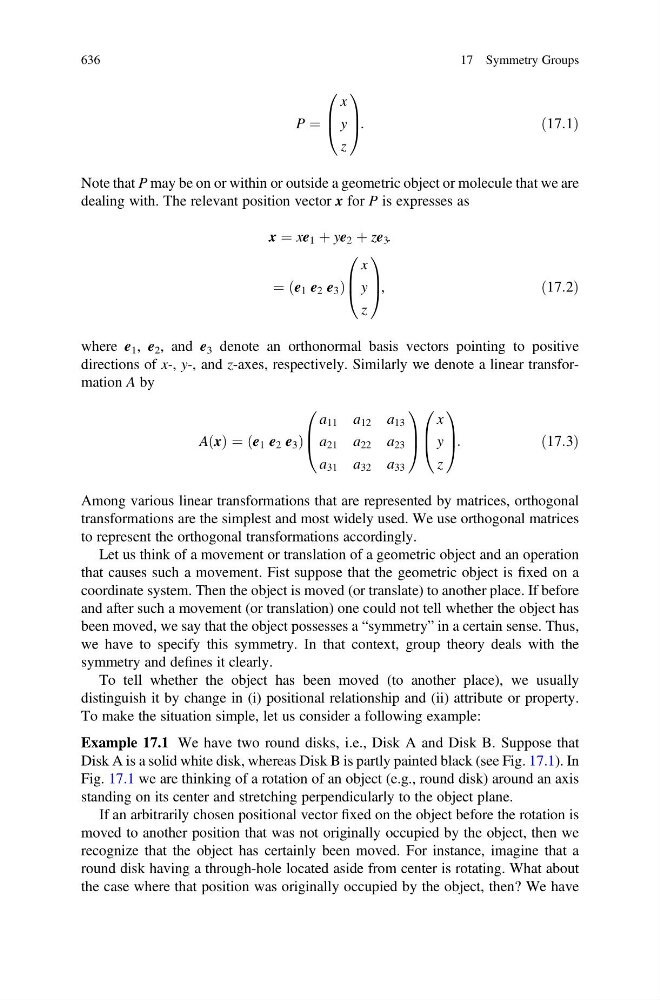
P ¼
x
y
z
0
B
@
1
C
A:
ð17:1Þ
Note that P may be on or within or outside a geometric object or molecule that we are
dealing with. The relevant position vector x for P is expresses as
x ¼ xe 1 þ ye 2 þ ze 3 :
¼ e 1 e 2 e 3
ð
Þ
x
y
z
0
B
@
1
C
A,
ð17:2Þ
where e 1 , e 2 , and e 3 denote an orthonormal basis vectors pointing to positive
directions of x-, y-, and z-axes, respectively. Similarly we denote a linear transformation A by
A x
ð Þ ¼ e 1 e 2 e 3
ð
Þ
a 11 a 12 a 13
a 21 a 22 a 23
a 31 a 32 a 33
0
B
@
1
C
A
x
y
z
0
B
@
1
C
A:
ð17:3Þ
Among various linear transformations that are represented by matrices, orthogonal
transformations are the simplest and most widely used. We use orthogonal matrices
to represent the orthogonal transformations accordingly.
Let us think of a movement or translation of a geometric object and an operation
that causes such a movement. Fist suppose that the geometric object is fixed on a
coordinate system. Then the object is moved (or translate) to another place. If before
and after such a movement (or translation) one could not tell whether the object has
been moved, we say that the object possesses a “symmetry” in a certain sense. Thus,
we have to specify this symmetry. In that context, group theory deals with the
symmetry and defines it clearly.
To tell whether the object has been moved (to another place), we usually
distinguish it by change in (i) positional relationship and (ii) attribute or property.
To make the situation simple, let us consider a following example:
Example 17.1 We have two round disks, i.e., Disk A and Disk B. Suppose that
Disk A is a solid white disk, whereas Disk B is partly painted black (see Fig. 17.1). In
Fig. 17.1 we are thinking of a rotation of an object (e.g., round disk) around an axis
standing on its center and stretching perpendicularly to the object plane.
If an arbitrarily chosen positional vector fixed on the object before the rotation is
moved to another position that was not originally occupied by the object, then we
recognize that the object has certainly been moved. For instance, imagine that a
round disk having a through-hole located aside from center is rotating. What about
the case where that position was originally occupied by the object, then? We have
636
17 Symmetry Groups
x
y
z
0
B
@
1
C
A:
ð17:1Þ
Note that P may be on or within or outside a geometric object or molecule that we are
dealing with. The relevant position vector x for P is expresses as
x ¼ xe 1 þ ye 2 þ ze 3 :
¼ e 1 e 2 e 3
ð
Þ
x
y
z
0
B
@
1
C
A,
ð17:2Þ
where e 1 , e 2 , and e 3 denote an orthonormal basis vectors pointing to positive
directions of x-, y-, and z-axes, respectively. Similarly we denote a linear transformation A by
A x
ð Þ ¼ e 1 e 2 e 3
ð
Þ
a 11 a 12 a 13
a 21 a 22 a 23
a 31 a 32 a 33
0
B
@
1
C
A
x
y
z
0
B
@
1
C
A:
ð17:3Þ
Among various linear transformations that are represented by matrices, orthogonal
transformations are the simplest and most widely used. We use orthogonal matrices
to represent the orthogonal transformations accordingly.
Let us think of a movement or translation of a geometric object and an operation
that causes such a movement. Fist suppose that the geometric object is fixed on a
coordinate system. Then the object is moved (or translate) to another place. If before
and after such a movement (or translation) one could not tell whether the object has
been moved, we say that the object possesses a “symmetry” in a certain sense. Thus,
we have to specify this symmetry. In that context, group theory deals with the
symmetry and defines it clearly.
To tell whether the object has been moved (to another place), we usually
distinguish it by change in (i) positional relationship and (ii) attribute or property.
To make the situation simple, let us consider a following example:
Example 17.1 We have two round disks, i.e., Disk A and Disk B. Suppose that
Disk A is a solid white disk, whereas Disk B is partly painted black (see Fig. 17.1). In
Fig. 17.1 we are thinking of a rotation of an object (e.g., round disk) around an axis
standing on its center and stretching perpendicularly to the object plane.
If an arbitrarily chosen positional vector fixed on the object before the rotation is
moved to another position that was not originally occupied by the object, then we
recognize that the object has certainly been moved. For instance, imagine that a
round disk having a through-hole located aside from center is rotating. What about
the case where that position was originally occupied by the object, then? We have
636
17 Symmetry Groups