

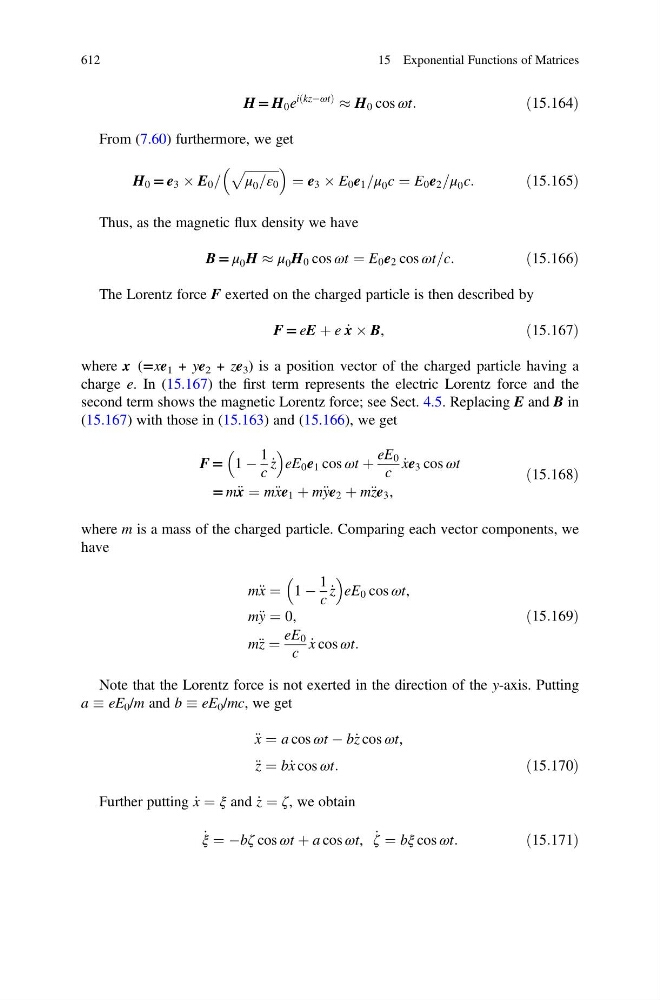
H = H 0 e
i kzÀωt
ð
Þ
% H 0 cos ωt:
ð15:164Þ
From (7.60) furthermore, we get
H 0 = e 3 Â E 0 =
ffiffiffiffiffiffiffiffiffiffiffi
μ 0 =ε 0
p
¼ e 3 Â E 0 e 1 =μ 0 c ¼ E 0 e 2 =μ 0 c:
ð15:165Þ
Thus, as the magnetic flux density we have
B = μ 0 H % μ 0 H 0 cos ωt ¼ E 0 e 2 cos ωt=c:
ð15:166Þ
The Lorentz force F exerted on the charged particle is then described by
F = eE þ e _
x  B,
ð15:167Þ
where x (=xe 1 + ye 2 + ze 3 ) is a position vector of the charged particle having a
charge e. In (15.167) the first term represents the electric Lorentz force and the
second term shows the magnetic Lorentz force; see Sect. 4.5. Replacing E and B in
(15.167) with those in (15.163) and (15.166), we get
F = 1 À
1
c
_
z
eE 0 e 1 cos ωt þ
eE 0
c
_
xe 3 cos ωt
= m€ x ¼ m€ xe 1 þ m€ ye 2 þ m€ ze 3 ,
ð15:168Þ
where m is a mass of the charged particle. Comparing each vector components, we
have
m€ x ¼ 1 À
1
c
_
z
eE 0 cos ωt,
m€ y ¼ 0,
m€ z ¼
eE 0
c
_
x cos ωt:
ð15:169Þ
Note that the Lorentz force is not exerted in the direction of the y-axis. Putting
a eE 0 /m and b eE 0 /mc, we get
€ x ¼ a cos ωt À b_ z cos ωt,
€ z ¼ b_ x cos ωt:
ð15:170Þ
Further putting _
x ¼ ξ and _
z ¼ ζ, we obtain
_
ξ ¼ Àbζ cos ωt þ a cos ωt, _
ζ ¼ bξ cos ωt:
ð15:171Þ
612
15 Exponential Functions of Matrices