

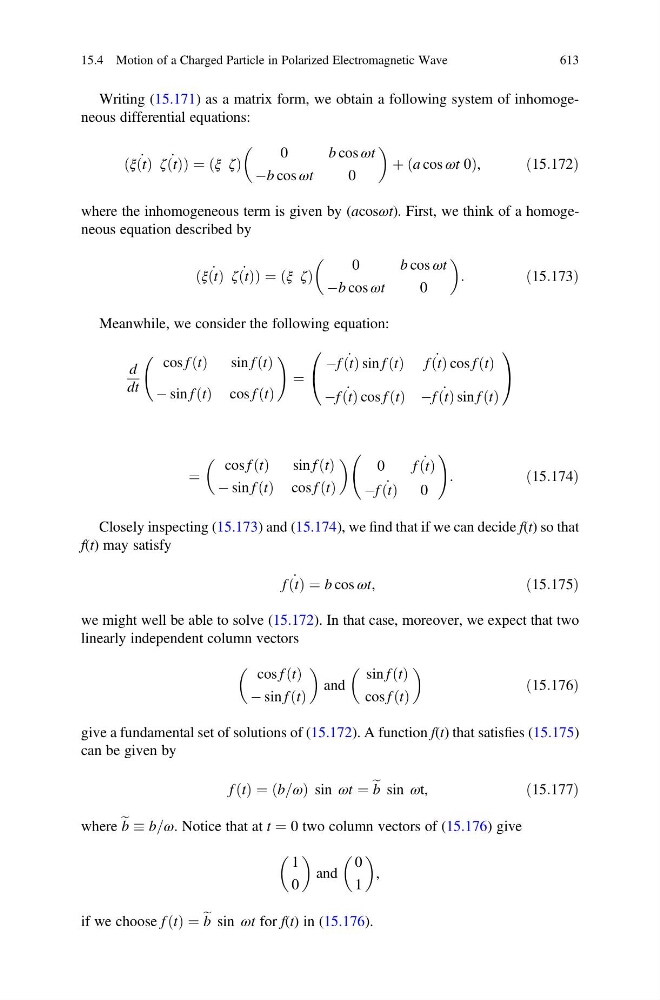
Writing (15.171) as a matrix form, we obtain a following system of inhomogeneous differential equations:
ð _
ξ t
ð Þ _
ζ t
ð ÞÞ ¼ ξ ζ
ð Þ
0
b cos ωt
Àb cos ωt
0
þ a cos ωt 0
ð
Þ ,
ð15:172Þ
where the inhomogeneous term is given by (acosωt). First, we think of a homogeneous equation described by
ð _
ξ t
ð Þ _
ζ t
ð ÞÞ ¼ ξ ζ
ð Þ
0
b cos ωt
Àb cos ωt
0
:
ð15:173Þ
Meanwhile, we consider the following equation:
d
dt
cos f t
ð Þ
sin f t
ð Þ
À sin f t
ð Þ cos f t
ð Þ
!
¼
À _
f t
ð Þ sin f t
ð Þ
_
f t
ð Þ cos f t
ð Þ
À _
f t
ð Þ cos f t
ð Þ À _
f t
ð Þ sin f t
ð Þ
0
@
1
A
¼
cos f t
ð Þ
sin f t
ð Þ
À sin f t
ð Þ cos f t
ð Þ
0
_
f t
ð Þ
À _
f t
ð Þ
0
!
:
ð15:174Þ
Closely inspecting (15.173) and (15.174), we find that if we can decide f(t) so that
f(t) may satisfy
_
f t
ð Þ ¼ b cos ωt,
ð15:175Þ
we might well be able to solve (15.172). In that case, moreover, we expect that two
linearly independent column vectors
cos f t
ð Þ
À sin f t
ð Þ
and
sin f t
ð Þ
cos f t
ð Þ
ð15:176Þ
give a fundamental set of solutions of (15.172). A function f(t) that satisfies (15.175)
can be given by
f t
ð Þ ¼ b=ω
ð
Þ sin ωt ¼ e b sin ωt,
ð15:177Þ
where e b b=ω. Notice that at t ¼ 0 two column vectors of (15.176) give
1
0
and
0
1
,
if we choose f t
ð Þ ¼ e b sin ωt for f(t) in (15.176).
15.4 Motion of a Charged Particle in Polarized Electromagnetic Wave
613
ð _
ξ t
ð Þ _
ζ t
ð ÞÞ ¼ ξ ζ
ð Þ
0
b cos ωt
Àb cos ωt
0
þ a cos ωt 0
ð
Þ ,
ð15:172Þ
where the inhomogeneous term is given by (acosωt). First, we think of a homogeneous equation described by
ð _
ξ t
ð Þ _
ζ t
ð ÞÞ ¼ ξ ζ
ð Þ
0
b cos ωt
Àb cos ωt
0
:
ð15:173Þ
Meanwhile, we consider the following equation:
d
dt
cos f t
ð Þ
sin f t
ð Þ
À sin f t
ð Þ cos f t
ð Þ
!
¼
À _
f t
ð Þ sin f t
ð Þ
_
f t
ð Þ cos f t
ð Þ
À _
f t
ð Þ cos f t
ð Þ À _
f t
ð Þ sin f t
ð Þ
0
@
1
A
¼
cos f t
ð Þ
sin f t
ð Þ
À sin f t
ð Þ cos f t
ð Þ
0
_
f t
ð Þ
À _
f t
ð Þ
0
!
:
ð15:174Þ
Closely inspecting (15.173) and (15.174), we find that if we can decide f(t) so that
f(t) may satisfy
_
f t
ð Þ ¼ b cos ωt,
ð15:175Þ
we might well be able to solve (15.172). In that case, moreover, we expect that two
linearly independent column vectors
cos f t
ð Þ
À sin f t
ð Þ
and
sin f t
ð Þ
cos f t
ð Þ
ð15:176Þ
give a fundamental set of solutions of (15.172). A function f(t) that satisfies (15.175)
can be given by
f t
ð Þ ¼ b=ω
ð
Þ sin ωt ¼ e b sin ωt,
ð15:177Þ
where e b b=ω. Notice that at t ¼ 0 two column vectors of (15.176) give
1
0
and
0
1
,
if we choose f t
ð Þ ¼ e b sin ωt for f(t) in (15.176).
15.4 Motion of a Charged Particle in Polarized Electromagnetic Wave
613