

15.4 Motion of a Charged Particle in Polarized
Electromagnetic Wave
In Sect. 4.5 we dealt with an electron motion under a circularly polarized light.
Here we consider the motion of a charged particle in a linearly polarized
electromagnetic wave.
Suppose that a charged particle is placed in vacuum. Suppose also that an
electromagnetic wave (light) linearly polarized along the x-direction is propagated
in the positive direction of the z-axis. Unlike the case of Sect. 4.5, we have to take
account of influence from both of the electric field and magnetic field components of
Lorentz force.
From (7.58) we have
E = E 0 e
i kÁxÀωt
ð
Þ
¼ E 0 e 1 e
i kzÀωt
ð
Þ ,
ð15:161Þ
where e 1 , e 2 , and e 3 are the unit vector of the x-, y-, and z-direction. (The latter two
unit vectors appear just below.) If the extent of motion of the charged particle is
narrow enough around the origin compared to a wavelength of the electromagnetic
field, we can ignore kz in the exponent (see Sect. 4.5). Then, we have
E % E 0 e 1 e
Àiωt
:
ð15:162Þ
Taking a real part of (15.162), we get
E = E 0 e 1 cos ωt:
ð15:163Þ
Meanwhile, from (7.59) we have
− /
− /
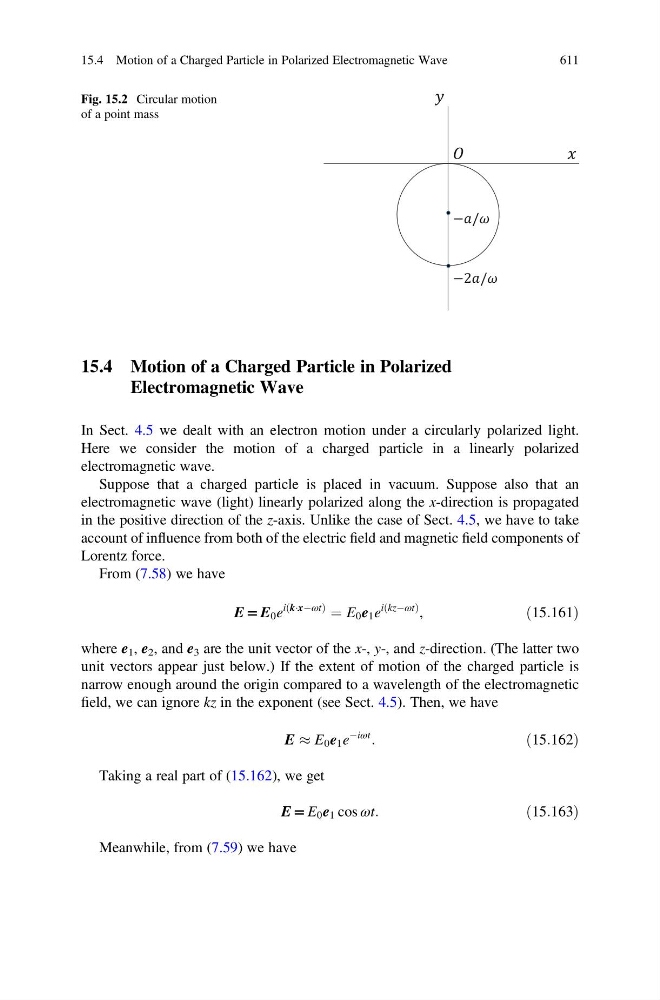
Fig. 15.2 Circular motion
of a point mass
15.4 Motion of a Charged Particle in Polarized Electromagnetic Wave
611