

ψ 0 q
ð Þ ¼ N 0 e
Àαq
2 ,
ð2:79Þ
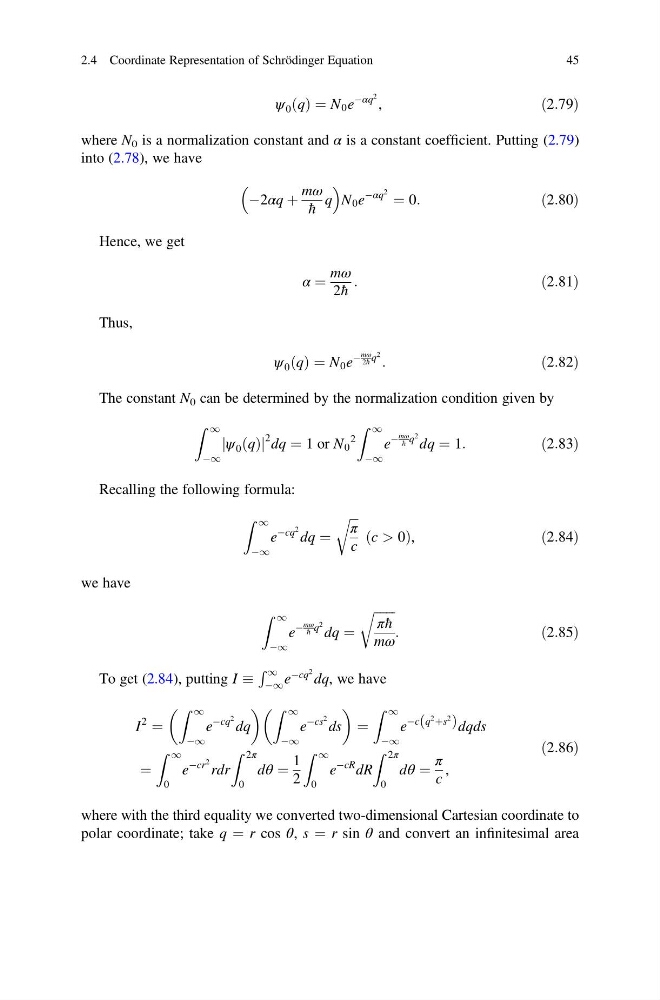
where N 0 is a normalization constant and α is a constant coefficient. Putting (2.79)
into (2.78), we have
À2αq þ
mω
ħ
q
N 0 e
Àαq
2 ¼ 0:
ð2:80Þ
Hence, we get
α ¼
mω
2ħ
:
ð2:81Þ
Thus,
ψ 0 q
ð Þ ¼ N 0 e
À
mω
2ħ q
2 :
ð2:82Þ
The constant N 0 can be determined by the normalization condition given by
Z 1
À1
ψ 0 q
ð Þ
j
j
2 dq ¼ 1 or N 0
2
Z 1
À1
e
À
mω
ħ q
2 dq ¼ 1:
ð2:83Þ
Recalling the following formula:
Z 1
À1
e
Àcq
2 dq ¼
ffiffiffi
π
c
r
c > 0
ð
Þ,
ð2:84Þ
we have
Z 1
À1
e
À
mω
ħ q
2 dq ¼
ffiffiffiffiffiffiffi
πħ
mω
r
:
ð2:85Þ
To get (2.84), putting I
R 1
À1 e
Àcq
2 dq, we have
I
2
¼
Z 1
À1
e
Àcq
2 dq
Z 1
À1
e
Àcs
2 ds
¼
Z 1
À1
e
Àc q
2 þs
2
ð
Þ dqds
¼
Z 1
0
e
Àcr
2 rdr
Z 2π
0
dθ ¼
1
2
Z 1
0
e
ÀcR dR
Z 2π
0
dθ ¼
π
c
,
ð2:86Þ
where with the third equality we converted two-dimensional Cartesian coordinate to
polar coordinate; take q ¼ r cos θ, s ¼ r sin θ and convert an infinitesimal area
2.4 Coordinate Representation of Schrödinger Equation
45
ð Þ ¼ N 0 e
Àαq
2 ,
ð2:79Þ
where N 0 is a normalization constant and α is a constant coefficient. Putting (2.79)
into (2.78), we have
À2αq þ
mω
ħ
q
N 0 e
Àαq
2 ¼ 0:
ð2:80Þ
Hence, we get
α ¼
mω
2ħ
:
ð2:81Þ
Thus,
ψ 0 q
ð Þ ¼ N 0 e
À
mω
2ħ q
2 :
ð2:82Þ
The constant N 0 can be determined by the normalization condition given by
Z 1
À1
ψ 0 q
ð Þ
j
j
2 dq ¼ 1 or N 0
2
Z 1
À1
e
À
mω
ħ q
2 dq ¼ 1:
ð2:83Þ
Recalling the following formula:
Z 1
À1
e
Àcq
2 dq ¼
ffiffiffi
π
c
r
c > 0
ð
Þ,
ð2:84Þ
we have
Z 1
À1
e
À
mω
ħ q
2 dq ¼
ffiffiffiffiffiffiffi
πħ
mω
r
:
ð2:85Þ
To get (2.84), putting I
R 1
À1 e
Àcq
2 dq, we have
I
2
¼
Z 1
À1
e
Àcq
2 dq
Z 1
À1
e
Àcs
2 ds
¼
Z 1
À1
e
Àc q
2 þs
2
ð
Þ dqds
¼
Z 1
0
e
Àcr
2 rdr
Z 2π
0
dθ ¼
1
2
Z 1
0
e
ÀcR dR
Z 2π
0
dθ ¼
π
c
,
ð2:86Þ
where with the third equality we converted two-dimensional Cartesian coordinate to
polar coordinate; take q ¼ r cos θ, s ¼ r sin θ and convert an infinitesimal area
2.4 Coordinate Representation of Schrödinger Equation
45