

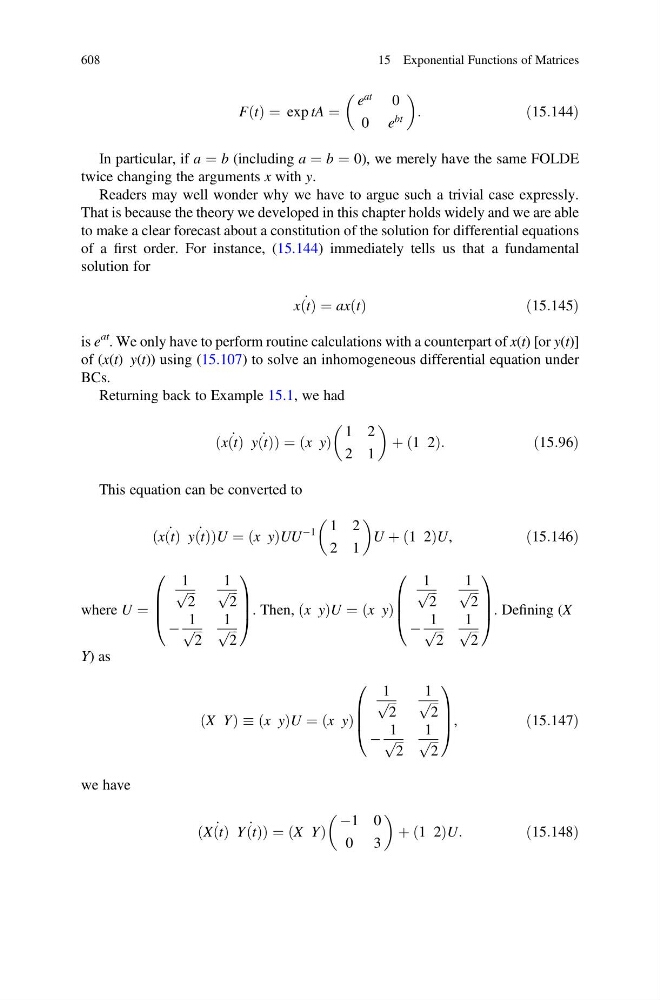
F t
ð Þ ¼ exp tA ¼
e
at
0
0 e
bt
:
ð15:144Þ
In particular, if a ¼ b (including a ¼ b ¼ 0), we merely have the same FOLDE
twice changing the arguments x with y.
Readers may well wonder why we have to argue such a trivial case expressly.
That is because the theory we developed in this chapter holds widely and we are able
to make a clear forecast about a constitution of the solution for differential equations
of a first order. For instance, (15.144) immediately tells us that a fundamental
solution for
_
x t
ð Þ ¼ ax t
ð Þ
ð15:145Þ
is e
at . We only have to perform routine calculations with a counterpart of x(t) [or y(t)]
of (x(t) y(t)) using (15.107) to solve an inhomogeneous differential equation under
BCs.
Returning back to Example 15.1, we had
ð _
x t
ð Þ _
y t
ð ÞÞ ¼ x y
ð Þ
1 2
2 1
þ 1 2
ð
Þ:
ð15:96Þ
This equation can be converted to
ð _
x t
ð Þ _
y t
ð ÞÞU ¼ x y
ð ÞUU
À1 1 2
2 1
U þ 1 2
ð
ÞU,
ð15:146Þ
where U ¼
1
ffiffi ffi
2
p
1
ffiffi ffi
2
p
À
1
ffiffi ffi
2
p
1
ffiffi ffi
2
p
0
B
B
@
1
C
C
A . Then, x y
ð ÞU ¼ x y
ð Þ
1
ffiffi ffi
2
p
1
ffiffi ffi
2
p
À
1
ffiffi ffi
2
p
1
ffiffi ffi
2
p
0
B
B
@
1
C
C
A . Defining (X
Y) as
X Y
ð
Þ x y
ð ÞU ¼ x y
ð Þ
1
ffiffi ffi
2
p
1
ffiffi ffi
2
p
À
1
ffiffi ffi
2
p
1
ffiffi ffi
2
p
0
B
B
@
1
C
C
A ,
ð15:147Þ
we have
ð _
X t
ð Þ _
Y t
ð ÞÞ ¼ X Y
ð
Þ
À1 0
0 3
þ 1 2
ð
ÞU:
ð15:148Þ
608
15 Exponential Functions of Matrices