

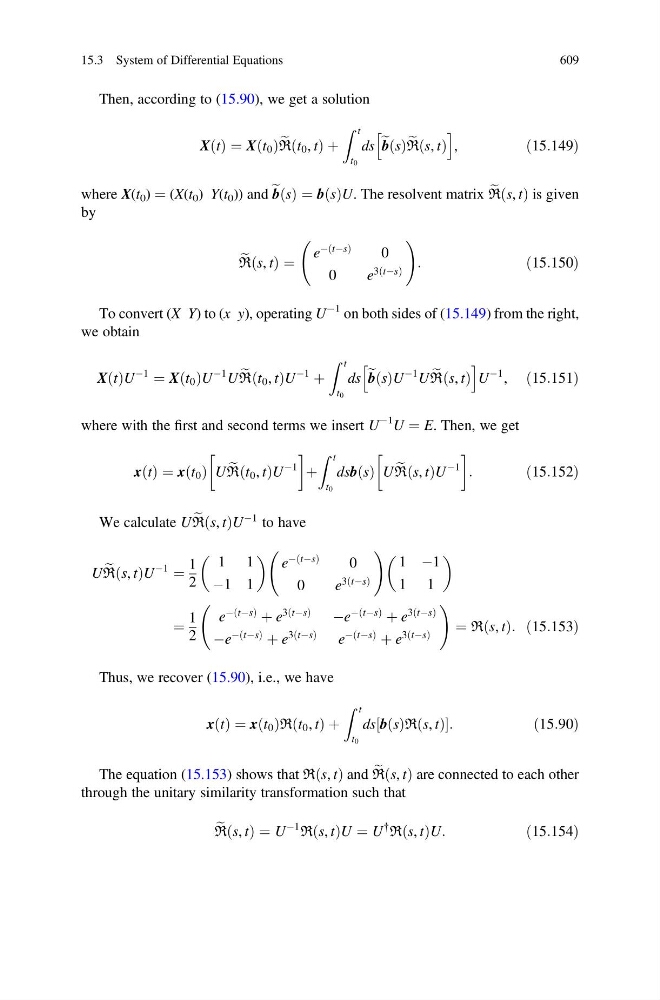
Then, according to (15.90), we get a solution
X t
ð Þ ¼ X t 0
ð Þ e
R t 0 , t
ð Þþ
Z t
t 0
ds e b s
ð Þ e
R s, t
ð Þ
h
i
,
ð15:149Þ
where X(t 0 ) ¼ (X(t 0 ) Y(t 0 )) and e b s
ð Þ ¼ b s
ð ÞU. The resolvent matrix e
R s, t
ð Þ is given
by
e
R s, t
ð Þ ¼
e
À tÀs
ð Þ
0
0
e
3 tÀs
ð Þ
!
:
ð15:150Þ
To convert (X Y) to (x y), operating U
À1 on both sides of (15.149) from the right,
we obtain
X t
ð ÞU
À1
¼ X t 0
ð ÞU
À1 U e
ℜ t 0 , t
ð ÞU
À1
þ
Z t
t 0
ds e b s
ð ÞU
À1 U e
ℜ s, t
ð Þ
h
i
U
À1 , ð15:151Þ
where with the first and second terms we insert U
À1 U ¼ E. Then, we get
x t
ð Þ ¼ x t 0
ð Þ U e
ℜ t 0 , t
ð ÞU
À1
þ
Z t
t 0
dsb s
ð Þ
!
U e
ℜ s, t
ð ÞU
À1
!
:
ð15:152Þ
We calculate U e
R s, t
ð ÞU
À1 to have
U e
R s, t
ð ÞU
À1
¼
1
2
1 1
À1 1
e
À tÀs
ð Þ
0
0
e
3 tÀs
ð Þ
!
1 À1
1 1
¼
1
2
e
À tÀs
ð Þ
þ e
3 tÀs
ð Þ
Àe
À tÀs
ð Þ
þ e
3 tÀs
ð Þ
Àe
À tÀs
ð Þ
þ e
3 tÀs
ð Þ
e
À tÀs
ð Þ
þ e
3 tÀs
ð Þ
!
¼ R s, t
ð Þ: ð15:153Þ
Thus, we recover (15.90), i.e., we have
x t
ð Þ ¼ x t 0
ð ÞR t 0 , t
ð Þþ
Z t
t 0
ds b s
ð ÞR s, t
ð Þ
½
:
ð15:90Þ
The equation (15.153) shows that R s, t
ð Þ and e
R s, t
ð Þ are connected to each other
through the unitary similarity transformation such that
e
R s, t
ð Þ ¼ U
À1
R s, t
ð ÞU ¼ U
{
R s, t
ð ÞU:
ð15:154Þ
15.3 System of Differential Equations
609
X t
ð Þ ¼ X t 0
ð Þ e
R t 0 , t
ð Þþ
Z t
t 0
ds e b s
ð Þ e
R s, t
ð Þ
h
i
,
ð15:149Þ
where X(t 0 ) ¼ (X(t 0 ) Y(t 0 )) and e b s
ð Þ ¼ b s
ð ÞU. The resolvent matrix e
R s, t
ð Þ is given
by
e
R s, t
ð Þ ¼
e
À tÀs
ð Þ
0
0
e
3 tÀs
ð Þ
!
:
ð15:150Þ
To convert (X Y) to (x y), operating U
À1 on both sides of (15.149) from the right,
we obtain
X t
ð ÞU
À1
¼ X t 0
ð ÞU
À1 U e
ℜ t 0 , t
ð ÞU
À1
þ
Z t
t 0
ds e b s
ð ÞU
À1 U e
ℜ s, t
ð Þ
h
i
U
À1 , ð15:151Þ
where with the first and second terms we insert U
À1 U ¼ E. Then, we get
x t
ð Þ ¼ x t 0
ð Þ U e
ℜ t 0 , t
ð ÞU
À1
þ
Z t
t 0
dsb s
ð Þ
!
U e
ℜ s, t
ð ÞU
À1
!
:
ð15:152Þ
We calculate U e
R s, t
ð ÞU
À1 to have
U e
R s, t
ð ÞU
À1
¼
1
2
1 1
À1 1
e
À tÀs
ð Þ
0
0
e
3 tÀs
ð Þ
!
1 À1
1 1
¼
1
2
e
À tÀs
ð Þ
þ e
3 tÀs
ð Þ
Àe
À tÀs
ð Þ
þ e
3 tÀs
ð Þ
Àe
À tÀs
ð Þ
þ e
3 tÀs
ð Þ
e
À tÀs
ð Þ
þ e
3 tÀs
ð Þ
!
¼ R s, t
ð Þ: ð15:153Þ
Thus, we recover (15.90), i.e., we have
x t
ð Þ ¼ x t 0
ð ÞR t 0 , t
ð Þþ
Z t
t 0
ds b s
ð ÞR s, t
ð Þ
½
:
ð15:90Þ
The equation (15.153) shows that R s, t
ð Þ and e
R s, t
ð Þ are connected to each other
through the unitary similarity transformation such that
e
R s, t
ð Þ ¼ U
À1
R s, t
ð ÞU ¼ U
{
R s, t
ð ÞU:
ð15:154Þ
15.3 System of Differential Equations
609