

.
*
0
ð15:37Þ
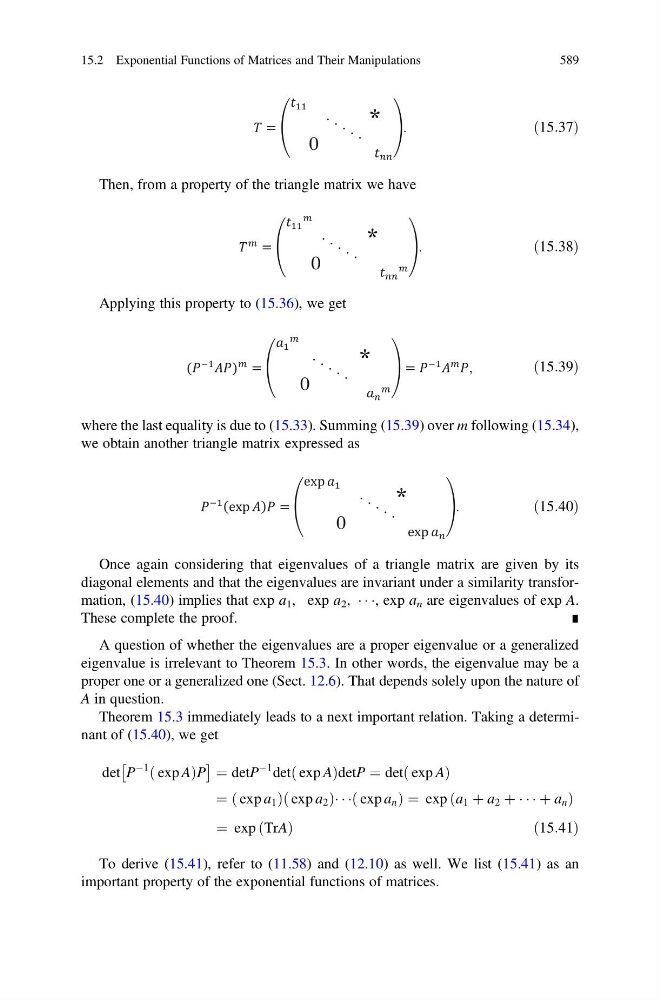
Then, from a property of the triangle matrix we have
.
*
ð15:38Þ
Applying this property to (15.36), we get
,
*
0
ð15:39Þ
where the last equality is due to (15.33). Summing (15.39) over m following (15.34),
we obtain another triangle matrix expressed as
exp
.
*
0
ð15:40Þ
Once again considering that eigenvalues of a triangle matrix are given by its
diagonal elements and that the eigenvalues are invariant under a similarity transformation, (15.40) implies that exp a 1 , exp a 2 , Á Á Á, exp a n are eigenvalues of exp A.
These complete the proof.
∎
A question of whether the eigenvalues are a proper eigenvalue or a generalized
eigenvalue is irrelevant to Theorem 15.3. In other words, the eigenvalue may be a
proper one or a generalized one (Sect. 12.6). That depends solely upon the nature of
A in question.
Theorem 15.3 immediately leads to a next important relation. Taking a determinant of (15.40), we get
det P
À1 exp A
ð
ÞP
Â
à ¼ detP
À1 det exp A
ð
ÞdetP ¼ det exp A
ð
Þ
¼ exp a 1 Þ exp a 2
ð
ÞÁÁÁ exp a n
ð
Þ¼ exp a 1 þ a 2 þ Á Á Á þ a n
ð
Þ
ð
¼ exp TrA
ð
Þ
ð15:41Þ
To derive (15.41), refer to (11.58) and (12.10) as well. We list (15.41) as an
important property of the exponential functions of matrices.
15.2 Exponential Functions of Matrices and Their Manipulations
589
*
0
ð15:37Þ
Then, from a property of the triangle matrix we have
.
*
ð15:38Þ
Applying this property to (15.36), we get
,
*
0
ð15:39Þ
where the last equality is due to (15.33). Summing (15.39) over m following (15.34),
we obtain another triangle matrix expressed as
exp
.
*
0
ð15:40Þ
Once again considering that eigenvalues of a triangle matrix are given by its
diagonal elements and that the eigenvalues are invariant under a similarity transformation, (15.40) implies that exp a 1 , exp a 2 , Á Á Á, exp a n are eigenvalues of exp A.
These complete the proof.
∎
A question of whether the eigenvalues are a proper eigenvalue or a generalized
eigenvalue is irrelevant to Theorem 15.3. In other words, the eigenvalue may be a
proper one or a generalized one (Sect. 12.6). That depends solely upon the nature of
A in question.
Theorem 15.3 immediately leads to a next important relation. Taking a determinant of (15.40), we get
det P
À1 exp A
ð
ÞP
Â
à ¼ detP
À1 det exp A
ð
ÞdetP ¼ det exp A
ð
Þ
¼ exp a 1 Þ exp a 2
ð
ÞÁÁÁ exp a n
ð
Þ¼ exp a 1 þ a 2 þ Á Á Á þ a n
ð
Þ
ð
¼ exp TrA
ð
Þ
ð15:41Þ
To derive (15.41), refer to (11.58) and (12.10) as well. We list (15.41) as an
important property of the exponential functions of matrices.
15.2 Exponential Functions of Matrices and Their Manipulations
589