

3
ð Þ exp A
T
À Á ¼ exp A
ð
Þ
T :
ð15:31Þ
4
ð Þ exp A
{
À Á ¼ exp A
ð
Þ
{ :
ð15:32Þ
To show (2) we have
P
À1 AP
À
Á n ¼ P
À1 AP
À
Á
P
À1 AP
À
Á Á Á Á P
À1 AP
À
Á
¼ P
À1 A PP
À1
À
Á
A PP
À1
À
Á
Á Á Á PP
À1
À
Á
AP
¼ P
À1 AEAEÁ Á ÁEAP ¼ P
À1 A
n P:
ð15:33Þ
Applying (15.33) to (15.7), we have
exp P
À1 AP
À
Á ¼ E þ P
À1 AP þ P
À1 AP
À
Á 2 þ Á Á Á þ P
À1 AP
À
Á n þ Á Á Á
¼ P
À1 EP þ P
À1 AP þ P
À1 A
2
2!
P þ Á Á Á þ P
À1 A
n
n!
P þ Á Á Á
¼ P
À1 E þ A þ
A
2
2!
þ Á Á Á þ
A
n
n!
þ Á Á Á
P ¼ P
À1 exp A
ð
ÞP:
ð15:34Þ
With (3) and (4), use the following equations:
A
T
À Á n ¼ A
n
ð Þ
T and A
{
À Á n ¼ A
n
ð Þ
{ :
ð15:35Þ
The confirmation of (15.31) and (15.32) is left for readers. For future purpose, we
describe other important theorem and properties of the exponential functions of
matrices.
Theorem 15.3 Let a 1 , a 2 , Á Á Á, a n be eigenvalue of a (n, n) square matrix A. Then,
exp a 1 , exp a 2 , Á Á Á, exp a n are eigenvalues of exp A.
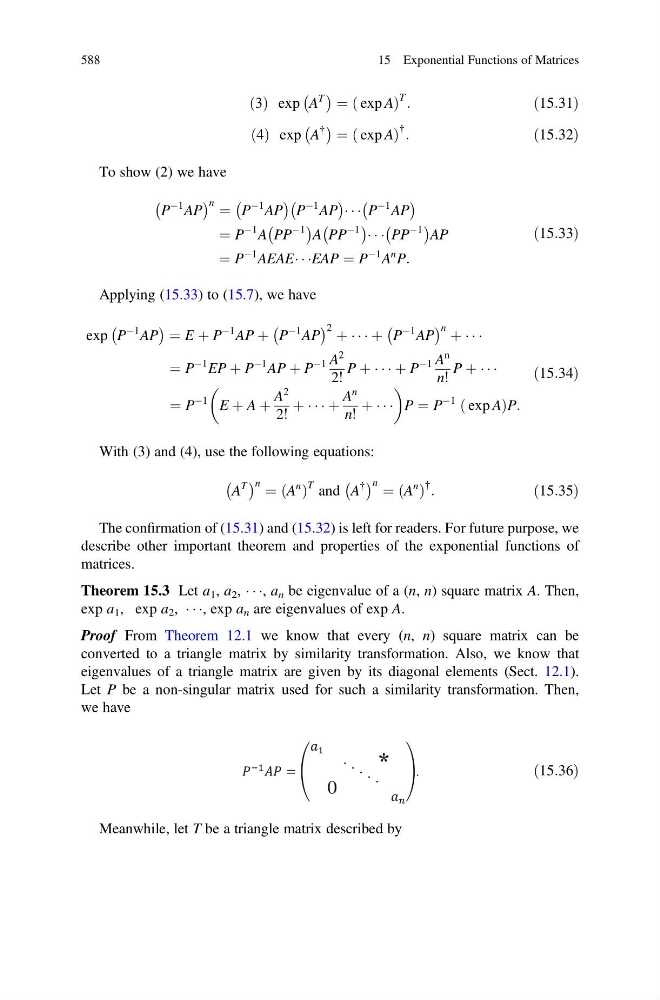
Proof From Theorem 12.1 we know that every (n, n) square matrix can be
converted to a triangle matrix by similarity transformation. Also, we know that
eigenvalues of a triangle matrix are given by its diagonal elements (Sect. 12.1).
Let P be a non-singular matrix used for such a similarity transformation. Then,
we have
=
.
*
0
ð15:36Þ
Meanwhile, let T be a triangle matrix described by
588
15 Exponential Functions of Matrices
ð Þ exp A
T
À Á ¼ exp A
ð
Þ
T :
ð15:31Þ
4
ð Þ exp A
{
À Á ¼ exp A
ð
Þ
{ :
ð15:32Þ
To show (2) we have
P
À1 AP
À
Á n ¼ P
À1 AP
À
Á
P
À1 AP
À
Á Á Á Á P
À1 AP
À
Á
¼ P
À1 A PP
À1
À
Á
A PP
À1
À
Á
Á Á Á PP
À1
À
Á
AP
¼ P
À1 AEAEÁ Á ÁEAP ¼ P
À1 A
n P:
ð15:33Þ
Applying (15.33) to (15.7), we have
exp P
À1 AP
À
Á ¼ E þ P
À1 AP þ P
À1 AP
À
Á 2 þ Á Á Á þ P
À1 AP
À
Á n þ Á Á Á
¼ P
À1 EP þ P
À1 AP þ P
À1 A
2
2!
P þ Á Á Á þ P
À1 A
n
n!
P þ Á Á Á
¼ P
À1 E þ A þ
A
2
2!
þ Á Á Á þ
A
n
n!
þ Á Á Á
P ¼ P
À1 exp A
ð
ÞP:
ð15:34Þ
With (3) and (4), use the following equations:
A
T
À Á n ¼ A
n
ð Þ
T and A
{
À Á n ¼ A
n
ð Þ
{ :
ð15:35Þ
The confirmation of (15.31) and (15.32) is left for readers. For future purpose, we
describe other important theorem and properties of the exponential functions of
matrices.
Theorem 15.3 Let a 1 , a 2 , Á Á Á, a n be eigenvalue of a (n, n) square matrix A. Then,
exp a 1 , exp a 2 , Á Á Á, exp a n are eigenvalues of exp A.
Proof From Theorem 12.1 we know that every (n, n) square matrix can be
converted to a triangle matrix by similarity transformation. Also, we know that
eigenvalues of a triangle matrix are given by its diagonal elements (Sect. 12.1).
Let P be a non-singular matrix used for such a similarity transformation. Then,
we have
=
.
*
0
ð15:36Þ
Meanwhile, let T be a triangle matrix described by
588
15 Exponential Functions of Matrices