

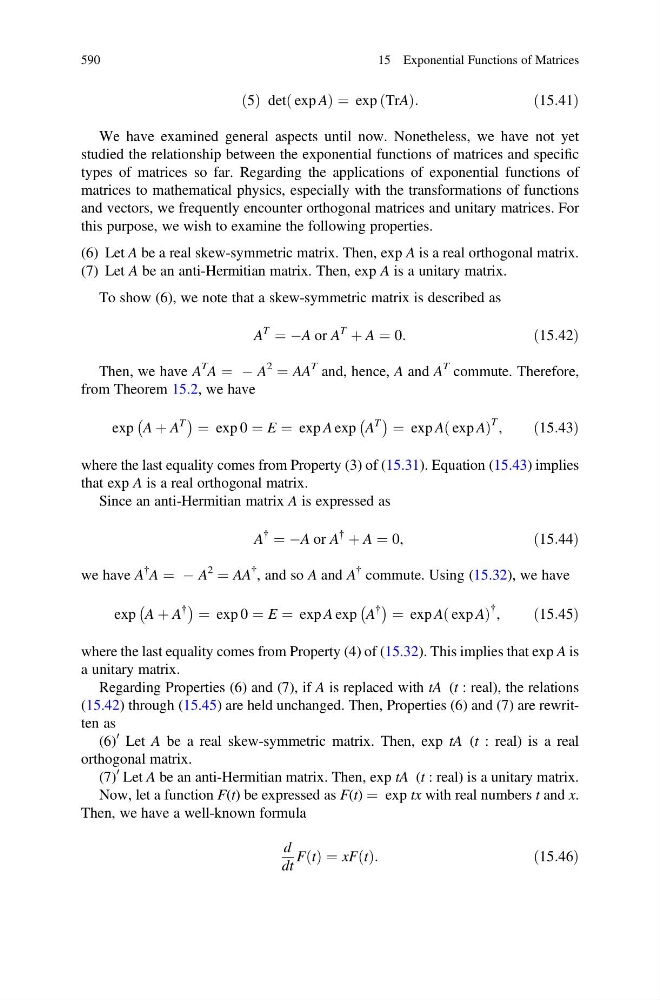
5
ð Þ det exp A
ð
Þ¼ exp TrA
ð
Þ:
ð15:41Þ
We have examined general aspects until now. Nonetheless, we have not yet
studied the relationship between the exponential functions of matrices and specific
types of matrices so far. Regarding the applications of exponential functions of
matrices to mathematical physics, especially with the transformations of functions
and vectors, we frequently encounter orthogonal matrices and unitary matrices. For
this purpose, we wish to examine the following properties.
(6) Let A be a real skew-symmetric matrix. Then, exp A is a real orthogonal matrix.
(7) Let A be an anti-Hermitian matrix. Then, exp A is a unitary matrix.
To show (6), we note that a skew-symmetric matrix is described as
A
T
¼ ÀA or A
T
þ A ¼ 0:
ð15:42Þ
Then, we have A
T A ¼ À A
2
¼ AA
T and, hence, A and A
T commute. Therefore,
from Theorem 15.2, we have
exp A þ A
T
À
Á ¼ exp 0 ¼ E ¼ exp A exp A
T
À Á ¼ exp A exp A
ð
Þ
T ,
ð15:43Þ
where the last equality comes from Property (3) of (15.31). Equation (15.43) implies
that exp A is a real orthogonal matrix.
Since an anti-Hermitian matrix A is expressed as
A
{
¼ ÀA or A
{
þ A ¼ 0,
ð15:44Þ
we have A
{ A ¼ À A
2
¼ AA
{ , and so A and A
{ commute. Using (15.32), we have
exp A þ A
{
À
Á ¼ exp 0 ¼ E ¼ exp A exp A
{
À Á ¼ exp A exp A
ð
Þ
{ ,
ð15:45Þ
where the last equality comes from Property (4) of (15.32). This implies that exp A is
a unitary matrix.
Regarding Properties (6) and (7), if A is replaced with tA (t : real), the relations
(15.42) through (15.45) are held unchanged. Then, Properties (6) and (7) are rewritten as
(6)
0 Let A be a real skew-symmetric matrix. Then, exp tA (t : real) is a real
orthogonal matrix.
(7)
0 Let A be an anti-Hermitian matrix. Then, exp tA (t : real) is a unitary matrix.
Now, let a function F(t) be expressed as F(t) ¼ exp tx with real numbers t and x.
Then, we have a well-known formula
d
dt
F t
ð Þ ¼ xF t
ð Þ:
ð15:46Þ
590
15 Exponential Functions of Matrices