

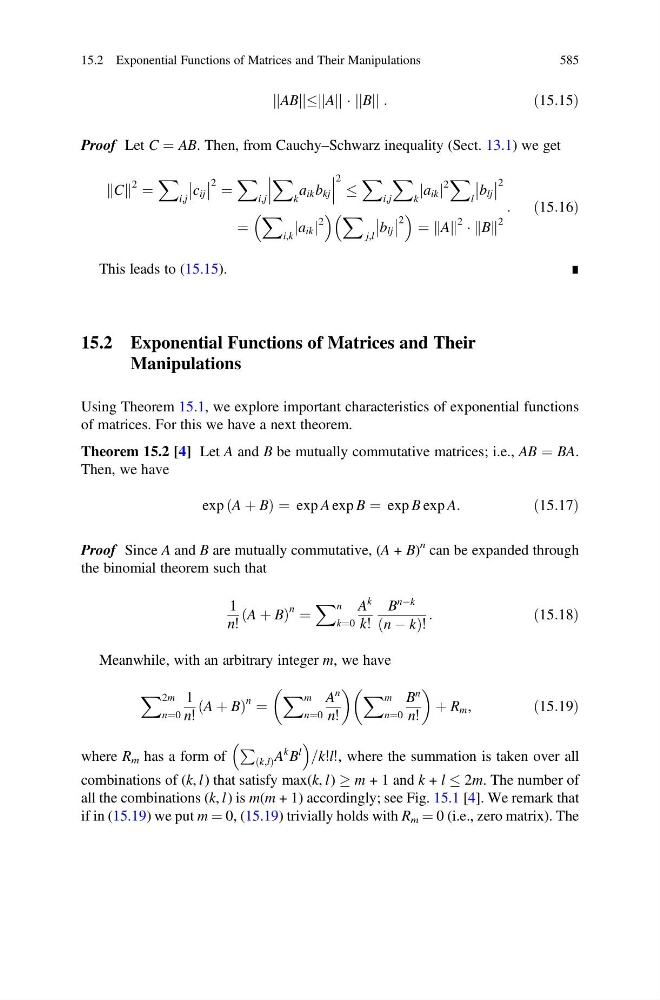
j AB
j jj j A
j jj Á j B
j jj :
ð15:15Þ
Proof Let C ¼ AB. Then, from Cauchy–Schwarz inequality (Sect. 13.1) we get
C
k k
2 ¼
X
i,j
c ij
2 ¼
X
i,j
X
k
a ik b kj
2
X
i,j
X
k
a ik
j j
2
X
l
b lj
2
¼
X
i,k
a ik
j j
2
X
j,l
b lj
2
¼ A
k k
2 Á B
k k
2
:
ð15:16Þ
This leads to (15.15).
∎
15.2 Exponential Functions of Matrices and Their
Manipulations
Using Theorem 15.1, we explore important characteristics of exponential functions
of matrices. For this we have a next theorem.
Theorem 15.2 [4] Let A and B be mutually commutative matrices; i.e., AB ¼ BA.
Then, we have
exp A þ B
ð
Þ¼ exp A exp B ¼ exp B exp A:
ð15:17Þ
Proof Since A and B are mutually commutative, (A + B)
n can be expanded through
the binomial theorem such that
1
n!
A þ B
ð
Þ
n ¼
X n
k¼0
A
k
k!
B
nÀk
n À k
ð
Þ!
:
ð15:18Þ
Meanwhile, with an arbitrary integer m, we have
X 2m
n¼0
1
n!
A þ B
ð
Þ
n ¼
X m
n¼0
A
n
n!
X m
n¼0
B
n
n!
þ R m ,
ð15:19Þ
where R m has a form of
P
k,l
ð Þ A
k B
l
=k!l!, where the summation is taken over all
combinations of (k, l) that satisfy max(k, l) ! m + 1 and k + l 2m. The number of
all the combinations (k, l) is m(m + 1) accordingly; see Fig. 15.1 [4]. We remark that
if in (15.19) we put m ¼ 0, (15.19) trivially holds with R m ¼ 0 (i.e., zero matrix). The
15.2 Exponential Functions of Matrices and Their Manipulations
585