

matrix R m , however, changes with increasing m, and so we must evaluate it at
m ! 1. Putting max(| |A|| , | |B|| , 1) ¼ C and using Theorem 15.1, we get
R m
j j
j
j
X
k,l
ð Þ
A
j j
k
B
j j
l
k!l!
:
ð15:20Þ
In (15.20) min(k, l ) ¼ 0, and so k ! l ! ! (m + 1)!. Since ||A||
k ||B||
l
C
k + l
C
2m
, we
have
X
k,l
ð Þ
A
j j
k
B
j j
l
k!l!
m m þ 1
ð
ÞC
2m
m þ 1
ð
Þ!
¼
C
2m
m À 1
ð
Þ!
,
ð15:21Þ
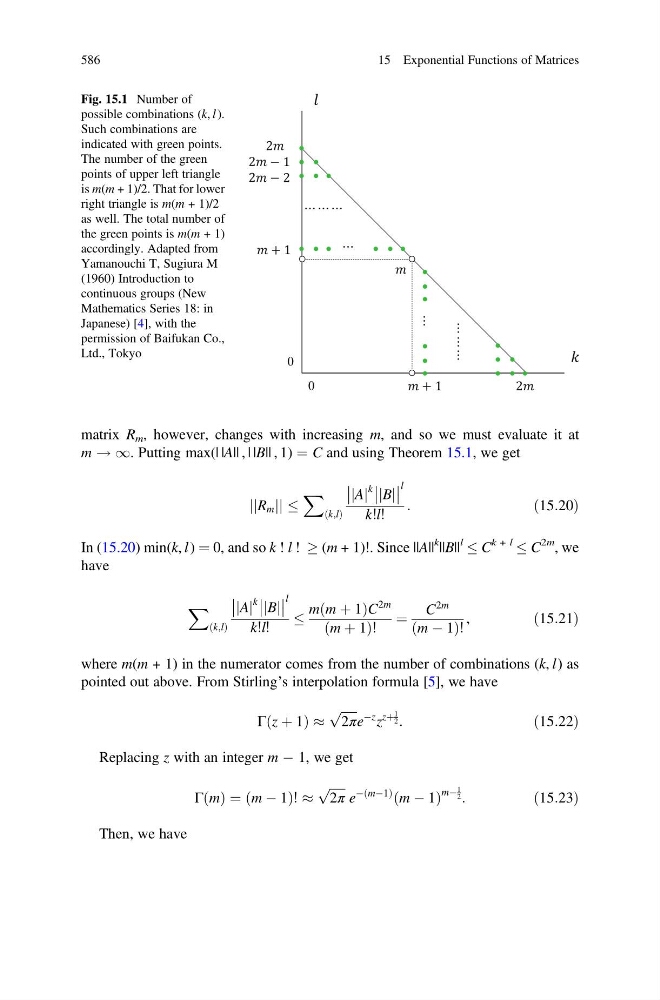
where m(m + 1) in the numerator comes from the number of combinations (k, l) as
pointed out above. From Stirling’s interpolation formula [5], we have
Γ z þ 1
ð
Þ%
ffiffiffiffiffi
2π
p
e
Àz z
zþ
1
2 :
ð15:22Þ
Replacing z with an integer m À 1, we get
Γ m
ð Þ ¼ m À 1
ð
Þ! %
ffiffiffiffiffi
2π
p
e
À mÀ1
ð
Þ m À 1
ð
Þ
mÀ
1
2 :
ð15:23Þ
Then, we have
⋯
⋯ ⋯ ⋯
⋯
⋯ ⋯ ⋯
− 1
− 2
+ 1
+ 1
0
0
Fig. 15.1 Number of
possible combinations (k, l ).
Such combinations are
indicated with green points.
The number of the green
points of upper left triangle
is m(m + 1)/2. That for lower
right triangle is m(m + 1)/2
as well. The total number of
the green points is m(m + 1)
accordingly. Adapted from
Yamanouchi T, Sugiura M
(1960) Introduction to
continuous groups (New
Mathematics Series 18: in
Japanese) [4], with the
permission of Baifukan Co.,
Ltd., Tokyo
586
15 Exponential Functions of Matrices