

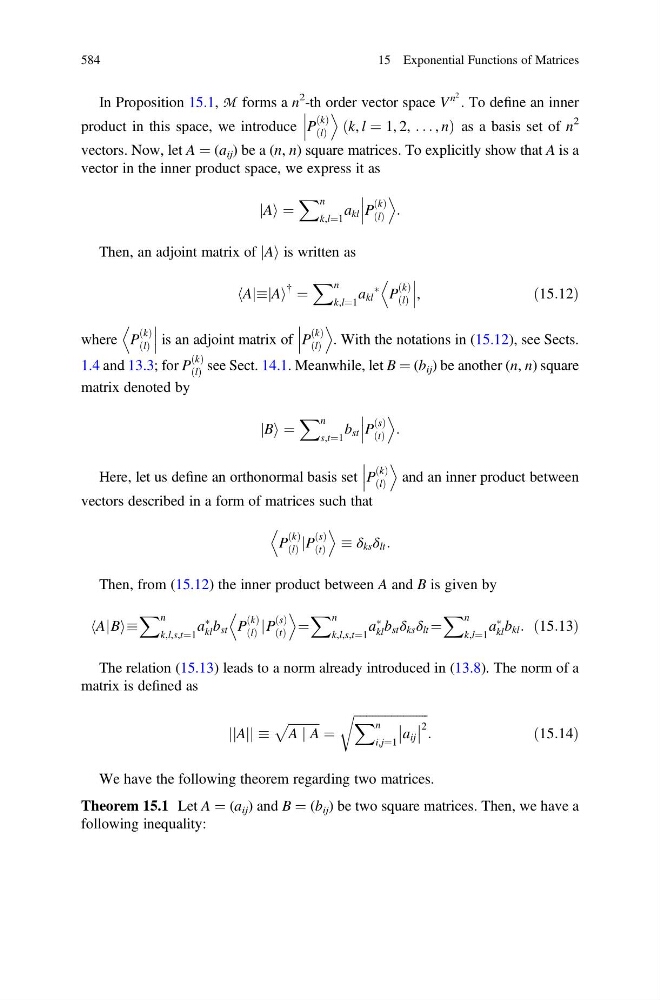
In Proposition 15.1, M forms a n
2 -th order vector space V
n
2 . To define an inner
product in this space, we introduce P
k
ð Þ
l
ð Þ
E
k, l ¼ 1, 2, . . . , n
ð
Þas a basis set of n
2
vectors. Now, let A ¼ (a ij ) be a (n, n) square matrices. To explicitly show that A is a
vector in the inner product space, we express it as
A
j i ¼
X n
k,l¼1
a kl P
k
ð Þ
l
ð Þ
E
:
Then, an adjoint matrix of jAi is written as
A
j jA
h
i
{ ¼
X n
k,l¼1
a kl
à P
k
ð Þ
l
ð Þ
D
,
ð15:12Þ
where P
k
ð Þ
l
ð Þ
D
is an adjoint matrix of P
k
ð Þ
l
ð Þ
E
. With the notations in (15.12), see Sects.
1.4 and 13.3; for P
k
ð Þ
l
ð Þ see Sect. 14.1. Meanwhile, let B ¼ (b ij ) be another (n, n) square
matrix denoted by
B
j i ¼
X n
s,t¼1
b st P
s
ð Þ
t
ð Þ
E
:
Here, let us define an orthonormal basis set P
k
ð Þ
l
ð Þ
E
and an inner product between
vectors described in a form of matrices such that
P
k
ð Þ
l
ð Þ jP
s
ð Þ
t
ð Þ
D
E
δ ks δ lt :
Then, from (15.12) the inner product between A and B is given by
AjB
h
i
X n
k,l,s,t¼1
a
Ã
kl b st P
k
ð Þ
l
ð Þ jP
s
ð Þ
t
ð Þ
D
E
¼
X n
k,l,s,t¼1
a
Ã
kl b st δ ks δ lt ¼
X n
k,l¼1
a
Ã
kl b kl : ð15:13Þ
The relation (15.13) leads to a norm already introduced in (13.8). The norm of a
matrix is defined as
A
j j
j j
ffiffiffiffiffiffiffiffiffiffi
A j A
p
¼
ffiffiffiffiffiffiffiffiffiffiffiffiffiffiffiffiffiffiffiffiffiffiffiffi
X n
i,j¼1
a ij
2
r
:
ð15:14Þ
We have the following theorem regarding two matrices.
Theorem 15.1 Let A ¼ (a ij ) and B ¼ (b ij ) be two square matrices. Then, we have a
following inequality:
584
15 Exponential Functions of Matrices