

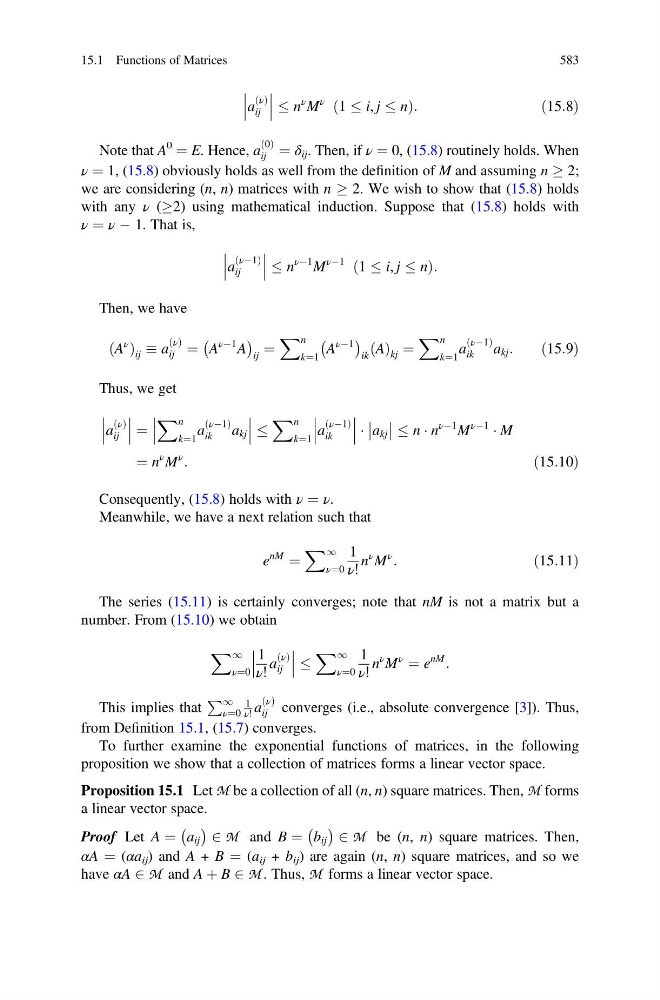
a
ν
ð Þ
ij
n
ν M
ν 1 i, j n
ð
Þ :
ð15:8Þ
Note that A
0
¼ E. Hence, a
0
ð Þ
ij ¼ δ ij . Then, if ν ¼ 0, (15.8) routinely holds. When
ν ¼ 1, (15.8) obviously holds as well from the definition of M and assuming n ! 2;
we are considering (n, n) matrices with n ! 2. We wish to show that (15.8) holds
with any ν (!2) using mathematical induction. Suppose that (15.8) holds with
ν ¼ ν À 1. That is,
a
νÀ1
ð
Þ
ij
n
νÀ1 M
νÀ1 1 i, j n
ð
Þ :
Then, we have
A
ν
ð Þ ij a
ν
ð Þ
ij ¼ A
νÀ1 A
À
Á
ij
¼
X n
k¼1
A
νÀ1
À
Á
ik
A
ð Þ kj ¼
X n
k¼1
a
νÀ1
ð
Þ
ik
a kj :
ð15:9Þ
Thus, we get
a
ν
ð Þ
ij
¼
X n
k¼1
a
νÀ1
ð
Þ
ik
a kj
X n
k¼1
a
νÀ1
ð
Þ
ik
Á a kj
n Á n
νÀ1 M
νÀ1
Á M
¼ n
ν M
ν
:
ð15:10Þ
Consequently, (15.8) holds with ν ¼ ν.
Meanwhile, we have a next relation such that
e
nM
¼
X 1
ν¼0
1
ν!
n
ν M
ν
:
ð15:11Þ
The series (15.11) is certainly converges; note that nM is not a matrix but a
number. From (15.10) we obtain
X 1
ν¼0
1
ν!
a
ν
ð Þ
ij
X 1
ν¼0
1
ν!
n
ν M
ν
¼ e
nM
:
This implies that
P 1
ν¼0
1
ν! a
ν
ð Þ
ij converges (i.e., absolute convergence [3]). Thus,
from Definition 15.1, (15.7) converges.
To further examine the exponential functions of matrices, in the following
proposition we show that a collection of matrices forms a linear vector space.
Proposition 15.1 Let M be a collection of all (n, n) square matrices. Then, M forms
a linear vector space.
Proof Let A ¼ a ij
À Á 2 M and B ¼ b ij
À Á 2 M be (n, n) square matrices. Then,
αA ¼ (αa ij ) and A + B ¼ (a ij + b ij ) are again (n, n) square matrices, and so we
have αA 2 M and A þ B 2 M . Thus, M forms a linear vector space.
15.1 Functions of Matrices
583
ν
ð Þ
ij
n
ν M
ν 1 i, j n
ð
Þ :
ð15:8Þ
Note that A
0
¼ E. Hence, a
0
ð Þ
ij ¼ δ ij . Then, if ν ¼ 0, (15.8) routinely holds. When
ν ¼ 1, (15.8) obviously holds as well from the definition of M and assuming n ! 2;
we are considering (n, n) matrices with n ! 2. We wish to show that (15.8) holds
with any ν (!2) using mathematical induction. Suppose that (15.8) holds with
ν ¼ ν À 1. That is,
a
νÀ1
ð
Þ
ij
n
νÀ1 M
νÀ1 1 i, j n
ð
Þ :
Then, we have
A
ν
ð Þ ij a
ν
ð Þ
ij ¼ A
νÀ1 A
À
Á
ij
¼
X n
k¼1
A
νÀ1
À
Á
ik
A
ð Þ kj ¼
X n
k¼1
a
νÀ1
ð
Þ
ik
a kj :
ð15:9Þ
Thus, we get
a
ν
ð Þ
ij
¼
X n
k¼1
a
νÀ1
ð
Þ
ik
a kj
X n
k¼1
a
νÀ1
ð
Þ
ik
Á a kj
n Á n
νÀ1 M
νÀ1
Á M
¼ n
ν M
ν
:
ð15:10Þ
Consequently, (15.8) holds with ν ¼ ν.
Meanwhile, we have a next relation such that
e
nM
¼
X 1
ν¼0
1
ν!
n
ν M
ν
:
ð15:11Þ
The series (15.11) is certainly converges; note that nM is not a matrix but a
number. From (15.10) we obtain
X 1
ν¼0
1
ν!
a
ν
ð Þ
ij
X 1
ν¼0
1
ν!
n
ν M
ν
¼ e
nM
:
This implies that
P 1
ν¼0
1
ν! a
ν
ð Þ
ij converges (i.e., absolute convergence [3]). Thus,
from Definition 15.1, (15.7) converges.
To further examine the exponential functions of matrices, in the following
proposition we show that a collection of matrices forms a linear vector space.
Proposition 15.1 Let M be a collection of all (n, n) square matrices. Then, M forms
a linear vector space.
Proof Let A ¼ a ij
À Á 2 M and B ¼ b ij
À Á 2 M be (n, n) square matrices. Then,
αA ¼ (αa ij ) and A + B ¼ (a ij + b ij ) are again (n, n) square matrices, and so we
have αA 2 M and A þ B 2 M . Thus, M forms a linear vector space.
15.1 Functions of Matrices
583