

α 11 Á Á Á α 1m
⋮ ⋱ ⋮
α m1 Á Á Á α mm
0
B
@
1
C
A
γ
μ
ð Þ
1
⋮
γ
μ
ð Þ
m
0
B
@
1
C
A ¼ c μ
γ
μ
ð Þ
1
⋮
γ
μ
ð Þ
m
0
B
@
1
C
A:
ð14:120Þ
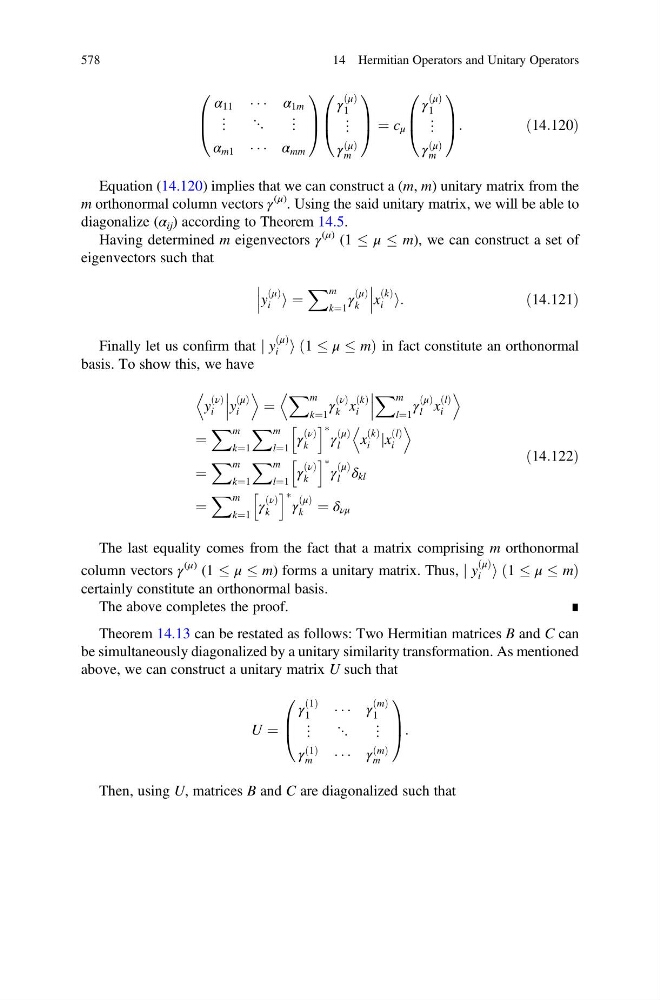
Equation (14.120) implies that we can construct a (m, m) unitary matrix from the
m orthonormal column vectors γ
(μ)
. Using the said unitary matrix, we will be able to
diagonalize (α ij ) according to Theorem 14.5.
Having determined m eigenvectors γ
(μ) (1 μ m), we can construct a set of
eigenvectors such that
y
μ
ð Þ
i i ¼
X m
k¼1
γ
μ
ð Þ
k
x
k
ð Þ
i i:
ð14:121Þ
Finally let us confirm that j y
μ
ð Þ
i i 1 μ m
ð
Þin fact constitute an orthonormal
basis. To show this, we have
y
ν
ð Þ
i
y
μ
ð Þ
i
E
¼
X m
k¼1
γ
ν
ð Þ
k x
k
ð Þ
i
D
X m
l¼1
γ
μ
ð Þ
l x
l
ð Þ
i
D
E
¼
X m
k¼1
X m
l¼1
γ
ν
ð Þ
k
h i à γ
μ
ð Þ
l
x
k
ð Þ
i jx
l
ð Þ
i
D
E
¼
X m
k¼1
X m
l¼1
γ
ν
ð Þ
k
h i à γ
μ
ð Þ
l δ kl
¼
X m
k¼1
γ
ν
ð Þ
k
h i à γ
μ
ð Þ
k ¼ δ νμ
ð14:122Þ
The last equality comes from the fact that a matrix comprising m orthonormal
column vectors γ
(μ) (1 μ m) forms a unitary matrix. Thus, j y
μ
ð Þ
i i 1 μ m
ð
Þ
certainly constitute an orthonormal basis.
The above completes the proof.
∎
Theorem 14.13 can be restated as follows: Two Hermitian matrices B and C can
be simultaneously diagonalized by a unitary similarity transformation. As mentioned
above, we can construct a unitary matrix U such that
U ¼
γ
1
ð Þ
1
Á Á Á γ
m
ð Þ
1
⋮ ⋱ ⋮
γ
1
ð Þ
m
Á Á Á γ
m
ð Þ
m
0
B
@
1
C
A:
Then, using U, matrices B and C are diagonalized such that
578
14 Hermitian Operators and Unitary Operators
⋮ ⋱ ⋮
α m1 Á Á Á α mm
0
B
@
1
C
A
γ
μ
ð Þ
1
⋮
γ
μ
ð Þ
m
0
B
@
1
C
A ¼ c μ
γ
μ
ð Þ
1
⋮
γ
μ
ð Þ
m
0
B
@
1
C
A:
ð14:120Þ
Equation (14.120) implies that we can construct a (m, m) unitary matrix from the
m orthonormal column vectors γ
(μ)
. Using the said unitary matrix, we will be able to
diagonalize (α ij ) according to Theorem 14.5.
Having determined m eigenvectors γ
(μ) (1 μ m), we can construct a set of
eigenvectors such that
y
μ
ð Þ
i i ¼
X m
k¼1
γ
μ
ð Þ
k
x
k
ð Þ
i i:
ð14:121Þ
Finally let us confirm that j y
μ
ð Þ
i i 1 μ m
ð
Þin fact constitute an orthonormal
basis. To show this, we have
y
ν
ð Þ
i
y
μ
ð Þ
i
E
¼
X m
k¼1
γ
ν
ð Þ
k x
k
ð Þ
i
D
X m
l¼1
γ
μ
ð Þ
l x
l
ð Þ
i
D
E
¼
X m
k¼1
X m
l¼1
γ
ν
ð Þ
k
h i à γ
μ
ð Þ
l
x
k
ð Þ
i jx
l
ð Þ
i
D
E
¼
X m
k¼1
X m
l¼1
γ
ν
ð Þ
k
h i à γ
μ
ð Þ
l δ kl
¼
X m
k¼1
γ
ν
ð Þ
k
h i à γ
μ
ð Þ
k ¼ δ νμ
ð14:122Þ
The last equality comes from the fact that a matrix comprising m orthonormal
column vectors γ
(μ) (1 μ m) forms a unitary matrix. Thus, j y
μ
ð Þ
i i 1 μ m
ð
Þ
certainly constitute an orthonormal basis.
The above completes the proof.
∎
Theorem 14.13 can be restated as follows: Two Hermitian matrices B and C can
be simultaneously diagonalized by a unitary similarity transformation. As mentioned
above, we can construct a unitary matrix U such that
U ¼
γ
1
ð Þ
1
Á Á Á γ
m
ð Þ
1
⋮ ⋱ ⋮
γ
1
ð Þ
m
Á Á Á γ
m
ð Þ
m
0
B
@
1
C
A:
Then, using U, matrices B and C are diagonalized such that
578
14 Hermitian Operators and Unitary Operators