

x
l
ð Þ
i jCx
k
ð Þ
i
D
E
¼ x
k
ð Þ
i jC
{ x
l
ð Þ
i
D
E Ã ¼ x
k
ð Þ
i jCx
l
ð Þ
i
D
E Ã ¼ α kl
à ,
ð14:115Þ
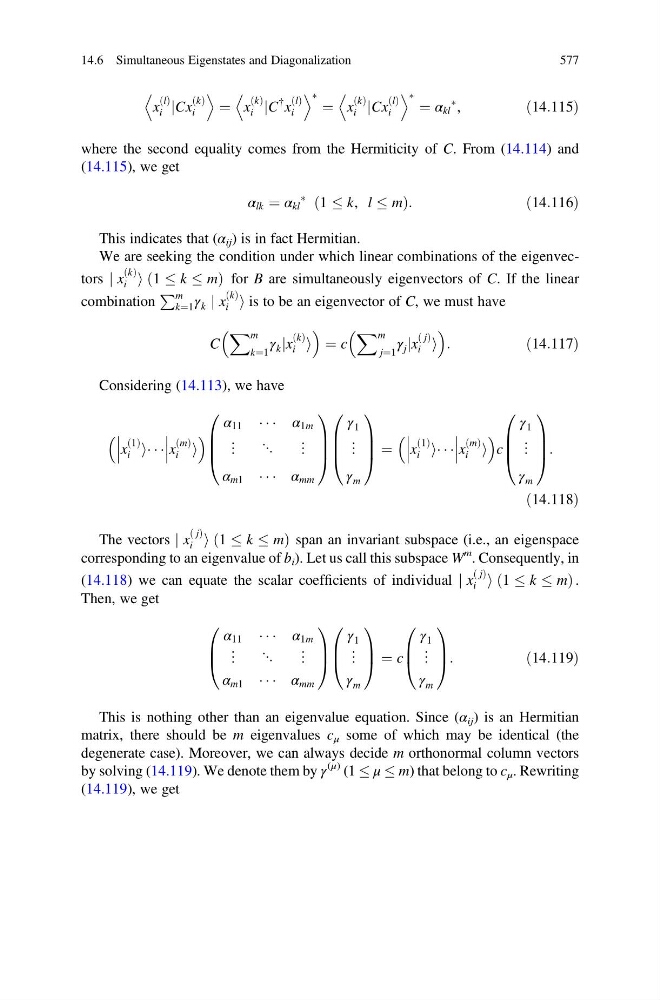
where the second equality comes from the Hermiticity of C. From (14.114) and
(14.115), we get
α lk ¼ α kl
à 1 k, l m
ð
Þ :
ð14:116Þ
This indicates that (α ij ) is in fact Hermitian.
We are seeking the condition under which linear combinations of the eigenvectors j x
k
ð Þ
i i 1 k m
ð
Þfor B are simultaneously eigenvectors of C. If the linear
combination
P m
k¼1 γ k j x
k
ð Þ
i i is to be an eigenvector of C, we must have
C
X m
k¼1
γ k jx
k
ð Þ
i i
¼ c
X m
j¼1
γ j jx
j
ð Þ
i i
:
ð14:117Þ
Considering (14.113), we have
x
1
ð Þ
i iÁ Á Á
x
m
ð Þ
i i
α 11 Á Á Á α 1m
⋮ ⋱ ⋮
α m1 Á Á Á α mm
0
B
B
@
1
C
C
A
γ 1
⋮
γ m
0
B
B
@
1
C
C
A ¼ x
1
ð Þ
i iÁ Á Á
x
m
ð Þ
i i
c
γ 1
⋮
γ m
0
B
B
@
1
C
C
A :
ð14:118Þ
The vectors j x
j
ð Þ
i i 1 k m
ð
Þspan an invariant subspace (i.e., an eigenspace
corresponding to an eigenvalue of b i ). Let us call this subspace W
m . Consequently, in
(14.118) we can equate the scalar coefficients of individual j x
j
ð Þ
i i 1 k m
ð
Þ.
Then, we get
α 11 Á Á Á α 1m
⋮ ⋱ ⋮
α m1 Á Á Á α mm
0
B
@
1
C
A
γ 1
⋮
γ m
0
B
@
1
C
A ¼ c
γ 1
⋮
γ m
0
B
@
1
C
A:
ð14:119Þ
This is nothing other than an eigenvalue equation. Since (α ij ) is an Hermitian
matrix, there should be m eigenvalues c μ some of which may be identical (the
degenerate case). Moreover, we can always decide m orthonormal column vectors
by solving (14.119). We denote them by γ
(μ) (1 μ m) that belong to c μ . Rewriting
(14.119), we get
14.6 Simultaneous Eigenstates and Diagonalization
577
l
ð Þ
i jCx
k
ð Þ
i
D
E
¼ x
k
ð Þ
i jC
{ x
l
ð Þ
i
D
E Ã ¼ x
k
ð Þ
i jCx
l
ð Þ
i
D
E Ã ¼ α kl
à ,
ð14:115Þ
where the second equality comes from the Hermiticity of C. From (14.114) and
(14.115), we get
α lk ¼ α kl
à 1 k, l m
ð
Þ :
ð14:116Þ
This indicates that (α ij ) is in fact Hermitian.
We are seeking the condition under which linear combinations of the eigenvectors j x
k
ð Þ
i i 1 k m
ð
Þfor B are simultaneously eigenvectors of C. If the linear
combination
P m
k¼1 γ k j x
k
ð Þ
i i is to be an eigenvector of C, we must have
C
X m
k¼1
γ k jx
k
ð Þ
i i
¼ c
X m
j¼1
γ j jx
j
ð Þ
i i
:
ð14:117Þ
Considering (14.113), we have
x
1
ð Þ
i iÁ Á Á
x
m
ð Þ
i i
α 11 Á Á Á α 1m
⋮ ⋱ ⋮
α m1 Á Á Á α mm
0
B
B
@
1
C
C
A
γ 1
⋮
γ m
0
B
B
@
1
C
C
A ¼ x
1
ð Þ
i iÁ Á Á
x
m
ð Þ
i i
c
γ 1
⋮
γ m
0
B
B
@
1
C
C
A :
ð14:118Þ
The vectors j x
j
ð Þ
i i 1 k m
ð
Þspan an invariant subspace (i.e., an eigenspace
corresponding to an eigenvalue of b i ). Let us call this subspace W
m . Consequently, in
(14.118) we can equate the scalar coefficients of individual j x
j
ð Þ
i i 1 k m
ð
Þ.
Then, we get
α 11 Á Á Á α 1m
⋮ ⋱ ⋮
α m1 Á Á Á α mm
0
B
@
1
C
A
γ 1
⋮
γ m
0
B
@
1
C
A ¼ c
γ 1
⋮
γ m
0
B
@
1
C
A:
ð14:119Þ
This is nothing other than an eigenvalue equation. Since (α ij ) is an Hermitian
matrix, there should be m eigenvalues c μ some of which may be identical (the
degenerate case). Moreover, we can always decide m orthonormal column vectors
by solving (14.119). We denote them by γ
(μ) (1 μ m) that belong to c μ . Rewriting
(14.119), we get
14.6 Simultaneous Eigenstates and Diagonalization
577