

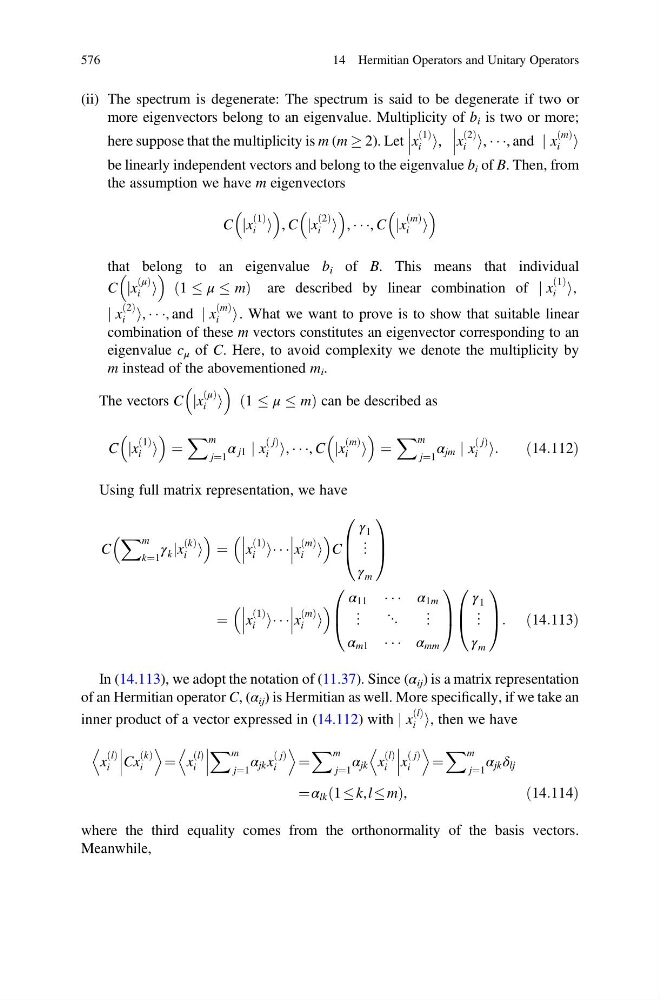
(ii) The spectrum is degenerate: The spectrum is said to be degenerate if two or
more eigenvectors belong to an eigenvalue. Multiplicity of b i is two or more;
here suppose that the multiplicity is m (m ! 2). Let x
1
ð Þ
i i,
x
2
ð Þ
i i, Á Á Á, and j x
m
ð Þ
i i
be linearly independent vectors and belong to the eigenvalue b i of B. Then, from
the assumption we have m eigenvectors
C jx
1
ð Þ
i i
, C jx
2
ð Þ
i i
, Á Á Á, C jx
m
ð Þ
i i
that belong to an eigenvalue b i of B. This means that individual
C jx
μ
ð Þ
i i
1 μ m
ð
Þ are described by linear combination of j x
1
ð Þ
i i,
j x
2
ð Þ
i i, Á Á Á, and j x
m
ð Þ
i i. What we want to prove is to show that suitable linear
combination of these m vectors constitutes an eigenvector corresponding to an
eigenvalue c μ of C. Here, to avoid complexity we denote the multiplicity by
m instead of the abovementioned m i .
The vectors C jx
μ
ð Þ
i i
1 μ m
ð
Þcan be described as
C jx
1
ð Þ
i i
¼
X m
j¼1
α j1 j x
j
ð Þ
i i, Á Á Á, C jx
m
ð Þ
i i
¼
X m
j¼1
α jm j x
j
ð Þ
i i:
ð14:112Þ
Using full matrix representation, we have
C
X m
k¼1
γ k jx
k
ð Þ
i i
¼ x
1
ð Þ
i iÁ Á Á
x
m
ð Þ
i i
C
γ 1
⋮
γ m
0
B
@
1
C
A
¼ x
1
ð Þ
i iÁ Á Á
x
m
ð Þ
i i
α 11 Á Á Á α 1m
⋮ ⋱ ⋮
α m1 Á Á Á α mm
0
B
@
1
C
A
γ 1
⋮
γ m
0
B
@
1
C
A: ð14:113Þ
In (14.113), we adopt the notation of (11.37). Since (α ij ) is a matrix representation
of an Hermitian operator C, (α ij ) is Hermitian as well. More specifically, if we take an
inner product of a vector expressed in (14.112) with j x
l
ð Þ
i i, then we have
x
l
ð Þ
i
D
Cx
k
ð Þ
i
E
¼ x
l
ð Þ
i
D
X m
j¼1
α jk x
j
ð Þ
i
E
¼
X m
j¼1
α jk x
l
ð Þ
i
D
x
j
ð Þ
i
E
¼
X m
j¼1
α jk δ lj
¼ α lk 1 k,l m
ð
Þ ,
ð14:114Þ
where the third equality comes from the orthonormality of the basis vectors.
Meanwhile,
576
14 Hermitian Operators and Unitary Operators
more eigenvectors belong to an eigenvalue. Multiplicity of b i is two or more;
here suppose that the multiplicity is m (m ! 2). Let x
1
ð Þ
i i,
x
2
ð Þ
i i, Á Á Á, and j x
m
ð Þ
i i
be linearly independent vectors and belong to the eigenvalue b i of B. Then, from
the assumption we have m eigenvectors
C jx
1
ð Þ
i i
, C jx
2
ð Þ
i i
, Á Á Á, C jx
m
ð Þ
i i
that belong to an eigenvalue b i of B. This means that individual
C jx
μ
ð Þ
i i
1 μ m
ð
Þ are described by linear combination of j x
1
ð Þ
i i,
j x
2
ð Þ
i i, Á Á Á, and j x
m
ð Þ
i i. What we want to prove is to show that suitable linear
combination of these m vectors constitutes an eigenvector corresponding to an
eigenvalue c μ of C. Here, to avoid complexity we denote the multiplicity by
m instead of the abovementioned m i .
The vectors C jx
μ
ð Þ
i i
1 μ m
ð
Þcan be described as
C jx
1
ð Þ
i i
¼
X m
j¼1
α j1 j x
j
ð Þ
i i, Á Á Á, C jx
m
ð Þ
i i
¼
X m
j¼1
α jm j x
j
ð Þ
i i:
ð14:112Þ
Using full matrix representation, we have
C
X m
k¼1
γ k jx
k
ð Þ
i i
¼ x
1
ð Þ
i iÁ Á Á
x
m
ð Þ
i i
C
γ 1
⋮
γ m
0
B
@
1
C
A
¼ x
1
ð Þ
i iÁ Á Á
x
m
ð Þ
i i
α 11 Á Á Á α 1m
⋮ ⋱ ⋮
α m1 Á Á Á α mm
0
B
@
1
C
A
γ 1
⋮
γ m
0
B
@
1
C
A: ð14:113Þ
In (14.113), we adopt the notation of (11.37). Since (α ij ) is a matrix representation
of an Hermitian operator C, (α ij ) is Hermitian as well. More specifically, if we take an
inner product of a vector expressed in (14.112) with j x
l
ð Þ
i i, then we have
x
l
ð Þ
i
D
Cx
k
ð Þ
i
E
¼ x
l
ð Þ
i
D
X m
j¼1
α jk x
j
ð Þ
i
E
¼
X m
j¼1
α jk x
l
ð Þ
i
D
x
j
ð Þ
i
E
¼
X m
j¼1
α jk δ lj
¼ α lk 1 k,l m
ð
Þ ,
ð14:114Þ
where the third equality comes from the orthonormality of the basis vectors.
Meanwhile,
576
14 Hermitian Operators and Unitary Operators