

of eigenvectors. The question is boiled down to whether the two operators commute.
To address this question, the following theorem is important.
Theorem 14.13 [2] Two Hermitian matrices B and C commute if and only if there
exists a complete orthonormal set of common eigenvectors.
Proof Suppose that there exists a complete orthonormal set of common eigenvectors {jx i ; m i i} that span the linear vector space, where i and m i are a positive integer
and that jx i i corresponds to an eigenvalue b i of B and c i of C. Note that if m i is 1, we
say that the spectrum is nondegenerate and that if m i is equal to two or more, the
spectrum is said to be degenerate. Then we have
B jx i i
ð Þ ¼ b i j x i i, C jx i i
ð Þ ¼ c i j x i i:
ð14:110Þ
Therefore, BC(| x i i) ¼ B(c i | x i i) ¼ c i B(| x i i) ¼ c i b i j x i i. Similarly, CB(|
x i i) ¼ c i b i j x i i. Consequently, (BC À CB)(| x i i) ¼ 0 for any jx i i. As all the set of
jx i i span the vector space, BC À CB ¼ 0, namely BC ¼ CB.
In turn, assume that BC ¼ CB and that B(| x i i) ¼ b i j x i i, where jx i i are
orthonormal. Then, we have
CB jx i i
ð Þ ¼ b i C jx i i
ð Þ⟹B C jx i i
ð Þ
½
¼b i C jx i i
ð Þ:
ð14:111Þ
This implies that C(| x i i) is an eigenvector of B corresponding to the eigenvalue b i .
We have two cases.
(i) The spectrum is nondegenerate: The spectrum is said to be nondegenerate if
only one eigenvector belongs to an eigenvalue. In other words, multiplicity of b i
is one. Then, C(| x i i) must be equal to some constant times jx i i; i.e., C(|
x i i) ¼ c i j x i i. That is, jx i i is an eigenvector of C corresponding to an eigenvalue
c i . That is, jx i i is a common eigenvector to B and C. This completes the proof.
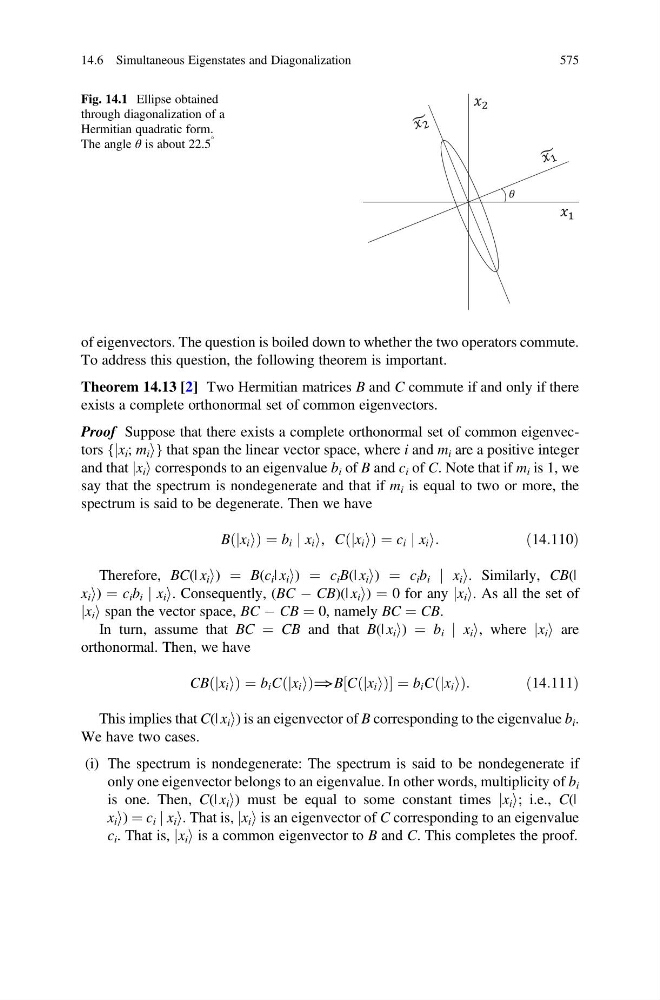
Fig. 14.1 Ellipse obtained
through diagonalization of a
Hermitian quadratic form.
The angle θ is about 22.5
14.6 Simultaneous Eigenstates and Diagonalization
575
To address this question, the following theorem is important.
Theorem 14.13 [2] Two Hermitian matrices B and C commute if and only if there
exists a complete orthonormal set of common eigenvectors.
Proof Suppose that there exists a complete orthonormal set of common eigenvectors {jx i ; m i i} that span the linear vector space, where i and m i are a positive integer
and that jx i i corresponds to an eigenvalue b i of B and c i of C. Note that if m i is 1, we
say that the spectrum is nondegenerate and that if m i is equal to two or more, the
spectrum is said to be degenerate. Then we have
B jx i i
ð Þ ¼ b i j x i i, C jx i i
ð Þ ¼ c i j x i i:
ð14:110Þ
Therefore, BC(| x i i) ¼ B(c i | x i i) ¼ c i B(| x i i) ¼ c i b i j x i i. Similarly, CB(|
x i i) ¼ c i b i j x i i. Consequently, (BC À CB)(| x i i) ¼ 0 for any jx i i. As all the set of
jx i i span the vector space, BC À CB ¼ 0, namely BC ¼ CB.
In turn, assume that BC ¼ CB and that B(| x i i) ¼ b i j x i i, where jx i i are
orthonormal. Then, we have
CB jx i i
ð Þ ¼ b i C jx i i
ð Þ⟹B C jx i i
ð Þ
½
¼b i C jx i i
ð Þ:
ð14:111Þ
This implies that C(| x i i) is an eigenvector of B corresponding to the eigenvalue b i .
We have two cases.
(i) The spectrum is nondegenerate: The spectrum is said to be nondegenerate if
only one eigenvector belongs to an eigenvalue. In other words, multiplicity of b i
is one. Then, C(| x i i) must be equal to some constant times jx i i; i.e., C(|
x i i) ¼ c i j x i i. That is, jx i i is an eigenvector of C corresponding to an eigenvalue
c i . That is, jx i i is a common eigenvector to B and C. This completes the proof.
Fig. 14.1 Ellipse obtained
through diagonalization of a
Hermitian quadratic form.
The angle θ is about 22.5
14.6 Simultaneous Eigenstates and Diagonalization
575