

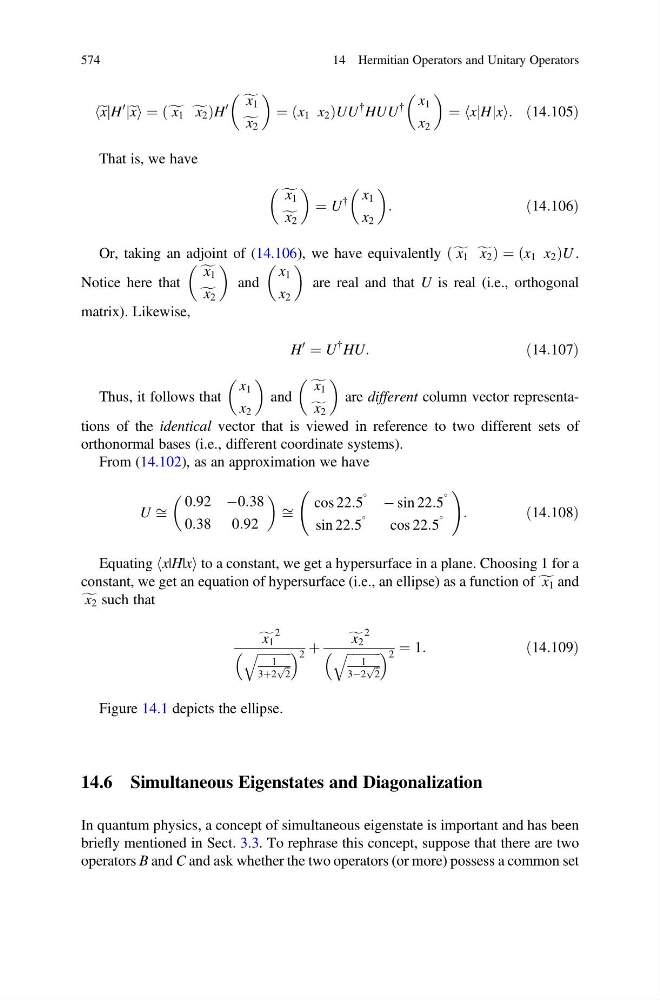
e x H
0
j je x
h
i¼ f x 1 f x 2
ð
ÞH
0 f x 1
f x 2
¼ x 1 x 2
ð
ÞUU
{ HUU
{ x 1
x 2
¼ x H
j jx
h
i: ð14:105Þ
That is, we have
f x 1
f x 2
¼ U
{ x 1
x 2
:
ð14:106Þ
Or, taking an adjoint of (14.106), we have equivalently f x 1 f x 2
ð
Þ¼ x 1 x 2
ð
ÞU .
Notice here that
f x 1
f x 2
and
x 1
x 2
are real and that U is real (i.e., orthogonal
matrix). Likewise,
H
0
¼ U
{ HU:
ð14:107Þ
Thus, it follows that
x 1
x 2
and
f x 1
f x 2
are different column vector representations of the identical vector that is viewed in reference to two different sets of
orthonormal bases (i.e., different coordinate systems).
From (14.102), as an approximation we have
U ffi
0:92 À0:38
0:38 0:92
ffi
cos 22:5
À sin 22:5
sin 22:5
cos 22:5
!
:
ð14:108Þ
Equating hx|H|xi to a constant, we get a hypersurface in a plane. Choosing 1 for a
constant, we get an equation of hypersurface (i.e., an ellipse) as a function of f x 1 and
f x 2 such that
f x 1
2
ffiffiffiffiffiffiffiffiffiffi ffi
1
3þ2
ffiffi
2
p
q
2 þ
f x 2
2
ffiffiffiffiffiffiffiffiffiffi ffi
1
3À2
ffiffi
2
p
q
2 ¼ 1:
ð14:109Þ
Figure 14.1 depicts the ellipse.
14.6 Simultaneous Eigenstates and Diagonalization
In quantum physics, a concept of simultaneous eigenstate is important and has been
briefly mentioned in Sect. 3.3. To rephrase this concept, suppose that there are two
operators B and C and ask whether the two operators (or more) possess a common set
574
14 Hermitian Operators and Unitary Operators
0
j je x
h
i¼ f x 1 f x 2
ð
ÞH
0 f x 1
f x 2
¼ x 1 x 2
ð
ÞUU
{ HUU
{ x 1
x 2
¼ x H
j jx
h
i: ð14:105Þ
That is, we have
f x 1
f x 2
¼ U
{ x 1
x 2
:
ð14:106Þ
Or, taking an adjoint of (14.106), we have equivalently f x 1 f x 2
ð
Þ¼ x 1 x 2
ð
ÞU .
Notice here that
f x 1
f x 2
and
x 1
x 2
are real and that U is real (i.e., orthogonal
matrix). Likewise,
H
0
¼ U
{ HU:
ð14:107Þ
Thus, it follows that
x 1
x 2
and
f x 1
f x 2
are different column vector representations of the identical vector that is viewed in reference to two different sets of
orthonormal bases (i.e., different coordinate systems).
From (14.102), as an approximation we have
U ffi
0:92 À0:38
0:38 0:92
ffi
cos 22:5
À sin 22:5
sin 22:5
cos 22:5
!
:
ð14:108Þ
Equating hx|H|xi to a constant, we get a hypersurface in a plane. Choosing 1 for a
constant, we get an equation of hypersurface (i.e., an ellipse) as a function of f x 1 and
f x 2 such that
f x 1
2
ffiffiffiffiffiffiffiffiffiffi ffi
1
3þ2
ffiffi
2
p
q
2 þ
f x 2
2
ffiffiffiffiffiffiffiffiffiffi ffi
1
3À2
ffiffi
2
p
q
2 ¼ 1:
ð14:109Þ
Figure 14.1 depicts the ellipse.
14.6 Simultaneous Eigenstates and Diagonalization
In quantum physics, a concept of simultaneous eigenstate is important and has been
briefly mentioned in Sect. 3.3. To rephrase this concept, suppose that there are two
operators B and C and ask whether the two operators (or more) possess a common set
574
14 Hermitian Operators and Unitary Operators