

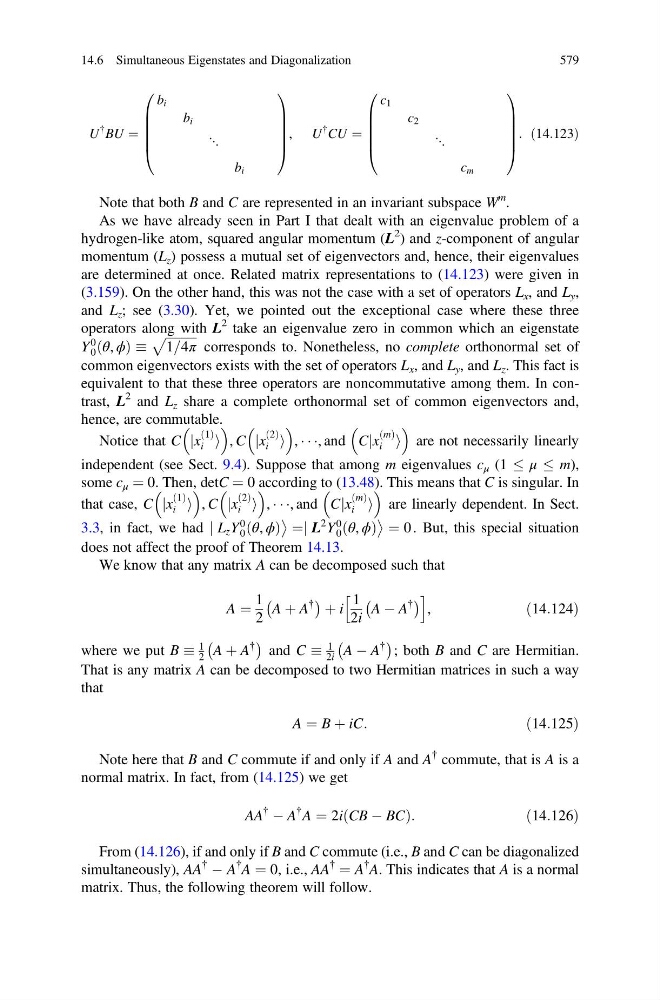
U
{ BU ¼
b i
b i
⋱
b i
0
B
B
B
B
@
1
C
C
C
C
A
, U
{ CU ¼
c 1
c 2
⋱
c m
0
B
B
B
B
@
1
C
C
C
C
A
: ð14:123Þ
Note that both B and C are represented in an invariant subspace W
m .
As we have already seen in Part I that dealt with an eigenvalue problem of a
hydrogen-like atom, squared angular momentum (L
2 ) and z-component of angular
momentum (L z ) possess a mutual set of eigenvectors and, hence, their eigenvalues
are determined at once. Related matrix representations to (14.123) were given in
(3.159). On the other hand, this was not the case with a set of operators L x , and L y ,
and L z ; see (3.30). Yet, we pointed out the exceptional case where these three
operators along with L
2 take an eigenvalue zero in common which an eigenstate
Y
0
0 θ, ϕ
ð
Þ
ffiffiffiffiffiffiffiffiffiffi
1=4π
p
corresponds to. Nonetheless, no complete orthonormal set of
common eigenvectors exists with the set of operators L x , and L y , and L z . This fact is
equivalent to that these three operators are noncommutative among them. In contrast, L
2 and L z share a complete orthonormal set of common eigenvectors and,
hence, are commutable.
Notice that C jx
1
ð Þ
i i
, C jx
2
ð Þ
i i
, Á Á Á, and Cjx
m
ð Þ
i i
are not necessarily linearly
independent (see Sect. 9.4). Suppose that among m eigenvalues c μ (1 μ
m),
some c μ ¼ 0. Then, detC ¼ 0 according to (13.48). This means that C is singular. In
that case, C jx
1
ð Þ
i i
, C jx
2
ð Þ
i i
, Á Á Á, and Cjx
m
ð Þ
i i
are linearly dependent. In Sect.
3.3, in fact, we had j L z Y
0
0 θ, ϕ
ð
Þ
¼j L
2 Y
0
0 θ, ϕ
ð
Þ
¼ 0 . But, this special situation
does not affect the proof of Theorem 14.13.
We know that any matrix A can be decomposed such that
A ¼
1
2
A þ A
{
À
Á þ i
1
2i
A À A
{
À
Á
h
i
,
ð14:124Þ
where we put B
1
2 A þ A
{
À
Á
and C
1
2i A À A
{
À
Á
; both B and C are Hermitian.
That is any matrix A can be decomposed to two Hermitian matrices in such a way
that
A ¼ B þ iC:
ð14:125Þ
Note here that B and C commute if and only if A and A
{ commute, that is A is a
normal matrix. In fact, from (14.125) we get
AA
{
À A
{ A ¼ 2i CB À BC
ð
Þ :
ð14:126Þ
From (14.126), if and only if B and C commute (i.e., B and C can be diagonalized
simultaneously), AA
{ À A
{ A ¼ 0, i.e., AA
{ ¼ A
{ A. This indicates that A is a normal
matrix. Thus, the following theorem will follow.
14.6 Simultaneous Eigenstates and Diagonalization
579