

U
{ AU ¼ α 1 P 1 þ α 2 P 2 þ Á Á Á þ α s P s ,
ð14:71Þ
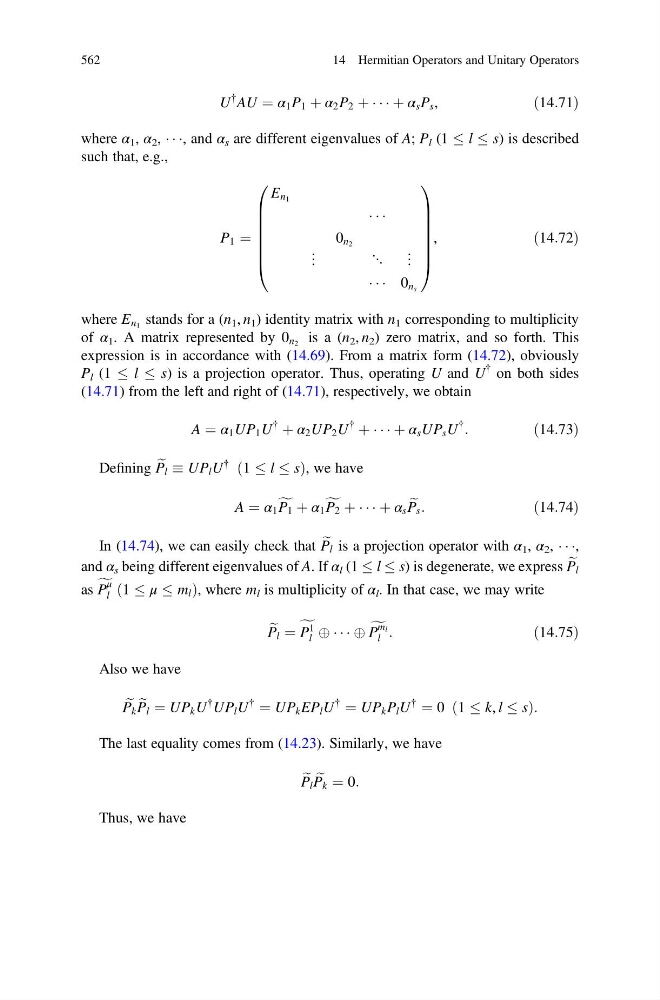
where α 1 , α 2 , Á Á Á, and α s are different eigenvalues of A; P l (1 l s) is described
such that, e.g.,
P 1 ¼
E n 1
Á Á Á
0 n 2
⋮
⋱ ⋮
Á Á Á 0 n s
0
B
B
B
B
B
B
@
1
C
C
C
C
C
C
A
,
ð14:72Þ
where E n 1 stands for a (n 1 , n 1 ) identity matrix with n 1 corresponding to multiplicity
of α 1 . A matrix represented by 0 n 2 is a (n 2 , n 2 ) zero matrix, and so forth. This
expression is in accordance with (14.69). From a matrix form (14.72), obviously
P l (1
l
s) is a projection operator. Thus, operating U and U
{ on both sides
(14.71) from the left and right of (14.71), respectively, we obtain
A ¼ α 1 UP 1 U
{
þ α 2 UP 2 U
{
þ Á Á Á þ α s UP s U
{
:
ð14:73Þ
Defining e
P l UP l U
{ 1 l s
ð
Þ , we have
A ¼ α 1 f P 1 þ α 1 f P 2 þ Á Á Á þ α s e
P s :
ð14:74Þ
In (14.74), we can easily check that e
P l is a projection operator with α 1 , α 2 , Á Á Á,
and α s being different eigenvalues of A. If α l (1 l s) is degenerate, we express e
P l
as f
P
μ
l 1 μ m l
ð
Þ , where m l is multiplicity of α l . In that case, we may write
e
P l ¼ f P
1
l È Á Á Á È f
P
m l
l :
ð14:75Þ
Also we have
e
P k e
P l ¼ UP k U
{ UP l U
{
¼ UP k EP l U
{
¼ UP k P l U
{
¼ 0 1 k, l s
ð
Þ :
The last equality comes from (14.23). Similarly, we have
e
P l e
P k ¼ 0:
Thus, we have
562
14 Hermitian Operators and Unitary Operators
{ AU ¼ α 1 P 1 þ α 2 P 2 þ Á Á Á þ α s P s ,
ð14:71Þ
where α 1 , α 2 , Á Á Á, and α s are different eigenvalues of A; P l (1 l s) is described
such that, e.g.,
P 1 ¼
E n 1
Á Á Á
0 n 2
⋮
⋱ ⋮
Á Á Á 0 n s
0
B
B
B
B
B
B
@
1
C
C
C
C
C
C
A
,
ð14:72Þ
where E n 1 stands for a (n 1 , n 1 ) identity matrix with n 1 corresponding to multiplicity
of α 1 . A matrix represented by 0 n 2 is a (n 2 , n 2 ) zero matrix, and so forth. This
expression is in accordance with (14.69). From a matrix form (14.72), obviously
P l (1
l
s) is a projection operator. Thus, operating U and U
{ on both sides
(14.71) from the left and right of (14.71), respectively, we obtain
A ¼ α 1 UP 1 U
{
þ α 2 UP 2 U
{
þ Á Á Á þ α s UP s U
{
:
ð14:73Þ
Defining e
P l UP l U
{ 1 l s
ð
Þ , we have
A ¼ α 1 f P 1 þ α 1 f P 2 þ Á Á Á þ α s e
P s :
ð14:74Þ
In (14.74), we can easily check that e
P l is a projection operator with α 1 , α 2 , Á Á Á,
and α s being different eigenvalues of A. If α l (1 l s) is degenerate, we express e
P l
as f
P
μ
l 1 μ m l
ð
Þ , where m l is multiplicity of α l . In that case, we may write
e
P l ¼ f P
1
l È Á Á Á È f
P
m l
l :
ð14:75Þ
Also we have
e
P k e
P l ¼ UP k U
{ UP l U
{
¼ UP k EP l U
{
¼ UP k P l U
{
¼ 0 1 k, l s
ð
Þ :
The last equality comes from (14.23). Similarly, we have
e
P l e
P k ¼ 0:
Thus, we have
562
14 Hermitian Operators and Unitary Operators