

~
A n
A
1
ð Þ
Á Á Á
A
2
ð Þ
⋮
⋱ ⋮
Á Á Á A
s
ð Þ
0
B
B
B
B
B
B
@
1
C
C
C
C
C
C
A
,
ð14:69Þ
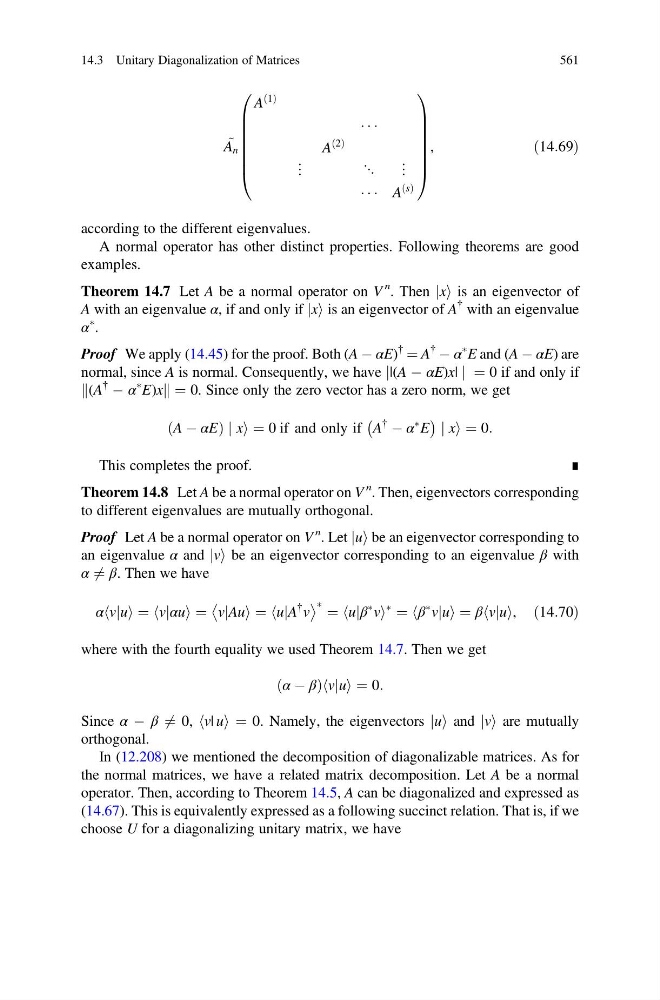
according to the different eigenvalues.
A normal operator has other distinct properties. Following theorems are good
examples.
Theorem 14.7 Let A be a normal operator on V
n . Then jxi is an eigenvector of
A with an eigenvalue α, if and only if jxi is an eigenvector of A
{ with an eigenvalue
α
à .
Proof We apply (14.45) for the proof. Both (A À αE)
{
¼ A
{
À α
à E and (A À αE) are
normal, since A is normal. Consequently, we have j|(A À αE)x| j ¼ 0 if and only if
k(A
{
À α
à E)xk ¼ 0. Since only the zero vector has a zero norm, we get
A À αE
ð
Þjxi ¼ 0 if and only if A
{
À α
à E
À
Á j xi ¼ 0:
This completes the proof.
∎
Theorem 14.8 Let A be a normal operator on V
n . Then, eigenvectors corresponding
to different eigenvalues are mutually orthogonal.
Proof Let A be a normal operator on V
n . Let jui be an eigenvector corresponding to
an eigenvalue α and jvi be an eigenvector corresponding to an eigenvalue β with
α 6 ¼ β. Then we have
α v ui ¼ hv
j
j αu
h
i¼ v Aui ¼ hu
j
j A
{ v
à ¼ u β
à vi
Ã
¼ hβ
à v
j
j u
h
i ¼ β vju
h i, ð14:70Þ
where with the fourth equality we used Theorem 14.7. Then we get
α À β
ð
Þ vju
h i ¼ 0:
Since α À β 6 ¼ 0, hv| ui ¼ 0. Namely, the eigenvectors jui and jvi are mutually
orthogonal.
In (12.208) we mentioned the decomposition of diagonalizable matrices. As for
the normal matrices, we have a related matrix decomposition. Let A be a normal
operator. Then, according to Theorem 14.5, A can be diagonalized and expressed as
(14.67). This is equivalently expressed as a following succinct relation. That is, if we
choose U for a diagonalizing unitary matrix, we have
14.3 Unitary Diagonalization of Matrices
561
A n
A
1
ð Þ
Á Á Á
A
2
ð Þ
⋮
⋱ ⋮
Á Á Á A
s
ð Þ
0
B
B
B
B
B
B
@
1
C
C
C
C
C
C
A
,
ð14:69Þ
according to the different eigenvalues.
A normal operator has other distinct properties. Following theorems are good
examples.
Theorem 14.7 Let A be a normal operator on V
n . Then jxi is an eigenvector of
A with an eigenvalue α, if and only if jxi is an eigenvector of A
{ with an eigenvalue
α
à .
Proof We apply (14.45) for the proof. Both (A À αE)
{
¼ A
{
À α
à E and (A À αE) are
normal, since A is normal. Consequently, we have j|(A À αE)x| j ¼ 0 if and only if
k(A
{
À α
à E)xk ¼ 0. Since only the zero vector has a zero norm, we get
A À αE
ð
Þjxi ¼ 0 if and only if A
{
À α
à E
À
Á j xi ¼ 0:
This completes the proof.
∎
Theorem 14.8 Let A be a normal operator on V
n . Then, eigenvectors corresponding
to different eigenvalues are mutually orthogonal.
Proof Let A be a normal operator on V
n . Let jui be an eigenvector corresponding to
an eigenvalue α and jvi be an eigenvector corresponding to an eigenvalue β with
α 6 ¼ β. Then we have
α v ui ¼ hv
j
j αu
h
i¼ v Aui ¼ hu
j
j A
{ v
à ¼ u β
à vi
Ã
¼ hβ
à v
j
j u
h
i ¼ β vju
h i, ð14:70Þ
where with the fourth equality we used Theorem 14.7. Then we get
α À β
ð
Þ vju
h i ¼ 0:
Since α À β 6 ¼ 0, hv| ui ¼ 0. Namely, the eigenvectors jui and jvi are mutually
orthogonal.
In (12.208) we mentioned the decomposition of diagonalizable matrices. As for
the normal matrices, we have a related matrix decomposition. Let A be a normal
operator. Then, according to Theorem 14.5, A can be diagonalized and expressed as
(14.67). This is equivalently expressed as a following succinct relation. That is, if we
choose U for a diagonalizing unitary matrix, we have
14.3 Unitary Diagonalization of Matrices
561