

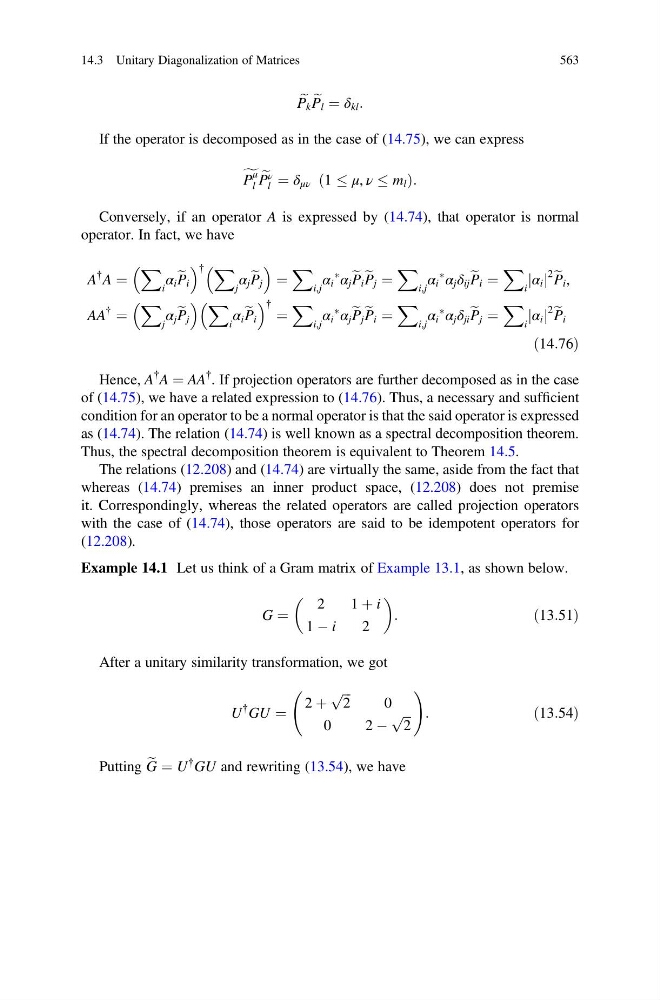
e
P k e
P l ¼ δ kl :
If the operator is decomposed as in the case of (14.75), we can express
f
P
μ
l
e
P
ν
l ¼ δ μν 1 μ, ν m l
ð
Þ :
Conversely, if an operator A is expressed by (14.74), that operator is normal
operator. In fact, we have
A
{ A ¼
X
i
α i e
P i
{ X
j
α j e
P j
¼
X
i,j
α i
Ã
α j e
P i e
P j ¼
X
i,j
α i
Ã
α j δ ij e
P i ¼
X
i
α i
j j
2 e
P i ,
AA
{
¼
X
j
α j e
P j
X
i
α i e
P i
{ ¼
X
i,j
α i
Ã
α j e
P j e
P i ¼
X
i,j
α i
Ã
α j δ ji e
P j ¼
X
i
α i
j j
2 e
P i
ð14:76Þ
Hence, A
{ A ¼ AA
{ . If projection operators are further decomposed as in the case
of (14.75), we have a related expression to (14.76). Thus, a necessary and sufficient
condition for an operator to be a normal operator is that the said operator is expressed
as (14.74). The relation (14.74) is well known as a spectral decomposition theorem.
Thus, the spectral decomposition theorem is equivalent to Theorem 14.5.
The relations (12.208) and (14.74) are virtually the same, aside from the fact that
whereas (14.74) premises an inner product space, (12.208) does not premise
it. Correspondingly, whereas the related operators are called projection operators
with the case of (14.74), those operators are said to be idempotent operators for
(12.208).
Example 14.1 Let us think of a Gram matrix of Example 13.1, as shown below.
G ¼
2
1þ i
1 À i
2
:
ð13:51Þ
After a unitary similarity transformation, we got
U
{ GU ¼
2 þ
ffiffi ffi
2
p
0
0
2À
ffiffi ffi
2
p
!
:
ð13:54Þ
Putting e
G ¼ U
{ GU and rewriting (13.54), we have
14.3 Unitary Diagonalization of Matrices
563
P k e
P l ¼ δ kl :
If the operator is decomposed as in the case of (14.75), we can express
f
P
μ
l
e
P
ν
l ¼ δ μν 1 μ, ν m l
ð
Þ :
Conversely, if an operator A is expressed by (14.74), that operator is normal
operator. In fact, we have
A
{ A ¼
X
i
α i e
P i
{ X
j
α j e
P j
¼
X
i,j
α i
Ã
α j e
P i e
P j ¼
X
i,j
α i
Ã
α j δ ij e
P i ¼
X
i
α i
j j
2 e
P i ,
AA
{
¼
X
j
α j e
P j
X
i
α i e
P i
{ ¼
X
i,j
α i
Ã
α j e
P j e
P i ¼
X
i,j
α i
Ã
α j δ ji e
P j ¼
X
i
α i
j j
2 e
P i
ð14:76Þ
Hence, A
{ A ¼ AA
{ . If projection operators are further decomposed as in the case
of (14.75), we have a related expression to (14.76). Thus, a necessary and sufficient
condition for an operator to be a normal operator is that the said operator is expressed
as (14.74). The relation (14.74) is well known as a spectral decomposition theorem.
Thus, the spectral decomposition theorem is equivalent to Theorem 14.5.
The relations (12.208) and (14.74) are virtually the same, aside from the fact that
whereas (14.74) premises an inner product space, (12.208) does not premise
it. Correspondingly, whereas the related operators are called projection operators
with the case of (14.74), those operators are said to be idempotent operators for
(12.208).
Example 14.1 Let us think of a Gram matrix of Example 13.1, as shown below.
G ¼
2
1þ i
1 À i
2
:
ð13:51Þ
After a unitary similarity transformation, we got
U
{ GU ¼
2 þ
ffiffi ffi
2
p
0
0
2À
ffiffi ffi
2
p
!
:
ð13:54Þ
Putting e
G ¼ U
{ GU and rewriting (13.54), we have
14.3 Unitary Diagonalization of Matrices
563