

f
½A n
{
¼
α
Ã
n
0
x
Ã
B
{
,
ð14:55Þ
where x
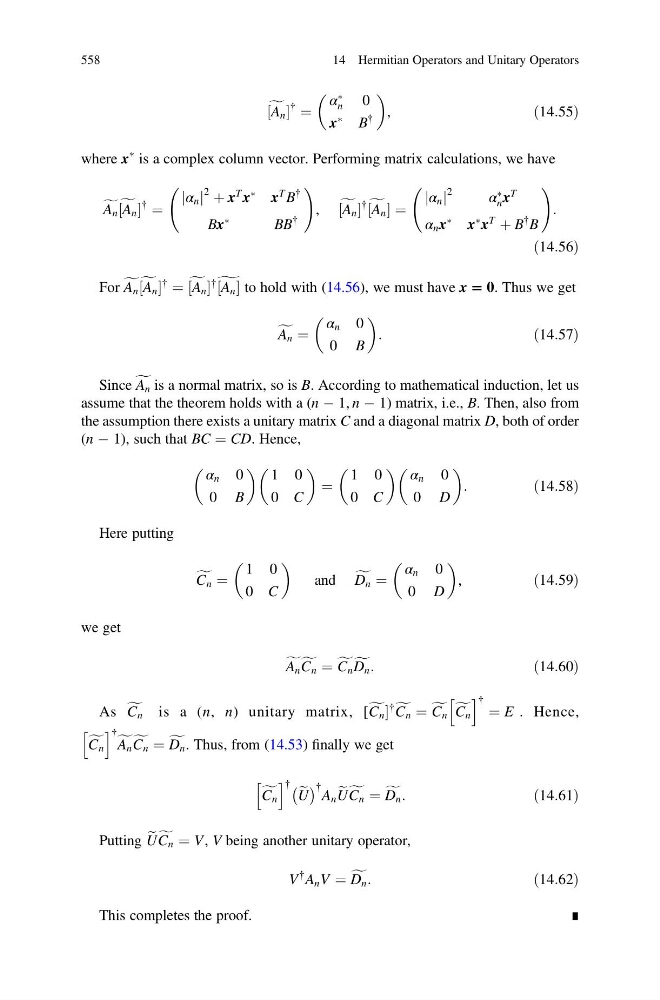
à is a complex column vector. Performing matrix calculations, we have
f A n f
½A n
{
¼
α n
j j
2 þ x
T
x
Ã
x
T B
{
Bx
Ã
BB
{
!
, f
½A n
{ f
½A n ¼
α n
j j
2
α
Ã
n x
T
α n x
Ã
x
Ã
x
T
þ B
{ B
!
:
ð14:56Þ
For f
A n f
½A n
{
¼ f
½A n
{ g A n
½ to hold with (14.56), we must have x = 0. Thus we get
f
A n ¼
α n 0
0 B
:
ð14:57Þ
Since f A n is a normal matrix, so is B. According to mathematical induction, let us
assume that the theorem holds with a (n À 1, n À 1) matrix, i.e., B. Then, also from
the assumption there exists a unitary matrix C and a diagonal matrix D, both of order
(n À 1), such that BC ¼ CD. Hence,
α n 0
0 B
1 0
0 C
¼
1 0
0 C
α n 0
0 D
:
ð14:58Þ
Here putting
f
C n ¼
1 0
0 C
and f
D n ¼
α n 0
0 D
,
ð14:59Þ
we get
f A n f
C n ¼ f
C n f
D n :
ð14:60Þ
As f
C n is a (n, n) unitary matrix, [ f
C n
{ f
C n ¼ f
C n f
C n
h i { ¼ E . Hence,
f
C n
h i { f
A n f
C n ¼ f
D n . Thus, from (14.53) finally we get
f
C n
h i { e
U
À Á { A n e
U f
C n ¼ f
D n :
ð14:61Þ
Putting e
U f
C n ¼ V, V being another unitary operator,
V
{ A n V ¼ f
D n :
ð14:62Þ
This completes the proof.
∎
558
14 Hermitian Operators and Unitary Operators
½A n
{
¼
α
Ã
n
0
x
Ã
B
{
,
ð14:55Þ
where x
à is a complex column vector. Performing matrix calculations, we have
f A n f
½A n
{
¼
α n
j j
2 þ x
T
x
Ã
x
T B
{
Bx
Ã
BB
{
!
, f
½A n
{ f
½A n ¼
α n
j j
2
α
Ã
n x
T
α n x
Ã
x
Ã
x
T
þ B
{ B
!
:
ð14:56Þ
For f
A n f
½A n
{
¼ f
½A n
{ g A n
½ to hold with (14.56), we must have x = 0. Thus we get
f
A n ¼
α n 0
0 B
:
ð14:57Þ
Since f A n is a normal matrix, so is B. According to mathematical induction, let us
assume that the theorem holds with a (n À 1, n À 1) matrix, i.e., B. Then, also from
the assumption there exists a unitary matrix C and a diagonal matrix D, both of order
(n À 1), such that BC ¼ CD. Hence,
α n 0
0 B
1 0
0 C
¼
1 0
0 C
α n 0
0 D
:
ð14:58Þ
Here putting
f
C n ¼
1 0
0 C
and f
D n ¼
α n 0
0 D
,
ð14:59Þ
we get
f A n f
C n ¼ f
C n f
D n :
ð14:60Þ
As f
C n is a (n, n) unitary matrix, [ f
C n
{ f
C n ¼ f
C n f
C n
h i { ¼ E . Hence,
f
C n
h i { f
A n f
C n ¼ f
D n . Thus, from (14.53) finally we get
f
C n
h i { e
U
À Á { A n e
U f
C n ¼ f
D n :
ð14:61Þ
Putting e
U f
C n ¼ V, V being another unitary operator,
V
{ A n V ¼ f
D n :
ð14:62Þ
This completes the proof.
∎
558
14 Hermitian Operators and Unitary Operators