

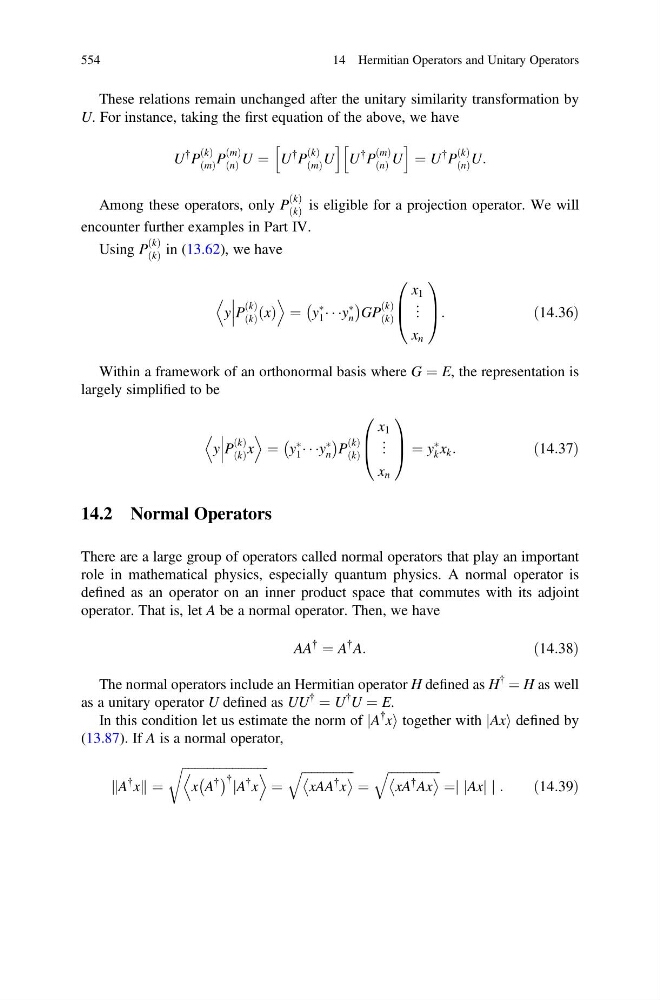
These relations remain unchanged after the unitary similarity transformation by
U. For instance, taking the first equation of the above, we have
U
{ P
k
ð Þ
m
ð Þ P
m
ð Þ
n
ð Þ U ¼ U
{ P
k
ð Þ
m
ð Þ U
h
i
U
{ P
m
ð Þ
n
ð Þ U
h
i
¼ U
{ P
k
ð Þ
n
ð Þ U:
Among these operators, only P
k
ð Þ
k
ð Þ is eligible for a projection operator. We will
encounter further examples in Part IV.
Using P
k
ð Þ
k
ð Þ in (13.62), we have
y P
k
ð Þ
k
ð Þ x
ð Þ
D
E
¼ y
Ã
1 Á Á Áy
Ã
n
À
Á
GP
k
ð Þ
k
ð Þ
x 1
⋮
x n
0
B
@
1
C
A:
ð14:36Þ
Within a framework of an orthonormal basis where G ¼ E, the representation is
largely simplified to be
y P
k
ð Þ
k
ð Þ x
D
E
¼ y
Ã
1 Á Á Áy
Ã
n
À
Á
P
k
ð Þ
k
ð Þ
x 1
⋮
x n
0
B
@
1
C
A ¼ y
Ã
k x k :
ð14:37Þ
14.2 Normal Operators
There are a large group of operators called normal operators that play an important
role in mathematical physics, especially quantum physics. A normal operator is
defined as an operator on an inner product space that commutes with its adjoint
operator. That is, let A be a normal operator. Then, we have
AA
{
¼ A
{ A:
ð14:38Þ
The normal operators include an Hermitian operator H defined as H
{
¼ H as well
as a unitary operator U defined as UU
{
¼ U
{ U ¼ E.
In this condition let us estimate the norm of jA
{ xi together with jAxi defined by
(13.87). If A is a normal operator,
kA
{ xk ¼
ffiffiffiffiffiffiffiffiffiffiffiffiffiffiffiffiffiffiffiffiffiffiffiffiffiffiffi ffi
x A
{
À Á { jA
{ x
D
E
r
¼
ffiffiffiffiffiffiffiffiffiffiffiffiffiffiffiffi ffi
xAA
{ x
q
¼
ffiffiffiffiffiffiffiffiffiffiffiffiffiffiffiffi ffi
xA
{ Ax
q
¼j Ax
j j j :
ð14:39Þ
554
14 Hermitian Operators and Unitary Operators
U. For instance, taking the first equation of the above, we have
U
{ P
k
ð Þ
m
ð Þ P
m
ð Þ
n
ð Þ U ¼ U
{ P
k
ð Þ
m
ð Þ U
h
i
U
{ P
m
ð Þ
n
ð Þ U
h
i
¼ U
{ P
k
ð Þ
n
ð Þ U:
Among these operators, only P
k
ð Þ
k
ð Þ is eligible for a projection operator. We will
encounter further examples in Part IV.
Using P
k
ð Þ
k
ð Þ in (13.62), we have
y P
k
ð Þ
k
ð Þ x
ð Þ
D
E
¼ y
Ã
1 Á Á Áy
Ã
n
À
Á
GP
k
ð Þ
k
ð Þ
x 1
⋮
x n
0
B
@
1
C
A:
ð14:36Þ
Within a framework of an orthonormal basis where G ¼ E, the representation is
largely simplified to be
y P
k
ð Þ
k
ð Þ x
D
E
¼ y
Ã
1 Á Á Áy
Ã
n
À
Á
P
k
ð Þ
k
ð Þ
x 1
⋮
x n
0
B
@
1
C
A ¼ y
Ã
k x k :
ð14:37Þ
14.2 Normal Operators
There are a large group of operators called normal operators that play an important
role in mathematical physics, especially quantum physics. A normal operator is
defined as an operator on an inner product space that commutes with its adjoint
operator. That is, let A be a normal operator. Then, we have
AA
{
¼ A
{ A:
ð14:38Þ
The normal operators include an Hermitian operator H defined as H
{
¼ H as well
as a unitary operator U defined as UU
{
¼ U
{ U ¼ E.
In this condition let us estimate the norm of jA
{ xi together with jAxi defined by
(13.87). If A is a normal operator,
kA
{ xk ¼
ffiffiffiffiffiffiffiffiffiffiffiffiffiffiffiffiffiffiffiffiffiffiffiffiffiffiffi ffi
x A
{
À Á { jA
{ x
D
E
r
¼
ffiffiffiffiffiffiffiffiffiffiffiffiffiffiffiffi ffi
xAA
{ x
q
¼
ffiffiffiffiffiffiffiffiffiffiffiffiffiffiffiffi ffi
xA
{ Ax
q
¼j Ax
j j j :
ð14:39Þ
554
14 Hermitian Operators and Unitary Operators