

e
P k xi¼
j
je k i e k
h
X n
j¼1
x j e j
¼
e k i
X n
j¼1
x j e k e j
¼ e k i
X n
j¼1
x j δ kj
¼x k
e k i:
Thus, we find that e
P k plays the same role as P
(k) defined in (12.201). Represented
by a matrix, e
P k has the same structure as that denoted in (12.205). Evidently,
e
P k
À Á 2 ¼ e
P k , e
P k
{ ¼ e
P k , f
P 1 þ f P 2 þ Á Á Á þ f P n ¼ E:
ð14:33Þ
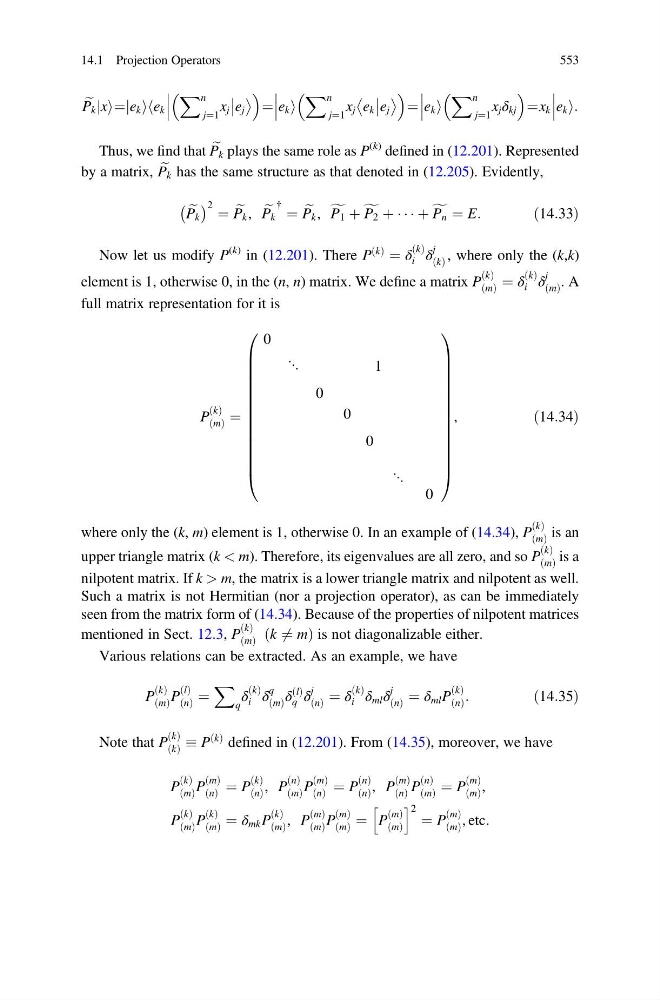
Now let us modify P
(k) in (12.201). There P
k
ð Þ
¼ δ
k
ð Þ
i δ
j
k
ð Þ , where only the (k,k)
element is 1, otherwise 0, in the (n, n) matrix. We define a matrix P
k
ð Þ
m
ð Þ ¼ δ
k
ð Þ
i δ
j
m
ð Þ . A
full matrix representation for it is
P
k
ð Þ
m
ð Þ ¼
0
⋱
0
1
0
0
⋱
0
0
B
B
B
B
B
B
B
B
B
B
B
B
B
@
1
C
C
C
C
C
C
C
C
C
C
C
C
C
A
,
ð14:34Þ
where only the (k, m) element is 1, otherwise 0. In an example of (14.34), P
k
ð Þ
m
ð Þ is an
upper triangle matrix (k < m). Therefore, its eigenvalues are all zero, and so P
k
ð Þ
m
ð Þ is a
nilpotent matrix. If k > m, the matrix is a lower triangle matrix and nilpotent as well.
Such a matrix is not Hermitian (nor a projection operator), as can be immediately
seen from the matrix form of (14.34). Because of the properties of nilpotent matrices
mentioned in Sect. 12.3, P
k
ð Þ
m
ð Þ k 6 ¼ m
ð
Þis not diagonalizable either.
Various relations can be extracted. As an example, we have
P
k
ð Þ
m
ð Þ P
l
ð Þ
n
ð Þ ¼
X
q
δ
k
ð Þ
i δ
q
m
ð Þ δ
l
ð Þ
q δ
j
n
ð Þ ¼ δ
k
ð Þ
i δ ml δ
j
n
ð Þ ¼ δ ml P
k
ð Þ
n
ð Þ :
ð14:35Þ
Note that P
k
ð Þ
k
ð Þ P
k
ð Þ defined in (12.201). From (14.35), moreover, we have
P
k
ð Þ
m
ð Þ P
m
ð Þ
n
ð Þ ¼ P
k
ð Þ
n
ð Þ , P
n
ð Þ
m
ð Þ P
m
ð Þ
n
ð Þ ¼ P
n
ð Þ
n
ð Þ , P
m
ð Þ
n
ð Þ P
n
ð Þ
m
ð Þ ¼ P
m
ð Þ
m
ð Þ ,
P
k
ð Þ
m
ð Þ P
k
ð Þ
m
ð Þ ¼ δ mk P
k
ð Þ
m
ð Þ , P
m
ð Þ
m
ð Þ P
m
ð Þ
m
ð Þ ¼ P
m
ð Þ
m
ð Þ
h
i 2 ¼ P
m
ð Þ
m
ð Þ , etc:
14.1 Projection Operators
553
P k xi¼
j
je k i e k
h
X n
j¼1
x j e j
¼
e k i
X n
j¼1
x j e k e j
¼ e k i
X n
j¼1
x j δ kj
¼x k
e k i:
Thus, we find that e
P k plays the same role as P
(k) defined in (12.201). Represented
by a matrix, e
P k has the same structure as that denoted in (12.205). Evidently,
e
P k
À Á 2 ¼ e
P k , e
P k
{ ¼ e
P k , f
P 1 þ f P 2 þ Á Á Á þ f P n ¼ E:
ð14:33Þ
Now let us modify P
(k) in (12.201). There P
k
ð Þ
¼ δ
k
ð Þ
i δ
j
k
ð Þ , where only the (k,k)
element is 1, otherwise 0, in the (n, n) matrix. We define a matrix P
k
ð Þ
m
ð Þ ¼ δ
k
ð Þ
i δ
j
m
ð Þ . A
full matrix representation for it is
P
k
ð Þ
m
ð Þ ¼
0
⋱
0
1
0
0
⋱
0
0
B
B
B
B
B
B
B
B
B
B
B
B
B
@
1
C
C
C
C
C
C
C
C
C
C
C
C
C
A
,
ð14:34Þ
where only the (k, m) element is 1, otherwise 0. In an example of (14.34), P
k
ð Þ
m
ð Þ is an
upper triangle matrix (k < m). Therefore, its eigenvalues are all zero, and so P
k
ð Þ
m
ð Þ is a
nilpotent matrix. If k > m, the matrix is a lower triangle matrix and nilpotent as well.
Such a matrix is not Hermitian (nor a projection operator), as can be immediately
seen from the matrix form of (14.34). Because of the properties of nilpotent matrices
mentioned in Sect. 12.3, P
k
ð Þ
m
ð Þ k 6 ¼ m
ð
Þis not diagonalizable either.
Various relations can be extracted. As an example, we have
P
k
ð Þ
m
ð Þ P
l
ð Þ
n
ð Þ ¼
X
q
δ
k
ð Þ
i δ
q
m
ð Þ δ
l
ð Þ
q δ
j
n
ð Þ ¼ δ
k
ð Þ
i δ ml δ
j
n
ð Þ ¼ δ ml P
k
ð Þ
n
ð Þ :
ð14:35Þ
Note that P
k
ð Þ
k
ð Þ P
k
ð Þ defined in (12.201). From (14.35), moreover, we have
P
k
ð Þ
m
ð Þ P
m
ð Þ
n
ð Þ ¼ P
k
ð Þ
n
ð Þ , P
n
ð Þ
m
ð Þ P
m
ð Þ
n
ð Þ ¼ P
n
ð Þ
n
ð Þ , P
m
ð Þ
n
ð Þ P
n
ð Þ
m
ð Þ ¼ P
m
ð Þ
m
ð Þ ,
P
k
ð Þ
m
ð Þ P
k
ð Þ
m
ð Þ ¼ δ mk P
k
ð Þ
m
ð Þ , P
m
ð Þ
m
ð Þ P
m
ð Þ
m
ð Þ ¼ P
m
ð Þ
m
ð Þ
h
i 2 ¼ P
m
ð Þ
m
ð Þ , etc:
14.1 Projection Operators
553