

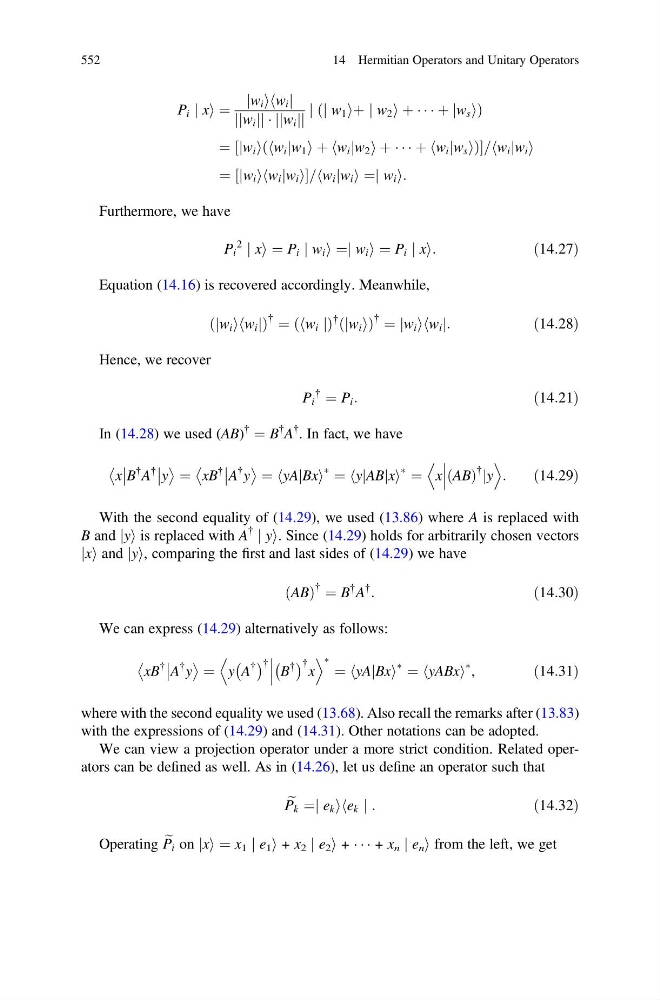
P i j xi ¼
w i ihw i
j
j
w i
j j
j jÁ w i
j j
j j
j j w 1 iþ j w 2 i þ Á Á Á þ w s i
j Þ
ð
¼ jw i i w i w 1 i þ hw i
j
j w 2
h
i þ Á Á Á þ hw i jw s i
ð
Þ
½
= w i jw i
h
i
¼ jw i i w i jw i
h
i
½
= w i jw i
h
i¼j w i i:
Furthermore, we have
P i
2
j xi ¼ P i j w i i ¼j w i i ¼ P i j xi:
ð14:27Þ
Equation (14.16) is recovered accordingly. Meanwhile,
w i ihw i
j
j
ð
Þ
{ ¼ hw i j
ð
Þ
{
jw i i
ð
Þ
{ ¼ w i ihw i
j
j:
ð14:28Þ
Hence, we recover
P i
{
¼ P i :
ð14:21Þ
In (14.28) we used (AB)
{
¼ B
{ A
{ . In fact, we have
x B
{ A
{
y
¼ xB
{ A
{ y
¼ yA Bx
j
h
i
à ¼ y AB
j jx
h
i
à ¼ x AB
ð Þ
{
y
j
D
E
:
ð14:29Þ
With the second equality of (14.29), we used (13.86) where A is replaced with
B and jyi is replaced with A
{
j yi. Since (14.29) holds for arbitrarily chosen vectors
jxi and jyi, comparing the first and last sides of (14.29) we have
AB
ð Þ
{ ¼ B
{ A
{
:
ð14:30Þ
We can express (14.29) alternatively as follows:
xB
{ A
{ y
¼ y A
{
À Á { B
{
À Á { x
D
E Ã ¼ yA Bx
j
h
i
à ¼ yABx
h
i
à ,
ð14:31Þ
where with the second equality we used (13.68). Also recall the remarks after (13.83)
with the expressions of (14.29) and (14.31). Other notations can be adopted.
We can view a projection operator under a more strict condition. Related operators can be defined as well. As in (14.26), let us define an operator such that
e
P k ¼j e k ihe k j :
ð14:32Þ
Operating e
P i on jxi ¼ x 1 j e 1 i + x 2 j e 2 i + Á Á Á + x n j e n i from the left, we get
552
14 Hermitian Operators and Unitary Operators
w i ihw i
j
j
w i
j j
j jÁ w i
j j
j j
j j w 1 iþ j w 2 i þ Á Á Á þ w s i
j Þ
ð
¼ jw i i w i w 1 i þ hw i
j
j w 2
h
i þ Á Á Á þ hw i jw s i
ð
Þ
½
= w i jw i
h
i
¼ jw i i w i jw i
h
i
½
= w i jw i
h
i¼j w i i:
Furthermore, we have
P i
2
j xi ¼ P i j w i i ¼j w i i ¼ P i j xi:
ð14:27Þ
Equation (14.16) is recovered accordingly. Meanwhile,
w i ihw i
j
j
ð
Þ
{ ¼ hw i j
ð
Þ
{
jw i i
ð
Þ
{ ¼ w i ihw i
j
j:
ð14:28Þ
Hence, we recover
P i
{
¼ P i :
ð14:21Þ
In (14.28) we used (AB)
{
¼ B
{ A
{ . In fact, we have
x B
{ A
{
y
¼ xB
{ A
{ y
¼ yA Bx
j
h
i
à ¼ y AB
j jx
h
i
à ¼ x AB
ð Þ
{
y
j
D
E
:
ð14:29Þ
With the second equality of (14.29), we used (13.86) where A is replaced with
B and jyi is replaced with A
{
j yi. Since (14.29) holds for arbitrarily chosen vectors
jxi and jyi, comparing the first and last sides of (14.29) we have
AB
ð Þ
{ ¼ B
{ A
{
:
ð14:30Þ
We can express (14.29) alternatively as follows:
xB
{ A
{ y
¼ y A
{
À Á { B
{
À Á { x
D
E Ã ¼ yA Bx
j
h
i
à ¼ yABx
h
i
à ,
ð14:31Þ
where with the second equality we used (13.68). Also recall the remarks after (13.83)
with the expressions of (14.29) and (14.31). Other notations can be adopted.
We can view a projection operator under a more strict condition. Related operators can be defined as well. As in (14.26), let us define an operator such that
e
P k ¼j e k ihe k j :
ð14:32Þ
Operating e
P i on jxi ¼ x 1 j e 1 i + x 2 j e 2 i + Á Á Á + x n j e n i from the left, we get
552
14 Hermitian Operators and Unitary Operators