

operator, we are thinking of orthogonal compliments as subspaces and their direct
sum. The projection operator can adequately be defined in an inner product vector
space having an orthonormal basis.
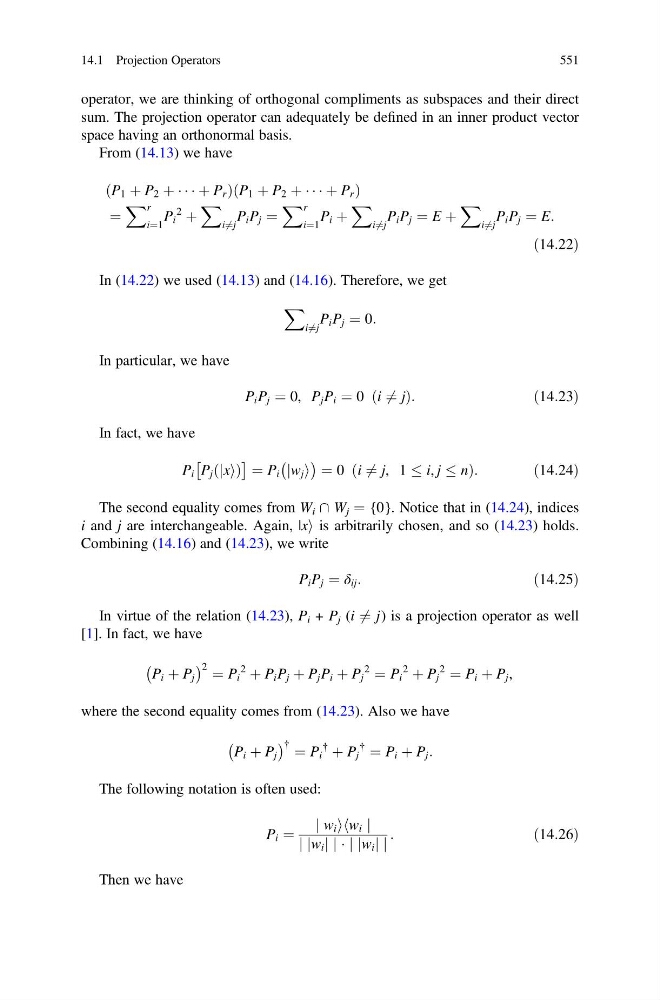
From (14.13) we have
P 1 þ P 2 þ Á Á Á þ P r
ð
Þ P 1 þ P 2 þ Á Á Á þ P r
ð
Þ
¼
X r
i¼1
P i
2
þ
X
i6 ¼j
P i P j ¼
X r
i¼1
P i þ
X
i6 ¼j
P i P j ¼ E þ
X
i6 ¼j
P i P j ¼ E:
ð14:22Þ
In (14.22) we used (14.13) and (14.16). Therefore, we get
X
i6 ¼j
P i P j ¼ 0:
In particular, we have
P i P j ¼ 0, P j P i ¼ 0 i 6 ¼ j
ð
Þ:
ð14:23Þ
In fact, we have
P i P j jxi
ð Þ
Â
à ¼ P i jw j i
À
Á ¼ 0 i 6 ¼ j, 1 i, j n
ð
Þ :
ð14:24Þ
The second equality comes from W i \ W j ¼ {0}. Notice that in (14.24), indices
i and j are interchangeable. Again, |xi is arbitrarily chosen, and so (14.23) holds.
Combining (14.16) and (14.23), we write
P i P j ¼ δ ij :
ð14:25Þ
In virtue of the relation (14.23), P i + P j (i 6 ¼ j) is a projection operator as well
[1]. In fact, we have
P i þ P j
À
Á 2 ¼ P i
2
þ P i P j þ P j P i þ P j
2
¼ P i
2
þ P j
2
¼ P i þ P j ,
where the second equality comes from (14.23). Also we have
P i þ P j
À
Á { ¼ P i
{
þ P j
{
¼ P i þ P j :
The following notation is often used:
P i ¼
j w i ihw i j
j w i
j j j Á j w i
j j j
:
ð14:26Þ
Then we have
14.1 Projection Operators
551
sum. The projection operator can adequately be defined in an inner product vector
space having an orthonormal basis.
From (14.13) we have
P 1 þ P 2 þ Á Á Á þ P r
ð
Þ P 1 þ P 2 þ Á Á Á þ P r
ð
Þ
¼
X r
i¼1
P i
2
þ
X
i6 ¼j
P i P j ¼
X r
i¼1
P i þ
X
i6 ¼j
P i P j ¼ E þ
X
i6 ¼j
P i P j ¼ E:
ð14:22Þ
In (14.22) we used (14.13) and (14.16). Therefore, we get
X
i6 ¼j
P i P j ¼ 0:
In particular, we have
P i P j ¼ 0, P j P i ¼ 0 i 6 ¼ j
ð
Þ:
ð14:23Þ
In fact, we have
P i P j jxi
ð Þ
Â
à ¼ P i jw j i
À
Á ¼ 0 i 6 ¼ j, 1 i, j n
ð
Þ :
ð14:24Þ
The second equality comes from W i \ W j ¼ {0}. Notice that in (14.24), indices
i and j are interchangeable. Again, |xi is arbitrarily chosen, and so (14.23) holds.
Combining (14.16) and (14.23), we write
P i P j ¼ δ ij :
ð14:25Þ
In virtue of the relation (14.23), P i + P j (i 6 ¼ j) is a projection operator as well
[1]. In fact, we have
P i þ P j
À
Á 2 ¼ P i
2
þ P i P j þ P j P i þ P j
2
¼ P i
2
þ P j
2
¼ P i þ P j ,
where the second equality comes from (14.23). Also we have
P i þ P j
À
Á { ¼ P i
{
þ P j
{
¼ P i þ P j :
The following notation is often used:
P i ¼
j w i ihw i j
j w i
j j j Á j w i
j j j
:
ð14:26Þ
Then we have
14.1 Projection Operators
551