

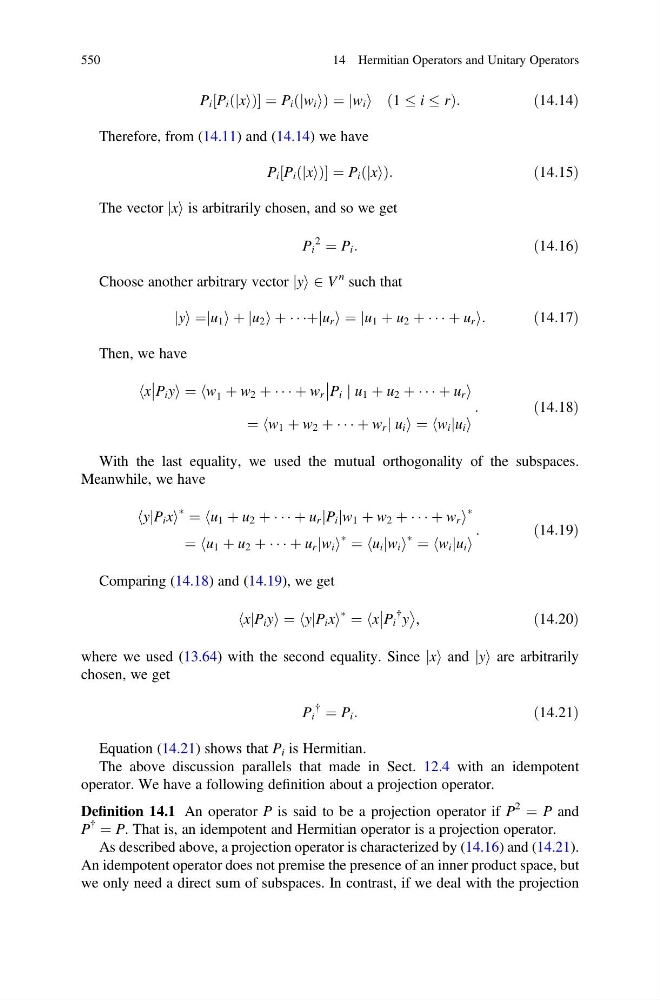
P i P i x
j i
ð Þ
½
¼P i w i
j i
ð
Þ ¼ w i
j i 1 i r
ð
Þ :
ð14:14Þ
Therefore, from (14.11) and (14.14) we have
P i P i jxi
ð Þ
½
¼P i x
j i
ð Þ:
ð14:15Þ
The vector jxi is arbitrarily chosen, and so we get
P i
2
¼ P i :
ð14:16Þ
Choose another arbitrary vector jyi 2 V
n such that
yi ¼
j
ju 1 i þ u 2 i þ Á Á Áþ
j
j u r i ¼ u 1 þ u 2 þ Á Á Á þ u r
j
i :
ð14:17Þ
Then, we have
x
h P i yi ¼ w
h 1 þ w 2 þ Á Á Á þ w r
P i j u 1 þ u 2 þ Á Á Á þ u r i
¼ w 1
h þ w 2 þ Á Á Á þ w r u i i ¼ w i
h
j
j u i i
:
ð14:18Þ
With the last equality, we used the mutual orthogonality of the subspaces.
Meanwhile, we have
y
h P i x
j i
à ¼ u 1
h þ u 2 þ Á Á Á þ u r P i
j jw 1 þ w 2 þ Á Á Á þ w r i
Ã
¼ u 1
h þ u 2 þ Á Á Á þ u r w i i
à ¼ u i
h
j
j w i i
à ¼ w i
h u i
j i
:
ð14:19Þ
Comparing (14.18) and (14.19), we get
x
h P i yi ¼ y
h
j
j P i xi
à ¼ x
h P i
{ y
,
ð14:20Þ
where we used (13.64) with the second equality. Since jxi and jyi are arbitrarily
chosen, we get
P i
{
¼ P i :
ð14:21Þ
Equation (14.21) shows that P i is Hermitian.
The above discussion parallels that made in Sect. 12.4 with an idempotent
operator. We have a following definition about a projection operator.
Definition 14.1 An operator P is said to be a projection operator if P
2
¼ P and
P
{
¼ P. That is, an idempotent and Hermitian operator is a projection operator.
As described above, a projection operator is characterized by (14.16) and (14.21).
An idempotent operator does not premise the presence of an inner product space, but
we only need a direct sum of subspaces. In contrast, if we deal with the projection
550
14 Hermitian Operators and Unitary Operators
j i
ð Þ
½
¼P i w i
j i
ð
Þ ¼ w i
j i 1 i r
ð
Þ :
ð14:14Þ
Therefore, from (14.11) and (14.14) we have
P i P i jxi
ð Þ
½
¼P i x
j i
ð Þ:
ð14:15Þ
The vector jxi is arbitrarily chosen, and so we get
P i
2
¼ P i :
ð14:16Þ
Choose another arbitrary vector jyi 2 V
n such that
yi ¼
j
ju 1 i þ u 2 i þ Á Á Áþ
j
j u r i ¼ u 1 þ u 2 þ Á Á Á þ u r
j
i :
ð14:17Þ
Then, we have
x
h P i yi ¼ w
h 1 þ w 2 þ Á Á Á þ w r
P i j u 1 þ u 2 þ Á Á Á þ u r i
¼ w 1
h þ w 2 þ Á Á Á þ w r u i i ¼ w i
h
j
j u i i
:
ð14:18Þ
With the last equality, we used the mutual orthogonality of the subspaces.
Meanwhile, we have
y
h P i x
j i
à ¼ u 1
h þ u 2 þ Á Á Á þ u r P i
j jw 1 þ w 2 þ Á Á Á þ w r i
Ã
¼ u 1
h þ u 2 þ Á Á Á þ u r w i i
à ¼ u i
h
j
j w i i
à ¼ w i
h u i
j i
:
ð14:19Þ
Comparing (14.18) and (14.19), we get
x
h P i yi ¼ y
h
j
j P i xi
à ¼ x
h P i
{ y
,
ð14:20Þ
where we used (13.64) with the second equality. Since jxi and jyi are arbitrarily
chosen, we get
P i
{
¼ P i :
ð14:21Þ
Equation (14.21) shows that P i is Hermitian.
The above discussion parallels that made in Sect. 12.4 with an idempotent
operator. We have a following definition about a projection operator.
Definition 14.1 An operator P is said to be a projection operator if P
2
¼ P and
P
{
¼ P. That is, an idempotent and Hermitian operator is a projection operator.
As described above, a projection operator is characterized by (14.16) and (14.21).
An idempotent operator does not premise the presence of an inner product space, but
we only need a direct sum of subspaces. In contrast, if we deal with the projection
550
14 Hermitian Operators and Unitary Operators