

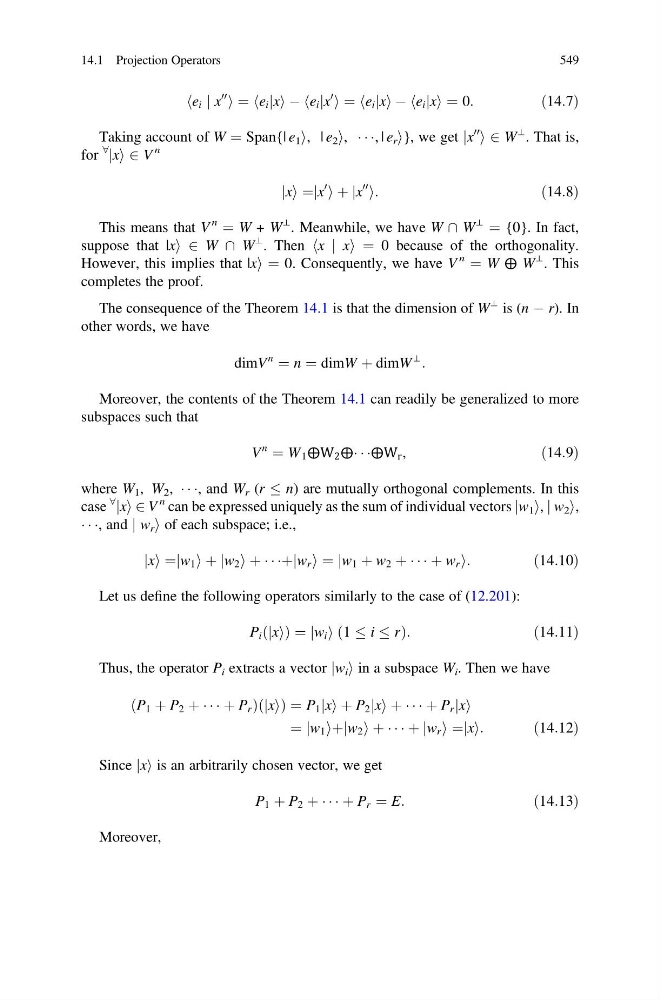
e i
h j x
00
i ¼ e i
h xi À e i
h
j
j x
0
i ¼ e i
h xi À e i
h
j
j xi ¼ 0:
ð14:7Þ
Taking account of W ¼ Span{| e 1 i, | e 2 i, Á Á Á, | e r i}, we get jx
00
i 2 W
⊥
. That is,
for
8
jxi 2 V
n
xi ¼
j
jx
0
i þ x
00
j i:
ð14:8Þ
This means that V
n
¼ W + W
⊥
. Meanwhile, we have W \ W
⊥
¼ {0}. In fact,
suppose that |xi 2 W \ W
⊥
. Then hx j xi ¼ 0 because of the orthogonality.
However, this implies that |xi ¼ 0. Consequently, we have V
n
¼ W ⨁ W
⊥ . This
completes the proof.
The consequence of the Theorem 14.1 is that the dimension of W
⊥ is (n À r). In
other words, we have
dimV
n
¼ n ¼ dimW þ dimW
⊥
:
Moreover, the contents of the Theorem 14.1 can readily be generalized to more
subspaces such that
V
n
¼ W 1 ⨁W 2 ⨁Á Á Á⨁W r ,
ð14:9Þ
where W 1 , W 2 , Á Á Á, and W r (r n) are mutually orthogonal complements. In this
case
8
jxi 2 V
n can be expressed uniquely as the sum of individual vectors jw 1 i, j w 2 i,
Á Á Á, and j w r i of each subspace; i.e.,
xi ¼
j
jw 1 i þ w 2 i þ Á Á Áþ
j
j w r i ¼ w 1 þ w 2 þ Á Á Á þ w r i
j
:
ð14:10Þ
Let us define the following operators similarly to the case of (12.201):
P i x
j i
ð Þ ¼ w i
j i 1 i r
ð
Þ :
ð14:11Þ
Thus, the operator P i extracts a vector jw i i in a subspace W i . Then we have
P 1 þ P 2 þ Á Á Á þ P r
ð
Þx j i
ð Þ ¼ P 1 xi þ P 2
j
j xi þ Á Á Á þ P r x
j i
¼ w 1 iþ
j
jw 2 i þ Á Á Á þ w r i ¼
j
jxi:
ð14:12Þ
Since jxi is an arbitrarily chosen vector, we get
P 1 þ P 2 þ Á Á Á þ P r ¼ E:
ð14:13Þ
Moreover,
14.1 Projection Operators
549
h j x
00
i ¼ e i
h xi À e i
h
j
j x
0
i ¼ e i
h xi À e i
h
j
j xi ¼ 0:
ð14:7Þ
Taking account of W ¼ Span{| e 1 i, | e 2 i, Á Á Á, | e r i}, we get jx
00
i 2 W
⊥
. That is,
for
8
jxi 2 V
n
xi ¼
j
jx
0
i þ x
00
j i:
ð14:8Þ
This means that V
n
¼ W + W
⊥
. Meanwhile, we have W \ W
⊥
¼ {0}. In fact,
suppose that |xi 2 W \ W
⊥
. Then hx j xi ¼ 0 because of the orthogonality.
However, this implies that |xi ¼ 0. Consequently, we have V
n
¼ W ⨁ W
⊥ . This
completes the proof.
The consequence of the Theorem 14.1 is that the dimension of W
⊥ is (n À r). In
other words, we have
dimV
n
¼ n ¼ dimW þ dimW
⊥
:
Moreover, the contents of the Theorem 14.1 can readily be generalized to more
subspaces such that
V
n
¼ W 1 ⨁W 2 ⨁Á Á Á⨁W r ,
ð14:9Þ
where W 1 , W 2 , Á Á Á, and W r (r n) are mutually orthogonal complements. In this
case
8
jxi 2 V
n can be expressed uniquely as the sum of individual vectors jw 1 i, j w 2 i,
Á Á Á, and j w r i of each subspace; i.e.,
xi ¼
j
jw 1 i þ w 2 i þ Á Á Áþ
j
j w r i ¼ w 1 þ w 2 þ Á Á Á þ w r i
j
:
ð14:10Þ
Let us define the following operators similarly to the case of (12.201):
P i x
j i
ð Þ ¼ w i
j i 1 i r
ð
Þ :
ð14:11Þ
Thus, the operator P i extracts a vector jw i i in a subspace W i . Then we have
P 1 þ P 2 þ Á Á Á þ P r
ð
Þx j i
ð Þ ¼ P 1 xi þ P 2
j
j xi þ Á Á Á þ P r x
j i
¼ w 1 iþ
j
jw 2 i þ Á Á Á þ w r i ¼
j
jxi:
ð14:12Þ
Since jxi is an arbitrarily chosen vector, we get
P 1 þ P 2 þ Á Á Á þ P r ¼ E:
ð14:13Þ
Moreover,
14.1 Projection Operators
549