

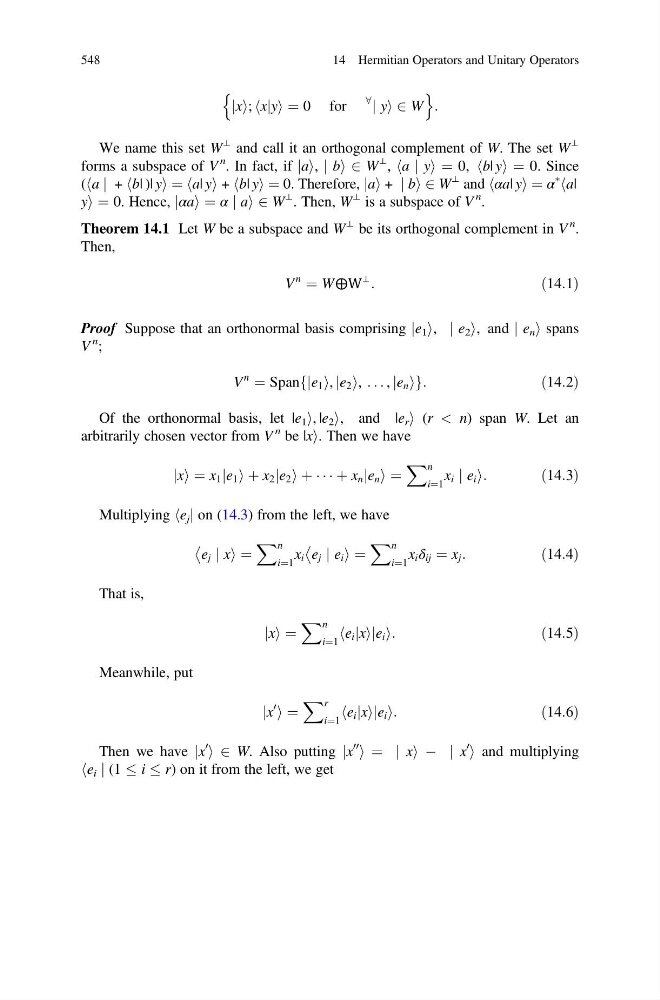
jxi; xjy
h i ¼ 0 for
8 j yi 2 W
n
o
:
We name this set W
⊥ and call it an orthogonal complement of W. The set W
⊥
forms a subspace of V
n . In fact, if jai, j bi 2 W
⊥ , ha j yi ¼ 0, hb| yi ¼ 0. Since
(ha j + hb| )| yi ¼ ha| yi + hb| yi ¼ 0. Therefore, jai + j bi 2 W
⊥ and hαa| yi ¼ α
à ha|
yi ¼ 0. Hence, jαai ¼ α j ai 2 W
⊥ . Then, W
⊥ is a subspace of V
n .
Theorem 14.1 Let W be a subspace and W
⊥ be its orthogonal complement in V
n .
Then,
V
n
¼ W⨁W
⊥
:
ð14:1Þ
Proof Suppose that an orthonormal basis comprising je 1 i, j e 2 i, and j e n i spans
V
n ;
V
n
¼ Span e 1 i,
j
je 2 i, . . . , je n i
f
g :
ð14:2Þ
Of the orthonormal basis, let |e 1 i, |e 2 i, and |e r i (r < n) span W. Let an
arbitrarily chosen vector from V
n be |xi. Then we have
xi ¼ x 1
j
je 1 i þ x 2 e 2 i þ Á Á Á þ x n
j
j e n i ¼
X n
i¼1
x i j e i i:
ð14:3Þ
Multiplying he j j on (14.3) from the left, we have
e j
j xi ¼
X n
i¼1
x i e j
j e i i ¼
X n
i¼1
x i δ ij ¼ x j :
ð14:4Þ
That is,
x
j i ¼
X n
i¼1
e i
h xi
j je i i:
ð14:5Þ
Meanwhile, put
x
0
j i ¼
X r
i¼1
e i
h xi
j je i i:
ð14:6Þ
Then we have jx
0
i 2 W. Also putting jx
00
i ¼ j xi À j x
0
i and multiplying
he i j (1 i r) on it from the left, we get
548
14 Hermitian Operators and Unitary Operators
h i ¼ 0 for
8 j yi 2 W
n
o
:
We name this set W
⊥ and call it an orthogonal complement of W. The set W
⊥
forms a subspace of V
n . In fact, if jai, j bi 2 W
⊥ , ha j yi ¼ 0, hb| yi ¼ 0. Since
(ha j + hb| )| yi ¼ ha| yi + hb| yi ¼ 0. Therefore, jai + j bi 2 W
⊥ and hαa| yi ¼ α
à ha|
yi ¼ 0. Hence, jαai ¼ α j ai 2 W
⊥ . Then, W
⊥ is a subspace of V
n .
Theorem 14.1 Let W be a subspace and W
⊥ be its orthogonal complement in V
n .
Then,
V
n
¼ W⨁W
⊥
:
ð14:1Þ
Proof Suppose that an orthonormal basis comprising je 1 i, j e 2 i, and j e n i spans
V
n ;
V
n
¼ Span e 1 i,
j
je 2 i, . . . , je n i
f
g :
ð14:2Þ
Of the orthonormal basis, let |e 1 i, |e 2 i, and |e r i (r < n) span W. Let an
arbitrarily chosen vector from V
n be |xi. Then we have
xi ¼ x 1
j
je 1 i þ x 2 e 2 i þ Á Á Á þ x n
j
j e n i ¼
X n
i¼1
x i j e i i:
ð14:3Þ
Multiplying he j j on (14.3) from the left, we have
e j
j xi ¼
X n
i¼1
x i e j
j e i i ¼
X n
i¼1
x i δ ij ¼ x j :
ð14:4Þ
That is,
x
j i ¼
X n
i¼1
e i
h xi
j je i i:
ð14:5Þ
Meanwhile, put
x
0
j i ¼
X r
i¼1
e i
h xi
j je i i:
ð14:6Þ
Then we have jx
0
i 2 W. Also putting jx
00
i ¼ j xi À j x
0
i and multiplying
he i j (1 i r) on it from the left, we get
548
14 Hermitian Operators and Unitary Operators