

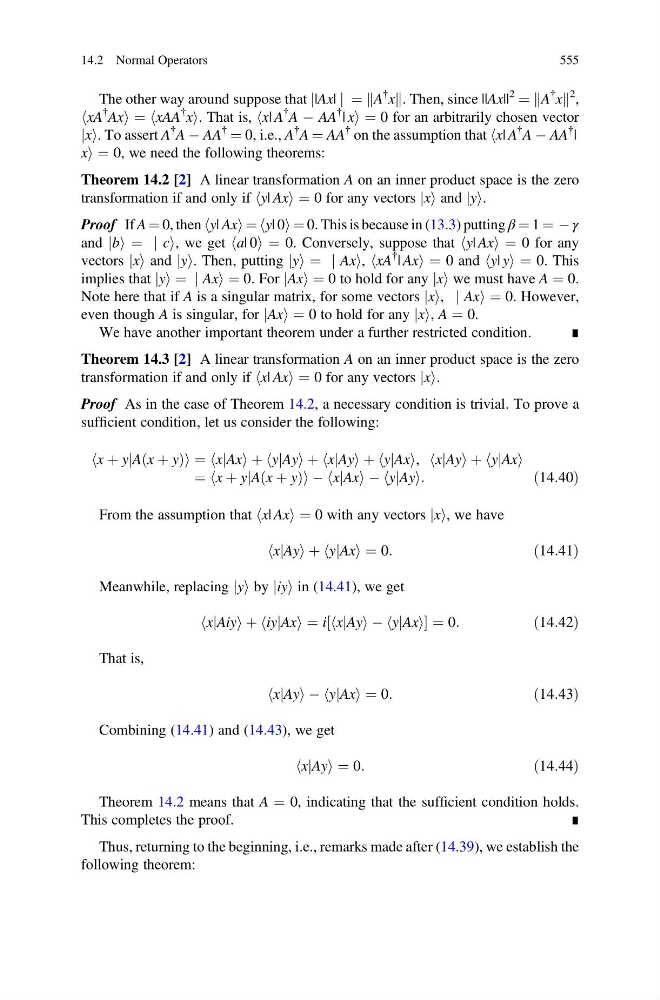
The other way around suppose that j|Ax| j ¼ kA
{ xk. Then, since ||Ax||
2
¼ kA
{ xk
2 ,
hxA
{ Axi ¼ hxAA
{ xi. That is, hx| A
{ A À AA
{ | xi ¼ 0 for an arbitrarily chosen vector
jxi. To assert A
{ A À AA
{
¼ 0, i.e., A
{ A ¼ AA
{ on the assumption that hx| A
{ A À AA
{ |
xi ¼ 0, we need the following theorems:
Theorem 14.2 [2] A linear transformation A on an inner product space is the zero
transformation if and only if hy| Axi ¼ 0 for any vectors jxi and jyi.
Proof If A ¼ 0, then hy| Axi ¼ hy| 0i ¼ 0. This is because in (13.3) putting β ¼ 1 ¼ À γ
and jbi ¼ j ci, we get ha| 0i ¼ 0. Conversely, suppose that hy| Axi ¼ 0 for any
vectors jxi and jyi. Then, putting jyi ¼ j Axi, hxA
{ | Axi ¼ 0 and hy| yi ¼ 0. This
implies that jyi ¼ j Axi ¼ 0. For jAxi ¼ 0 to hold for any jxi we must have A ¼ 0.
Note here that if A is a singular matrix, for some vectors jxi, j Axi ¼ 0. However,
even though A is singular, for jAxi ¼ 0 to hold for any jxi, A ¼ 0.
We have another important theorem under a further restricted condition.
∎
Theorem 14.3 [2] A linear transformation A on an inner product space is the zero
transformation if and only if hx| Axi ¼ 0 for any vectors jxi.
Proof As in the case of Theorem 14.2, a necessary condition is trivial. To prove a
sufficient condition, let us consider the following:
x þ yjA x þ y
ð
Þ
h
i ¼ xjAx
h
iþ yjAy
h
iþ xjAy
h
iþ yjAx
h
i, xjAy
h
iþ yjAx
h
i
¼ x þ yjA x þ y
ð
Þ
h
i À xjAx
h
iÀ yjAy
h
i:
ð14:40Þ
From the assumption that hx| Axi ¼ 0 with any vectors jxi, we have
xjAy
h
iþ yjAx
h
i ¼ 0:
ð14:41Þ
Meanwhile, replacing jyi by jiyi in (14.41), we get
xjAiy
h
iþ iyjAx
h
i¼ i xjAy
h
iÀ yjAx
h
i
½
¼ 0:
ð14:42Þ
That is,
xjAy
h
iÀ yjAx
h
i ¼ 0:
ð14:43Þ
Combining (14.41) and (14.43), we get
xjAy
h
i¼ 0:
ð14:44Þ
Theorem 14.2 means that A ¼ 0, indicating that the sufficient condition holds.
This completes the proof.
∎
Thus, returning to the beginning, i.e., remarks made after (14.39), we establish the
following theorem:
14.2 Normal Operators
555
{ xk. Then, since ||Ax||
2
¼ kA
{ xk
2 ,
hxA
{ Axi ¼ hxAA
{ xi. That is, hx| A
{ A À AA
{ | xi ¼ 0 for an arbitrarily chosen vector
jxi. To assert A
{ A À AA
{
¼ 0, i.e., A
{ A ¼ AA
{ on the assumption that hx| A
{ A À AA
{ |
xi ¼ 0, we need the following theorems:
Theorem 14.2 [2] A linear transformation A on an inner product space is the zero
transformation if and only if hy| Axi ¼ 0 for any vectors jxi and jyi.
Proof If A ¼ 0, then hy| Axi ¼ hy| 0i ¼ 0. This is because in (13.3) putting β ¼ 1 ¼ À γ
and jbi ¼ j ci, we get ha| 0i ¼ 0. Conversely, suppose that hy| Axi ¼ 0 for any
vectors jxi and jyi. Then, putting jyi ¼ j Axi, hxA
{ | Axi ¼ 0 and hy| yi ¼ 0. This
implies that jyi ¼ j Axi ¼ 0. For jAxi ¼ 0 to hold for any jxi we must have A ¼ 0.
Note here that if A is a singular matrix, for some vectors jxi, j Axi ¼ 0. However,
even though A is singular, for jAxi ¼ 0 to hold for any jxi, A ¼ 0.
We have another important theorem under a further restricted condition.
∎
Theorem 14.3 [2] A linear transformation A on an inner product space is the zero
transformation if and only if hx| Axi ¼ 0 for any vectors jxi.
Proof As in the case of Theorem 14.2, a necessary condition is trivial. To prove a
sufficient condition, let us consider the following:
x þ yjA x þ y
ð
Þ
h
i ¼ xjAx
h
iþ yjAy
h
iþ xjAy
h
iþ yjAx
h
i, xjAy
h
iþ yjAx
h
i
¼ x þ yjA x þ y
ð
Þ
h
i À xjAx
h
iÀ yjAy
h
i:
ð14:40Þ
From the assumption that hx| Axi ¼ 0 with any vectors jxi, we have
xjAy
h
iþ yjAx
h
i ¼ 0:
ð14:41Þ
Meanwhile, replacing jyi by jiyi in (14.41), we get
xjAiy
h
iþ iyjAx
h
i¼ i xjAy
h
iÀ yjAx
h
i
½
¼ 0:
ð14:42Þ
That is,
xjAy
h
iÀ yjAx
h
i ¼ 0:
ð14:43Þ
Combining (14.41) and (14.43), we get
xjAy
h
i¼ 0:
ð14:44Þ
Theorem 14.2 means that A ¼ 0, indicating that the sufficient condition holds.
This completes the proof.
∎
Thus, returning to the beginning, i.e., remarks made after (14.39), we establish the
following theorem:
14.2 Normal Operators
555