

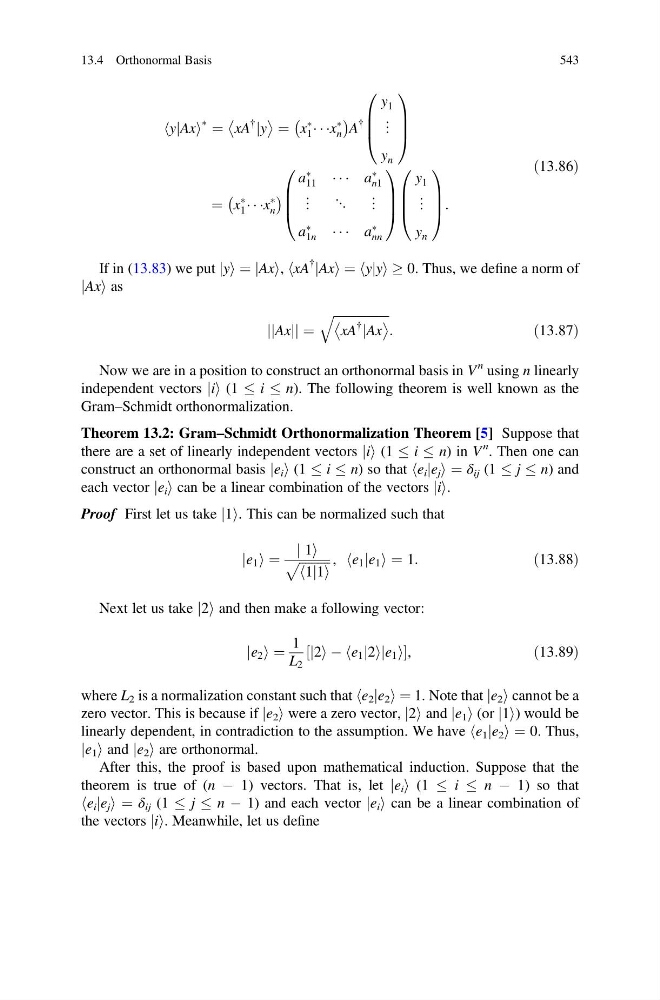
y Ax
j
h
i
à ¼ xA
{ y
j
¼ x
Ã
1 Á Á Áx
Ã
n
À
Á
A
{
y 1
⋮
y n
0
B
B
@
1
C
C
A
¼ x
Ã
1 Á Á Áx
Ã
n
À
Á
a
Ã
11 Á Á Á a
Ã
n1
⋮ ⋱ ⋮
a
Ã
1n Á Á Á a
Ã
nn
0
B
B
@
1
C
C
A
y 1
⋮
y n
0
B
B
@
1
C
C
A :
ð13:86Þ
If in (13.83) we put jyi ¼ jAxi, hxA
{
jAxi ¼ hyjyi ! 0. Thus, we define a norm of
jAxi as
jAx
j jj ¼
ffiffiffiffiffiffiffiffiffiffiffiffiffiffiffiffiffiffi
xA
{
jAx
q
:
ð13:87Þ
Now we are in a position to construct an orthonormal basis in V
n using n linearly
independent vectors jii (1 i n). The following theorem is well known as the
Gram–Schmidt orthonormalization.
Theorem 13.2: Gram–Schmidt Orthonormalization Theorem [5] Suppose that
there are a set of linearly independent vectors jii (1 i n) in V
n . Then one can
construct an orthonormal basis je i i (1 i n) so that he i je j i ¼ δ ij (1 j n) and
each vector je i i can be a linear combination of the vectors jii.
Proof First let us take j1i. This can be normalized such that
je 1 i ¼
j 1i
ffiffiffiffiffiffiffiffiffiffi
1j1
h i
p
, e 1 je 1
h
i¼ 1:
ð13:88Þ
Next let us take j2i and then make a following vector:
je 2 i ¼
1
L 2
j2i À e 1 j2
h
ije 1 i
½
,
ð13:89Þ
where L 2 is a normalization constant such that he 2 je 2 i ¼ 1. Note that je 2 i cannot be a
zero vector. This is because if je 2 i were a zero vector, j2i and je 1 i (or j1i) would be
linearly dependent, in contradiction to the assumption. We have he 1 je 2 i ¼ 0. Thus,
je 1 i and je 2 i are orthonormal.
After this, the proof is based upon mathematical induction. Suppose that the
theorem is true of (n À 1) vectors. That is, let je i i (1
i
n À 1) so that
he i je j i ¼ δ ij (1 j n À 1) and each vector je i i can be a linear combination of
the vectors jii. Meanwhile, let us define
13.4 Orthonormal Basis
543
j
h
i
à ¼ xA
{ y
j
¼ x
Ã
1 Á Á Áx
Ã
n
À
Á
A
{
y 1
⋮
y n
0
B
B
@
1
C
C
A
¼ x
Ã
1 Á Á Áx
Ã
n
À
Á
a
Ã
11 Á Á Á a
Ã
n1
⋮ ⋱ ⋮
a
Ã
1n Á Á Á a
Ã
nn
0
B
B
@
1
C
C
A
y 1
⋮
y n
0
B
B
@
1
C
C
A :
ð13:86Þ
If in (13.83) we put jyi ¼ jAxi, hxA
{
jAxi ¼ hyjyi ! 0. Thus, we define a norm of
jAxi as
jAx
j jj ¼
ffiffiffiffiffiffiffiffiffiffiffiffiffiffiffiffiffiffi
xA
{
jAx
q
:
ð13:87Þ
Now we are in a position to construct an orthonormal basis in V
n using n linearly
independent vectors jii (1 i n). The following theorem is well known as the
Gram–Schmidt orthonormalization.
Theorem 13.2: Gram–Schmidt Orthonormalization Theorem [5] Suppose that
there are a set of linearly independent vectors jii (1 i n) in V
n . Then one can
construct an orthonormal basis je i i (1 i n) so that he i je j i ¼ δ ij (1 j n) and
each vector je i i can be a linear combination of the vectors jii.
Proof First let us take j1i. This can be normalized such that
je 1 i ¼
j 1i
ffiffiffiffiffiffiffiffiffiffi
1j1
h i
p
, e 1 je 1
h
i¼ 1:
ð13:88Þ
Next let us take j2i and then make a following vector:
je 2 i ¼
1
L 2
j2i À e 1 j2
h
ije 1 i
½
,
ð13:89Þ
where L 2 is a normalization constant such that he 2 je 2 i ¼ 1. Note that je 2 i cannot be a
zero vector. This is because if je 2 i were a zero vector, j2i and je 1 i (or j1i) would be
linearly dependent, in contradiction to the assumption. We have he 1 je 2 i ¼ 0. Thus,
je 1 i and je 2 i are orthonormal.
After this, the proof is based upon mathematical induction. Suppose that the
theorem is true of (n À 1) vectors. That is, let je i i (1
i
n À 1) so that
he i je j i ¼ δ ij (1 j n À 1) and each vector je i i can be a linear combination of
the vectors jii. Meanwhile, let us define
13.4 Orthonormal Basis
543