

x
ð ÞA
{
jA x
ð Þ
¼ x
Ã
1 Á Á Áx
Ã
n
À
Á
a
Ã
11 Á Á Á a
Ã
n1
⋮ ⋱ ⋮
a
Ã
1n Á Á Á a
Ã
nn
0
B
B
@
1
C
C
A
e 1 j
h
⋮
e n
h j
0
B
B
@
1
C
C
A e 1 iÁ Á Á
j
je n i
ð
Þ
a 11 Á Á Á a 1n
⋮ ⋱ ⋮
a n1 Á Á Á a nn
0
B
B
@
1
C
C
A
x 1
⋮
x n
0
B
B
@
1
C
C
A
¼ x
Ã
1 Á Á Áx
Ã
n
À
Á
A
{ EA
x 1
⋮
x n
0
B
B
@
1
C
C
A ¼ x
Ã
1 Á Á Áx
Ã
n
À
Á
A
{ A
x 1
⋮
x n
0
B
B
@
1
C
C
A :
ð13:82Þ
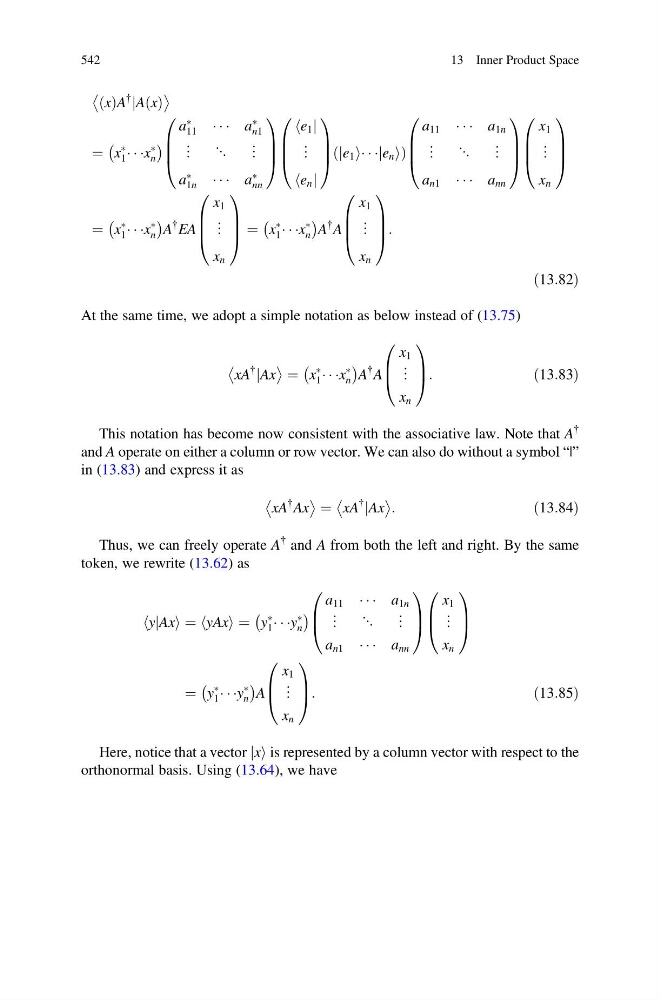
At the same time, we adopt a simple notation as below instead of (13.75)
xA
{
jAx
¼ x
Ã
1 Á Á Áx
Ã
n
À
Á
A
{ A
x 1
⋮
x n
0
B
@
1
C
A:
ð13:83Þ
This notation has become now consistent with the associative law. Note that A
{
and A operate on either a column or row vector. We can also do without a symbol “|”
in (13.83) and express it as
xA
{ Ax
¼ xA
{
jAx
:
ð13:84Þ
Thus, we can freely operate A
{ and A from both the left and right. By the same
token, we rewrite (13.62) as
yjAx
h
i ¼ yAx
h i ¼ y
Ã
1 Á Á Áy
Ã
n
À
Á
a 11 Á Á Á a 1n
⋮ ⋱ ⋮
a n1 Á Á Á a nn
0
B
@
1
C
A
x 1
⋮
x n
0
B
@
1
C
A
¼ y
Ã
1 Á Á Áy
Ã
n
À
Á
A
x 1
⋮
x n
0
B
@
1
C
A:
ð13:85Þ
Here, notice that a vector jxi is represented by a column vector with respect to the
orthonormal basis. Using (13.64), we have
542
13 Inner Product Space
ð ÞA
{
jA x
ð Þ
¼ x
Ã
1 Á Á Áx
Ã
n
À
Á
a
Ã
11 Á Á Á a
Ã
n1
⋮ ⋱ ⋮
a
Ã
1n Á Á Á a
Ã
nn
0
B
B
@
1
C
C
A
e 1 j
h
⋮
e n
h j
0
B
B
@
1
C
C
A e 1 iÁ Á Á
j
je n i
ð
Þ
a 11 Á Á Á a 1n
⋮ ⋱ ⋮
a n1 Á Á Á a nn
0
B
B
@
1
C
C
A
x 1
⋮
x n
0
B
B
@
1
C
C
A
¼ x
Ã
1 Á Á Áx
Ã
n
À
Á
A
{ EA
x 1
⋮
x n
0
B
B
@
1
C
C
A ¼ x
Ã
1 Á Á Áx
Ã
n
À
Á
A
{ A
x 1
⋮
x n
0
B
B
@
1
C
C
A :
ð13:82Þ
At the same time, we adopt a simple notation as below instead of (13.75)
xA
{
jAx
¼ x
Ã
1 Á Á Áx
Ã
n
À
Á
A
{ A
x 1
⋮
x n
0
B
@
1
C
A:
ð13:83Þ
This notation has become now consistent with the associative law. Note that A
{
and A operate on either a column or row vector. We can also do without a symbol “|”
in (13.83) and express it as
xA
{ Ax
¼ xA
{
jAx
:
ð13:84Þ
Thus, we can freely operate A
{ and A from both the left and right. By the same
token, we rewrite (13.62) as
yjAx
h
i ¼ yAx
h i ¼ y
Ã
1 Á Á Áy
Ã
n
À
Á
a 11 Á Á Á a 1n
⋮ ⋱ ⋮
a n1 Á Á Á a nn
0
B
@
1
C
A
x 1
⋮
x n
0
B
@
1
C
A
¼ y
Ã
1 Á Á Áy
Ã
n
À
Á
A
x 1
⋮
x n
0
B
@
1
C
A:
ð13:85Þ
Here, notice that a vector jxi is represented by a column vector with respect to the
orthonormal basis. Using (13.64), we have
542
13 Inner Product Space