

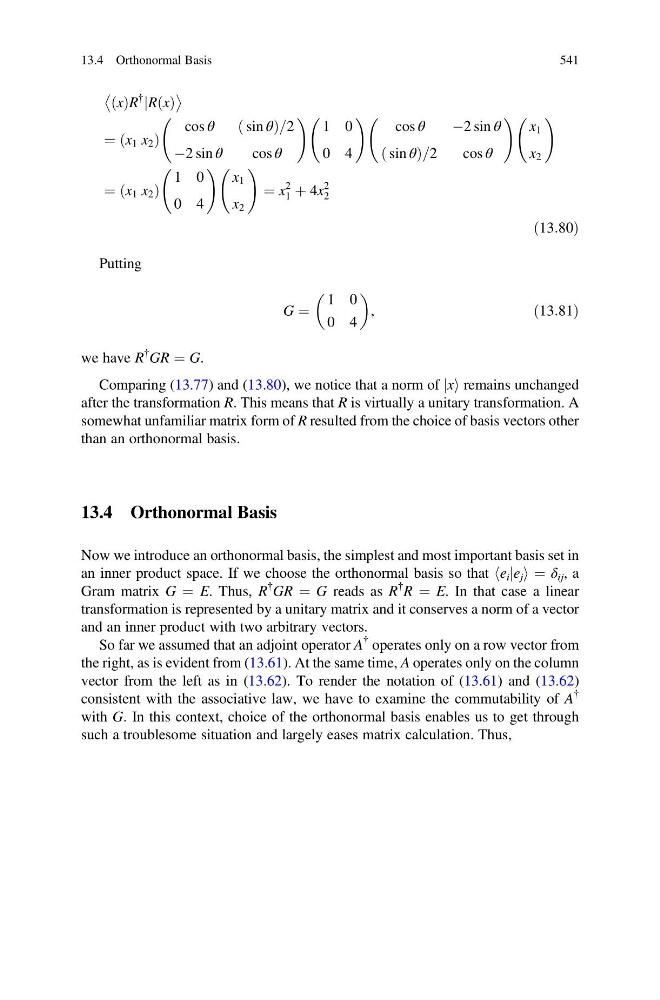
x
ð ÞR
{
jR x
ð Þ
¼ x 1 x 2
ð
Þ
cos θ
sin θ
ð
Þ=2
À2 sin θ
cos θ
!
1 0
0 4
!
cos θ
À2 sin θ
sin θ
ð
Þ=2
cos θ
!
x 1
x 2
!
¼ x 1 x 2
ð
Þ
1 0
0 4
!
x 1
x 2
!
¼ x
2
1 þ 4x
2
2
ð13:80Þ
Putting
G ¼
1 0
0 4
,
ð13:81Þ
we have R
{ GR ¼ G.
Comparing (13.77) and (13.80), we notice that a norm of jxi remains unchanged
after the transformation R. This means that R is virtually a unitary transformation. A
somewhat unfamiliar matrix form of R resulted from the choice of basis vectors other
than an orthonormal basis.
13.4 Orthonormal Basis
Now we introduce an orthonormal basis, the simplest and most important basis set in
an inner product space. If we choose the orthonormal basis so that he i je j i ¼ δ ij , a
Gram matrix G ¼ E. Thus, R
{ GR ¼ G reads as R
{ R ¼ E. In that case a linear
transformation is represented by a unitary matrix and it conserves a norm of a vector
and an inner product with two arbitrary vectors.
So far we assumed that an adjoint operator A
{ operates only on a row vector from
the right, as is evident from (13.61). At the same time, A operates only on the column
vector from the left as in (13.62). To render the notation of (13.61) and (13.62)
consistent with the associative law, we have to examine the commutability of A
{
with G. In this context, choice of the orthonormal basis enables us to get through
such a troublesome situation and largely eases matrix calculation. Thus,
13.4 Orthonormal Basis
541
ð ÞR
{
jR x
ð Þ
¼ x 1 x 2
ð
Þ
cos θ
sin θ
ð
Þ=2
À2 sin θ
cos θ
!
1 0
0 4
!
cos θ
À2 sin θ
sin θ
ð
Þ=2
cos θ
!
x 1
x 2
!
¼ x 1 x 2
ð
Þ
1 0
0 4
!
x 1
x 2
!
¼ x
2
1 þ 4x
2
2
ð13:80Þ
Putting
G ¼
1 0
0 4
,
ð13:81Þ
we have R
{ GR ¼ G.
Comparing (13.77) and (13.80), we notice that a norm of jxi remains unchanged
after the transformation R. This means that R is virtually a unitary transformation. A
somewhat unfamiliar matrix form of R resulted from the choice of basis vectors other
than an orthonormal basis.
13.4 Orthonormal Basis
Now we introduce an orthonormal basis, the simplest and most important basis set in
an inner product space. If we choose the orthonormal basis so that he i je j i ¼ δ ij , a
Gram matrix G ¼ E. Thus, R
{ GR ¼ G reads as R
{ R ¼ E. In that case a linear
transformation is represented by a unitary matrix and it conserves a norm of a vector
and an inner product with two arbitrary vectors.
So far we assumed that an adjoint operator A
{ operates only on a row vector from
the right, as is evident from (13.61). At the same time, A operates only on the column
vector from the left as in (13.62). To render the notation of (13.61) and (13.62)
consistent with the associative law, we have to examine the commutability of A
{
with G. In this context, choice of the orthonormal basis enables us to get through
such a troublesome situation and largely eases matrix calculation. Thus,
13.4 Orthonormal Basis
541