

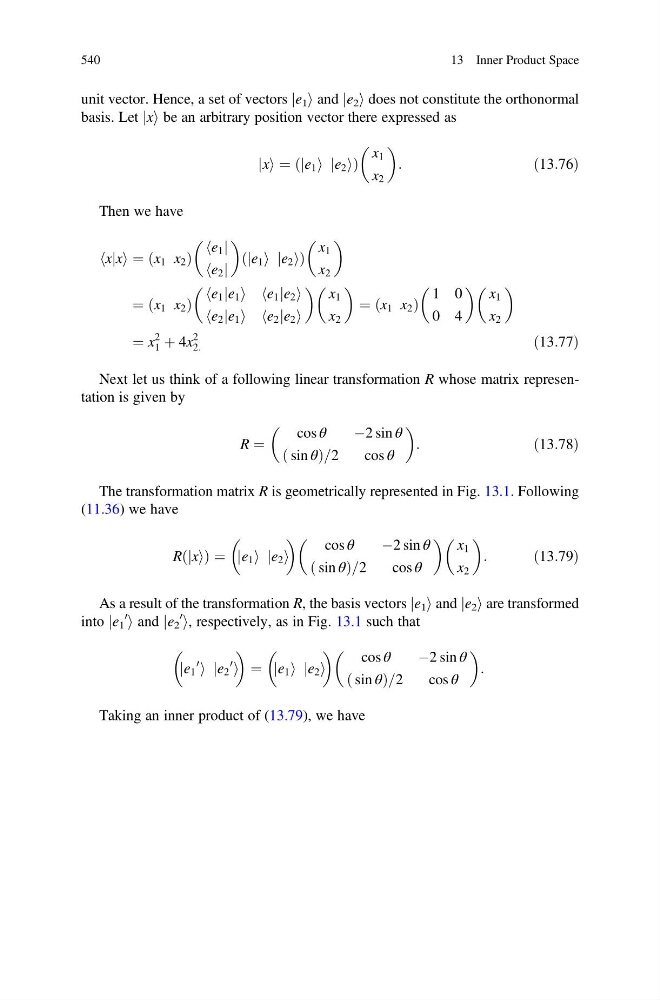
unit vector. Hence, a set of vectors je 1 i and je 2 i does not constitute the orthonormal
basis. Let jxi be an arbitrary position vector there expressed as
jxi ¼ je 1 i je 2 i
ð
Þ
x 1
x 2
:
ð13:76Þ
Then we have
xjx
h i ¼ x 1 x 2
ð
Þ
e 1
h j
e 2
h j
je 1
ð i e 2 i
j Þ
x 1
x 2
¼ x 1 x 2
ð
Þ
e 1 je 1
h
i e 1 je 2
h
i
e 2 je 1
h
i e 2 je 2
h
i
x 1
x 2
¼ x 1 x 2
ð
Þ
1 0
0 4
x 1
x 2
¼ x
2
1 þ 4x
2
2:
ð13:77Þ
Next let us think of a following linear transformation R whose matrix representation is given by
R ¼
cos θ
À2 sin θ
sin θ
ð
Þ=2
cos θ
:
ð13:78Þ
The transformation matrix R is geometrically represented in Fig. 13.1. Following
(11.36) we have
R jxi
ð Þ ¼ je 1 i e 2 i
j
cos θ
À2 sin θ
sin θ
ð
Þ=2
cos θ
x 1
x 2
:
ð13:79Þ
As a result of the transformation R, the basis vectors je 1 i and je 2 i are transformed
into je 1
0
i and je 2
0
i, respectively, as in Fig. 13.1 such that
je 1
0
i e 2
0
i
j
¼ je 1 i e 2 i
j
cos θ
À2 sin θ
sin θ
ð
Þ=2
cos θ
:
Taking an inner product of (13.79), we have
540
13 Inner Product Space
basis. Let jxi be an arbitrary position vector there expressed as
jxi ¼ je 1 i je 2 i
ð
Þ
x 1
x 2
:
ð13:76Þ
Then we have
xjx
h i ¼ x 1 x 2
ð
Þ
e 1
h j
e 2
h j
je 1
ð i e 2 i
j Þ
x 1
x 2
¼ x 1 x 2
ð
Þ
e 1 je 1
h
i e 1 je 2
h
i
e 2 je 1
h
i e 2 je 2
h
i
x 1
x 2
¼ x 1 x 2
ð
Þ
1 0
0 4
x 1
x 2
¼ x
2
1 þ 4x
2
2:
ð13:77Þ
Next let us think of a following linear transformation R whose matrix representation is given by
R ¼
cos θ
À2 sin θ
sin θ
ð
Þ=2
cos θ
:
ð13:78Þ
The transformation matrix R is geometrically represented in Fig. 13.1. Following
(11.36) we have
R jxi
ð Þ ¼ je 1 i e 2 i
j
cos θ
À2 sin θ
sin θ
ð
Þ=2
cos θ
x 1
x 2
:
ð13:79Þ
As a result of the transformation R, the basis vectors je 1 i and je 2 i are transformed
into je 1
0
i and je 2
0
i, respectively, as in Fig. 13.1 such that
je 1
0
i e 2
0
i
j
¼ je 1 i e 2 i
j
cos θ
À2 sin θ
sin θ
ð
Þ=2
cos θ
:
Taking an inner product of (13.79), we have
540
13 Inner Product Space