

x
ð ÞBjy
h
i¼ x
ð ÞCjy
h
i¼ yjA x
ð Þ
h
i
à :
ð13:73Þ
Also we have
x
ð ÞB À x
ð ÞCjy
h
i¼ x
ð Þ B À C
ð
Þjy
h
i¼ 0:
ð13:74Þ
As x and y are arbitrarily chosen elements, we get B ¼ C, indicating the
uniqueness of the adjoint operator.
It is of importance to examine how the norm of a vector is changed by the linear
transformation. To this end, let us perform a calculation as below:
x
ð ÞA
{
jA x
ð Þ
¼ x
Ã
1 Á Á Áx
Ã
n
À
Á
a
Ã
11 Á Á Á a
Ã
n1
⋮ ⋱ ⋮
a
Ã
1n Á Á Á a
Ã
nn
0
B
@
1
C
A
e 1
h j
⋮
e n
h j
0
B
@
1
C
A je 1 iÁ Á Áje n i
ð
Þ
Â
a 11 Á Á Á a 1n
⋮ ⋱ ⋮
a n1 Á Á Á a nn
0
B
@
1
C
A
x 1
⋮
x n
0
B
@
1
C
A
¼ x
Ã
1 Á Á Áx
Ã
n
À
Á
A
{ GA
x 1
⋮
x n
0
B
@
1
C
A:
ð13:75Þ
Equation (13.75) gives the norm of vector after its transformation.
We may have a case where the norm is conserved before and after the transformation. Actually, comparing (13.34) and (13.75), we notice that if A
{ GA ¼ G,
hxjxi ¼ h(x)A
{ | A(x)i. Let us have a following example for this.
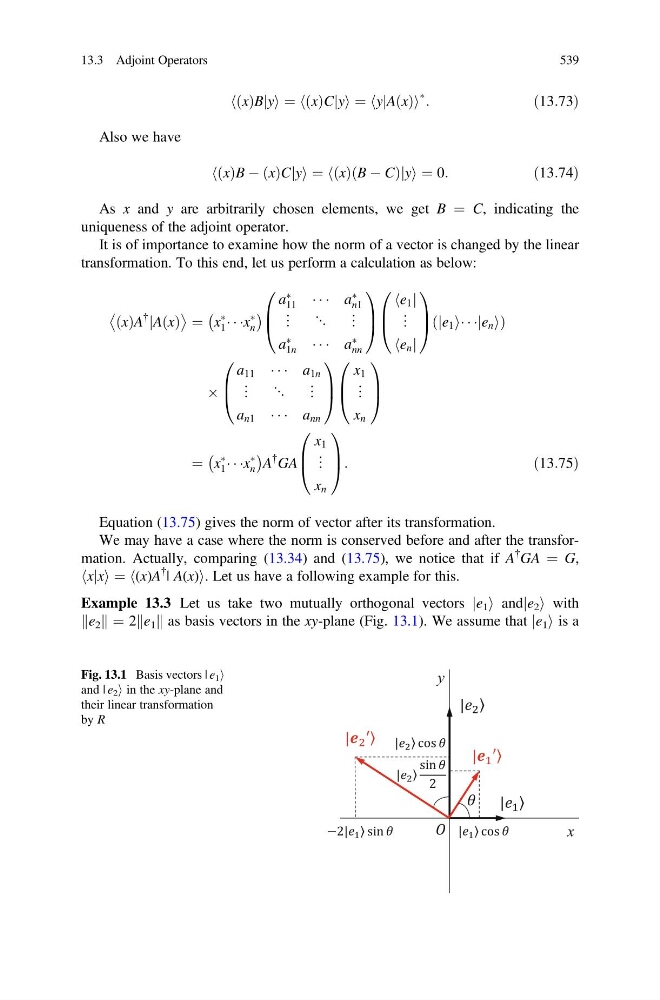
Example 13.3 Let us take two mutually orthogonal vectors je 1 i andje 2 i with
ke 2 k ¼ 2ke 1 k as basis vectors in the xy-plane (Fig. 13.1). We assume that je 1 i is a
y
x
| ⟩
| ⟩
| ⟩
′
| ⟩
′
| ⟩ cos
−2| ⟩ sin
| ⟩ cos
| ⟩
sin
2
Fig. 13.1 Basis vectors | e 1 i
and | e 2 i in the xy-plane and
their linear transformation
by R
13.3 Adjoint Operators
539
ð ÞBjy
h
i¼ x
ð ÞCjy
h
i¼ yjA x
ð Þ
h
i
à :
ð13:73Þ
Also we have
x
ð ÞB À x
ð ÞCjy
h
i¼ x
ð Þ B À C
ð
Þjy
h
i¼ 0:
ð13:74Þ
As x and y are arbitrarily chosen elements, we get B ¼ C, indicating the
uniqueness of the adjoint operator.
It is of importance to examine how the norm of a vector is changed by the linear
transformation. To this end, let us perform a calculation as below:
x
ð ÞA
{
jA x
ð Þ
¼ x
Ã
1 Á Á Áx
Ã
n
À
Á
a
Ã
11 Á Á Á a
Ã
n1
⋮ ⋱ ⋮
a
Ã
1n Á Á Á a
Ã
nn
0
B
@
1
C
A
e 1
h j
⋮
e n
h j
0
B
@
1
C
A je 1 iÁ Á Áje n i
ð
Þ
Â
a 11 Á Á Á a 1n
⋮ ⋱ ⋮
a n1 Á Á Á a nn
0
B
@
1
C
A
x 1
⋮
x n
0
B
@
1
C
A
¼ x
Ã
1 Á Á Áx
Ã
n
À
Á
A
{ GA
x 1
⋮
x n
0
B
@
1
C
A:
ð13:75Þ
Equation (13.75) gives the norm of vector after its transformation.
We may have a case where the norm is conserved before and after the transformation. Actually, comparing (13.34) and (13.75), we notice that if A
{ GA ¼ G,
hxjxi ¼ h(x)A
{ | A(x)i. Let us have a following example for this.
Example 13.3 Let us take two mutually orthogonal vectors je 1 i andje 2 i with
ke 2 k ¼ 2ke 1 k as basis vectors in the xy-plane (Fig. 13.1). We assume that je 1 i is a
y
x
| ⟩
| ⟩
| ⟩
′
| ⟩
′
| ⟩ cos
−2| ⟩ sin
| ⟩ cos
| ⟩
sin
2
Fig. 13.1 Basis vectors | e 1 i
and | e 2 i in the xy-plane and
their linear transformation
by R
13.3 Adjoint Operators
539