

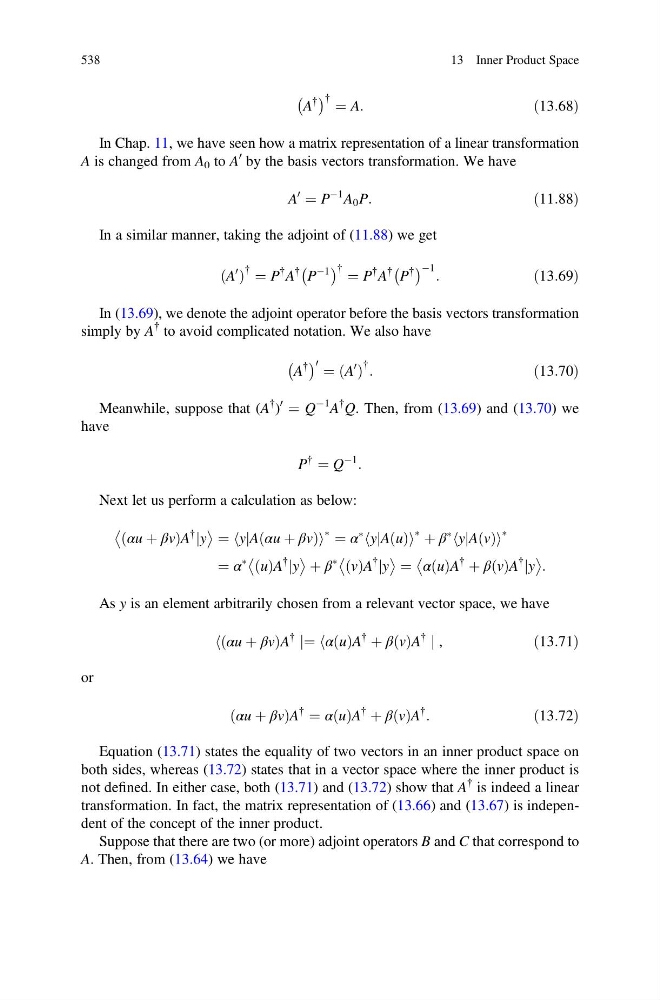
A
{
À Á { ¼ A:
ð13:68Þ
In Chap. 11, we have seen how a matrix representation of a linear transformation
A is changed from A 0 to A
0 by the basis vectors transformation. We have
A
0
¼ P
À1 A 0 P:
ð11:88Þ
In a similar manner, taking the adjoint of (11.88) we get
A
0
ð Þ
{ ¼ P
{ A
{ P
À1
À
Á { ¼ P
{ A
{ P
{
À Á À1 :
ð13:69Þ
In (13.69), we denote the adjoint operator before the basis vectors transformation
simply by A
{ to avoid complicated notation. We also have
A
{
À Á 0 ¼ A
0
ð Þ
{ :
ð13:70Þ
Meanwhile, suppose that (A
{ )
0
¼ Q
À1 A
{ Q. Then, from (13.69) and (13.70) we
have
P
{
¼ Q
À1
:
Next let us perform a calculation as below:
αu þ βv
ð
Þ A
{
jy
¼ yjA αu þ βv
ð
Þ
h
i
à ¼ α
à yjA u
ð Þ
h
i
à þ β
à yjA v
ð Þ
h
i
Ã
¼ α
à u
ð ÞA
{
jy
þ β
à v
ð ÞA
{
jy
¼ α u
ð ÞA
{
þ β v
ð ÞA
{
jy
:
As y is an element arbitrarily chosen from a relevant vector space, we have
h αu þ βv
ð
Þ A
{
j¼ hα u
ð ÞA
{
þ β v
ð ÞA
{
j ,
ð13:71Þ
or
αu þ βv
ð
Þ A
{
¼ α u
ð ÞA
{
þ β v
ð ÞA
{
:
ð13:72Þ
Equation (13.71) states the equality of two vectors in an inner product space on
both sides, whereas (13.72) states that in a vector space where the inner product is
not defined. In either case, both (13.71) and (13.72) show that A
{ is indeed a linear
transformation. In fact, the matrix representation of (13.66) and (13.67) is independent of the concept of the inner product.
Suppose that there are two (or more) adjoint operators B and C that correspond to
A. Then, from (13.64) we have
538
13 Inner Product Space
{
À Á { ¼ A:
ð13:68Þ
In Chap. 11, we have seen how a matrix representation of a linear transformation
A is changed from A 0 to A
0 by the basis vectors transformation. We have
A
0
¼ P
À1 A 0 P:
ð11:88Þ
In a similar manner, taking the adjoint of (11.88) we get
A
0
ð Þ
{ ¼ P
{ A
{ P
À1
À
Á { ¼ P
{ A
{ P
{
À Á À1 :
ð13:69Þ
In (13.69), we denote the adjoint operator before the basis vectors transformation
simply by A
{ to avoid complicated notation. We also have
A
{
À Á 0 ¼ A
0
ð Þ
{ :
ð13:70Þ
Meanwhile, suppose that (A
{ )
0
¼ Q
À1 A
{ Q. Then, from (13.69) and (13.70) we
have
P
{
¼ Q
À1
:
Next let us perform a calculation as below:
αu þ βv
ð
Þ A
{
jy
¼ yjA αu þ βv
ð
Þ
h
i
à ¼ α
à yjA u
ð Þ
h
i
à þ β
à yjA v
ð Þ
h
i
Ã
¼ α
à u
ð ÞA
{
jy
þ β
à v
ð ÞA
{
jy
¼ α u
ð ÞA
{
þ β v
ð ÞA
{
jy
:
As y is an element arbitrarily chosen from a relevant vector space, we have
h αu þ βv
ð
Þ A
{
j¼ hα u
ð ÞA
{
þ β v
ð ÞA
{
j ,
ð13:71Þ
or
αu þ βv
ð
Þ A
{
¼ α u
ð ÞA
{
þ β v
ð ÞA
{
:
ð13:72Þ
Equation (13.71) states the equality of two vectors in an inner product space on
both sides, whereas (13.72) states that in a vector space where the inner product is
not defined. In either case, both (13.71) and (13.72) show that A
{ is indeed a linear
transformation. In fact, the matrix representation of (13.66) and (13.67) is independent of the concept of the inner product.
Suppose that there are two (or more) adjoint operators B and C that correspond to
A. Then, from (13.64) we have
538
13 Inner Product Space