

A
Ã
a
Ã
11 Á Á Á a
Ã
1n
⋮ ⋱ ⋮
a
Ã
n1 Á Á Á a
Ã
nn
0
B
@
1
C
A:
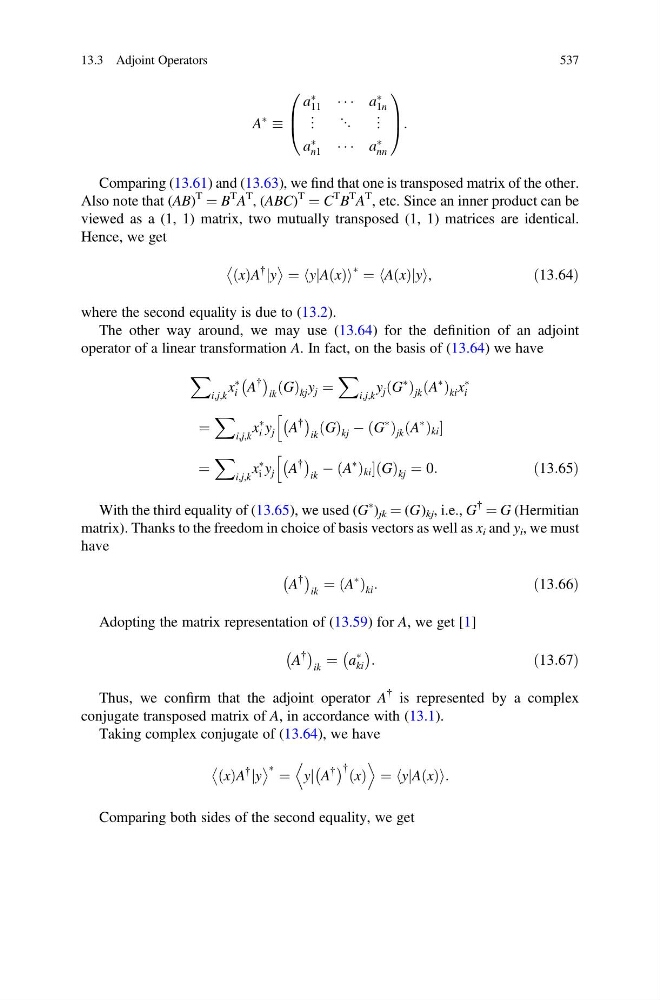
Comparing (13.61) and (13.63), we find that one is transposed matrix of the other.
Also note that (AB)
T
¼ B
T A
T , (ABC)
T
¼ C
T B
T A
T , etc. Since an inner product can be
viewed as a (1, 1) matrix, two mutually transposed (1, 1) matrices are identical.
Hence, we get
x
ð ÞA
{
jy
¼ yjA x
ð Þ
h
i
à ¼ A x
ð Þjy
h
i,
ð13:64Þ
where the second equality is due to (13.2).
The other way around, we may use (13.64) for the definition of an adjoint
operator of a linear transformation A. In fact, on the basis of (13.64) we have
X
i,j,k
x
Ã
i A
{
À Á
ik
G
ð Þ kj y j ¼
X
i,j,k
y j G
Ã
ð Þ jk A
Ã
ð Þ ki x
Ã
i
¼
X
i,j,k
x
Ã
i y j A
{
À Á
ik
G
ð Þ kj À G
Ã
ð Þ jk A
Ã
Þ ki
ð
h
¼
X
i,j,k
x
Ã
i y j A
{
À Á
ik
À A
Ã
Þ ki
ð
G
ð Þ kj ¼ 0:
h
ð13:65Þ
With the third equality of (13.65), we used (G
à ) jk ¼ (G) kj , i.e., G
{
¼ G (Hermitian
matrix). Thanks to the freedom in choice of basis vectors as well as x i and y i , we must
have
A
{
À Á
ik
¼ A
Ã
ð Þ ki :
ð13:66Þ
Adopting the matrix representation of (13.59) for A, we get [1]
A
{
À Á
ik
¼ a
Ã
ki
À Á :
ð13:67Þ
Thus, we confirm that the adjoint operator A
{ is represented by a complex
conjugate transposed matrix of A, in accordance with (13.1).
Taking complex conjugate of (13.64), we have
x
ð ÞA
{
jy
à ¼ yj A
{
À Á { x
ð Þ
D
E
¼ yjA x
ð Þ
h
i:
Comparing both sides of the second equality, we get
13.3 Adjoint Operators
537
Ã
a
Ã
11 Á Á Á a
Ã
1n
⋮ ⋱ ⋮
a
Ã
n1 Á Á Á a
Ã
nn
0
B
@
1
C
A:
Comparing (13.61) and (13.63), we find that one is transposed matrix of the other.
Also note that (AB)
T
¼ B
T A
T , (ABC)
T
¼ C
T B
T A
T , etc. Since an inner product can be
viewed as a (1, 1) matrix, two mutually transposed (1, 1) matrices are identical.
Hence, we get
x
ð ÞA
{
jy
¼ yjA x
ð Þ
h
i
à ¼ A x
ð Þjy
h
i,
ð13:64Þ
where the second equality is due to (13.2).
The other way around, we may use (13.64) for the definition of an adjoint
operator of a linear transformation A. In fact, on the basis of (13.64) we have
X
i,j,k
x
Ã
i A
{
À Á
ik
G
ð Þ kj y j ¼
X
i,j,k
y j G
Ã
ð Þ jk A
Ã
ð Þ ki x
Ã
i
¼
X
i,j,k
x
Ã
i y j A
{
À Á
ik
G
ð Þ kj À G
Ã
ð Þ jk A
Ã
Þ ki
ð
h
¼
X
i,j,k
x
Ã
i y j A
{
À Á
ik
À A
Ã
Þ ki
ð
G
ð Þ kj ¼ 0:
h
ð13:65Þ
With the third equality of (13.65), we used (G
à ) jk ¼ (G) kj , i.e., G
{
¼ G (Hermitian
matrix). Thanks to the freedom in choice of basis vectors as well as x i and y i , we must
have
A
{
À Á
ik
¼ A
Ã
ð Þ ki :
ð13:66Þ
Adopting the matrix representation of (13.59) for A, we get [1]
A
{
À Á
ik
¼ a
Ã
ki
À Á :
ð13:67Þ
Thus, we confirm that the adjoint operator A
{ is represented by a complex
conjugate transposed matrix of A, in accordance with (13.1).
Taking complex conjugate of (13.64), we have
x
ð ÞA
{
jy
à ¼ yj A
{
À Á { x
ð Þ
D
E
¼ yjA x
ð Þ
h
i:
Comparing both sides of the second equality, we get
13.3 Adjoint Operators
537