

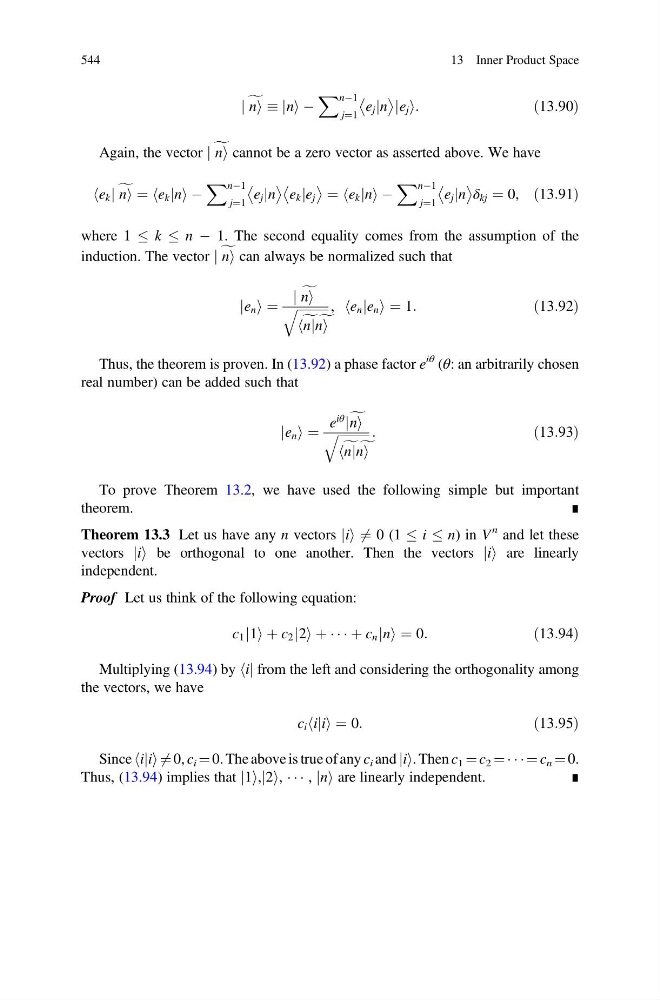
f
j ni jni À
X nÀ1
j¼1
e j jn
je j i:
ð13:90Þ
Again, the vector f
j ni cannot be a zero vector as asserted above. We have
he k f
j ni ¼ e k jn
h
iÀ
X nÀ1
j¼1
e j jn
e k je j
¼ e k jn
h
iÀ
X nÀ1
j¼1
e j jn
δ kj ¼ 0, ð13:91Þ
where 1
k
n À 1. The second equality comes from the assumption of the
induction. The vector f
j ni can always be normalized such that
je n i ¼
f
j ni
ffiffiffiffiffiffiffiffiffiffi
f
hnj f
ni
q
, e n je n
h
i¼ 1:
ð13:92Þ
Thus, the theorem is proven. In (13.92) a phase factor e
iθ (θ: an arbitrarily chosen
real number) can be added such that
je n i ¼
e
iθ f
jni
ffiffiffiffiffiffiffiffiffiffi
f
hnj f
ni
q
:
ð13:93Þ
To prove Theorem 13.2, we have used the following simple but important
theorem.
∎
Theorem 13.3 Let us have any n vectors jii 6 ¼ 0 (1 i n) in V
n and let these
vectors jii be orthogonal to one another. Then the vectors jii are linearly
independent.
Proof Let us think of the following equation:
c 1 j1i þ c 2 j2i þ Á Á Á þ c n jni ¼ 0:
ð13:94Þ
Multiplying (13.94) by hij from the left and considering the orthogonality among
the vectors, we have
c i iji
h i ¼ 0:
ð13:95Þ
Since hijii 6 ¼ 0, c i ¼ 0. The above is true of any c i and jii. Then c 1 ¼ c 2 ¼ Á Á Á ¼ c n ¼ 0.
Thus, (13.94) implies that j1i,j2i, Á Á Á , jni are linearly independent.
∎
544
13 Inner Product Space
j ni jni À
X nÀ1
j¼1
e j jn
je j i:
ð13:90Þ
Again, the vector f
j ni cannot be a zero vector as asserted above. We have
he k f
j ni ¼ e k jn
h
iÀ
X nÀ1
j¼1
e j jn
e k je j
¼ e k jn
h
iÀ
X nÀ1
j¼1
e j jn
δ kj ¼ 0, ð13:91Þ
where 1
k
n À 1. The second equality comes from the assumption of the
induction. The vector f
j ni can always be normalized such that
je n i ¼
f
j ni
ffiffiffiffiffiffiffiffiffiffi
f
hnj f
ni
q
, e n je n
h
i¼ 1:
ð13:92Þ
Thus, the theorem is proven. In (13.92) a phase factor e
iθ (θ: an arbitrarily chosen
real number) can be added such that
je n i ¼
e
iθ f
jni
ffiffiffiffiffiffiffiffiffiffi
f
hnj f
ni
q
:
ð13:93Þ
To prove Theorem 13.2, we have used the following simple but important
theorem.
∎
Theorem 13.3 Let us have any n vectors jii 6 ¼ 0 (1 i n) in V
n and let these
vectors jii be orthogonal to one another. Then the vectors jii are linearly
independent.
Proof Let us think of the following equation:
c 1 j1i þ c 2 j2i þ Á Á Á þ c n jni ¼ 0:
ð13:94Þ
Multiplying (13.94) by hij from the left and considering the orthogonality among
the vectors, we have
c i iji
h i ¼ 0:
ð13:95Þ
Since hijii 6 ¼ 0, c i ¼ 0. The above is true of any c i and jii. Then c 1 ¼ c 2 ¼ Á Á Á ¼ c n ¼ 0.
Thus, (13.94) implies that j1i,j2i, Á Á Á , jni are linearly independent.
∎
544
13 Inner Product Space