

e i
j i ¼
X n
j¼1
b ji η j
, he k e i i ¼
X n
j¼1
X n
l¼1
b
Ã
lk b ji hη l
η j i
¼
X n
j¼1
X n
l¼1
b
Ã
lk b ji δ lj ¼
X n
j¼1
b
Ã
jk b ji ¼
X n
j¼1
B
{
À Á
kj
B
ð Þ ji
¼ B
{ B
À
Á
ki
:
ð13:49Þ
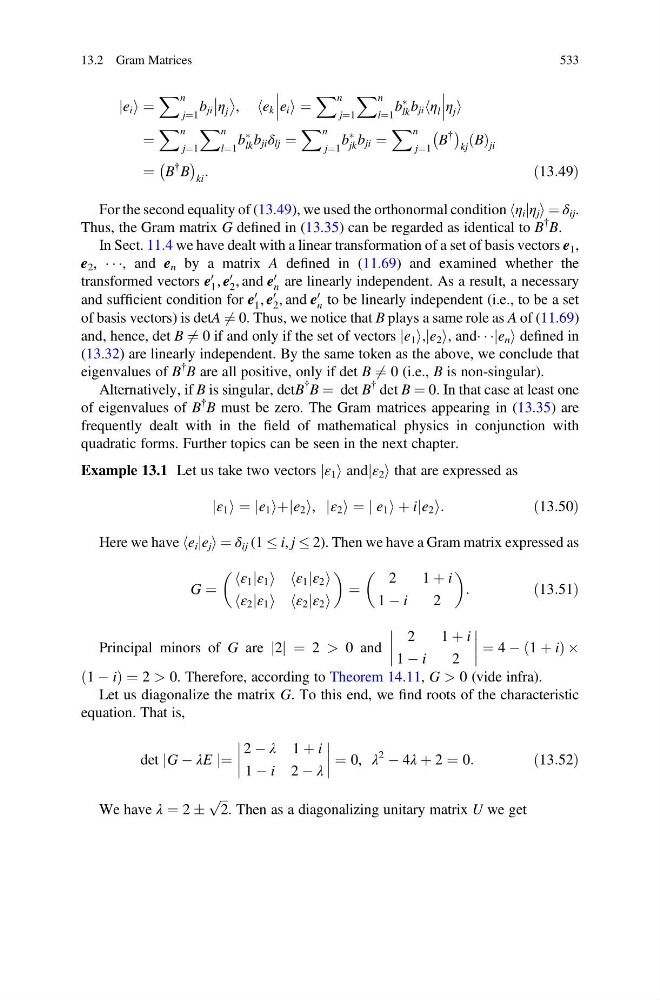
For the second equality of (13.49), we used the orthonormal condition hη i jη j i ¼ δ ij .
Thus, the Gram matrix G defined in (13.35) can be regarded as identical to B
{
B.
In Sect. 11.4 we have dealt with a linear transformation of a set of basis vectors e 1 ,
e 2 , Á Á Á, and e n by a matrix A defined in (11.69) and examined whether the
transformed vectors e
0
1 , e
0
2 , and e
0
n are linearly independent. As a result, a necessary
and sufficient condition for e
0
1 , e
0
2 , and e
0
n to be linearly independent (i.e., to be a set
of basis vectors) is detA 6 ¼ 0. Thus, we notice that B plays a same role as A of (11.69)
and, hence, det B 6 ¼ 0 if and only if the set of vectors je 1 i,je 2 i, andÁ Á Áje n i defined in
(13.32) are linearly independent. By the same token as the above, we conclude that
eigenvalues of B
{ B are all positive, only if det B 6 ¼ 0 (i.e., B is non-singular).
Alternatively, if B is singular, detB
{ B ¼ det B
{ det B ¼ 0. In that case at least one
of eigenvalues of B
{ B must be zero. The Gram matrices appearing in (13.35) are
frequently dealt with in the field of mathematical physics in conjunction with
quadratic forms. Further topics can be seen in the next chapter.
Example 13.1 Let us take two vectors jε 1 i andjε 2 i that are expressed as
jε 1 i ¼ je 1 iþje 2 i, jε 2 i ¼ j e 1 i þ ije 2 i:
ð13:50Þ
Here we have he i je j i ¼ δ ij (1 i, j 2). Then we have a Gram matrix expressed as
G ¼
ε 1 jε 1
h
i ε 1 jε 2
h
i
ε 2 jε 1
h
i ε 2 jε 2
h
i
¼
2
1þ i
1 À i
2
:
ð13:51Þ
Principal minors of G are j2j ¼ 2 > 0 and
2
1þ i
1 À i
2
¼ 4 À 1 þ i
ð
ÞÂ
1 À i
ð
Þ¼2 > 0. Therefore, according to Theorem 14.11, G > 0 (vide infra).
Let us diagonalize the matrix G. To this end, we find roots of the characteristic
equation. That is,
det jG À λE j¼
2 À λ 1 þ i
1 À i 2 À λ
¼ 0, λ
2
À 4λ þ 2 ¼ 0:
ð13:52Þ
We have λ ¼ 2 Æ
ffiffi ffi
2
p
. Then as a diagonalizing unitary matrix U we get
13.2 Gram Matrices
533
j i ¼
X n
j¼1
b ji η j
, he k e i i ¼
X n
j¼1
X n
l¼1
b
Ã
lk b ji hη l
η j i
¼
X n
j¼1
X n
l¼1
b
Ã
lk b ji δ lj ¼
X n
j¼1
b
Ã
jk b ji ¼
X n
j¼1
B
{
À Á
kj
B
ð Þ ji
¼ B
{ B
À
Á
ki
:
ð13:49Þ
For the second equality of (13.49), we used the orthonormal condition hη i jη j i ¼ δ ij .
Thus, the Gram matrix G defined in (13.35) can be regarded as identical to B
{
B.
In Sect. 11.4 we have dealt with a linear transformation of a set of basis vectors e 1 ,
e 2 , Á Á Á, and e n by a matrix A defined in (11.69) and examined whether the
transformed vectors e
0
1 , e
0
2 , and e
0
n are linearly independent. As a result, a necessary
and sufficient condition for e
0
1 , e
0
2 , and e
0
n to be linearly independent (i.e., to be a set
of basis vectors) is detA 6 ¼ 0. Thus, we notice that B plays a same role as A of (11.69)
and, hence, det B 6 ¼ 0 if and only if the set of vectors je 1 i,je 2 i, andÁ Á Áje n i defined in
(13.32) are linearly independent. By the same token as the above, we conclude that
eigenvalues of B
{ B are all positive, only if det B 6 ¼ 0 (i.e., B is non-singular).
Alternatively, if B is singular, detB
{ B ¼ det B
{ det B ¼ 0. In that case at least one
of eigenvalues of B
{ B must be zero. The Gram matrices appearing in (13.35) are
frequently dealt with in the field of mathematical physics in conjunction with
quadratic forms. Further topics can be seen in the next chapter.
Example 13.1 Let us take two vectors jε 1 i andjε 2 i that are expressed as
jε 1 i ¼ je 1 iþje 2 i, jε 2 i ¼ j e 1 i þ ije 2 i:
ð13:50Þ
Here we have he i je j i ¼ δ ij (1 i, j 2). Then we have a Gram matrix expressed as
G ¼
ε 1 jε 1
h
i ε 1 jε 2
h
i
ε 2 jε 1
h
i ε 2 jε 2
h
i
¼
2
1þ i
1 À i
2
:
ð13:51Þ
Principal minors of G are j2j ¼ 2 > 0 and
2
1þ i
1 À i
2
¼ 4 À 1 þ i
ð
ÞÂ
1 À i
ð
Þ¼2 > 0. Therefore, according to Theorem 14.11, G > 0 (vide infra).
Let us diagonalize the matrix G. To this end, we find roots of the characteristic
equation. That is,
det jG À λE j¼
2 À λ 1 þ i
1 À i 2 À λ
¼ 0, λ
2
À 4λ þ 2 ¼ 0:
ð13:52Þ
We have λ ¼ 2 Æ
ffiffi ffi
2
p
. Then as a diagonalizing unitary matrix U we get
13.2 Gram Matrices
533