

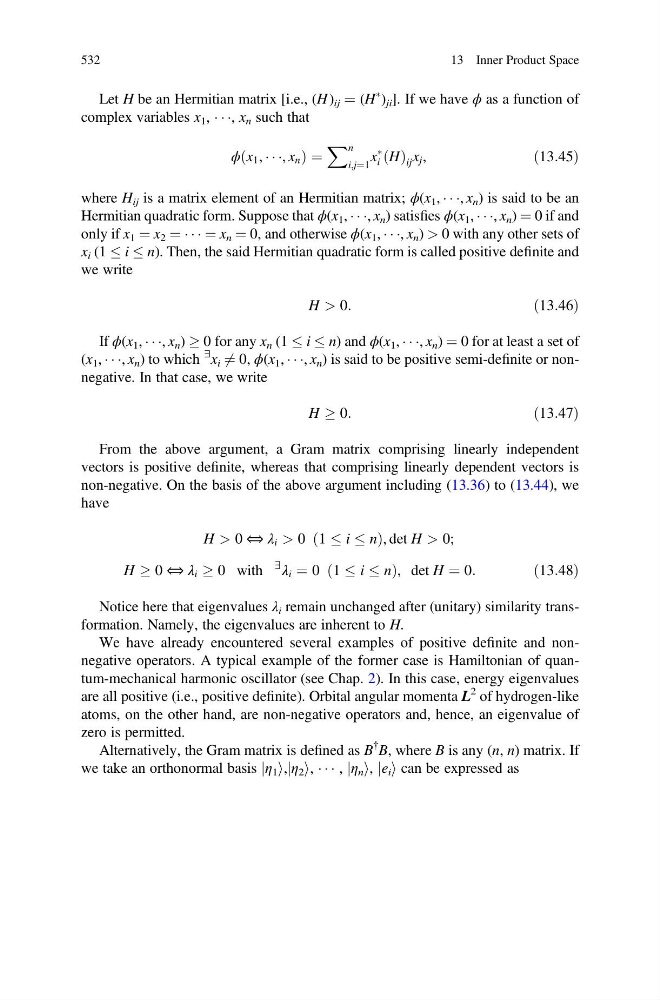
Let H be an Hermitian matrix [i.e., (H ) ij ¼ (H
à ) ji ]. If we have ϕ as a function of
complex variables x 1 , Á Á Á, x n such that
ϕ x 1 , Á Á Á, x n
ð
Þ¼
X n
i,j¼1
x
Ã
i H
ð Þ ij x j ,
ð13:45Þ
where H ij is a matrix element of an Hermitian matrix; ϕ(x 1 , Á Á Á, x n ) is said to be an
Hermitian quadratic form. Suppose that ϕ(x 1 , Á Á Á, x n ) satisfies ϕ(x 1 , Á Á Á, x n ) ¼ 0 if and
only if x 1 ¼ x 2 ¼ Á Á Á ¼ x n ¼ 0, and otherwise ϕ(x 1 , Á Á Á, x n ) > 0 with any other sets of
x i (1 i n). Then, the said Hermitian quadratic form is called positive definite and
we write
H > 0:
ð13:46Þ
If ϕ(x 1 , Á Á Á, x n ) ! 0 for any x n (1 i n) and ϕ(x 1 , Á Á Á, x n ) ¼ 0 for at least a set of
(x 1 , Á Á Á, x n ) to which
∃
x i 6 ¼ 0, ϕ(x 1 , Á Á Á, x n ) is said to be positive semi-definite or nonnegative. In that case, we write
H ! 0:
ð13:47Þ
From the above argument, a Gram matrix comprising linearly independent
vectors is positive definite, whereas that comprising linearly dependent vectors is
non-negative. On the basis of the above argument including (13.36) to (13.44), we
have
H > 0 ⟺ λ i > 0 1 i n
ð
Þ , det H > 0;
H ! 0 ⟺ λ i ! 0 with
∃
λ i ¼ 0 1 i n
ð
Þ , det H ¼ 0:
ð13:48Þ
Notice here that eigenvalues λ i remain unchanged after (unitary) similarity transformation. Namely, the eigenvalues are inherent to H.
We have already encountered several examples of positive definite and nonnegative operators. A typical example of the former case is Hamiltonian of quantum-mechanical harmonic oscillator (see Chap. 2). In this case, energy eigenvalues
are all positive (i.e., positive definite). Orbital angular momenta L
2 of hydrogen-like
atoms, on the other hand, are non-negative operators and, hence, an eigenvalue of
zero is permitted.
Alternatively, the Gram matrix is defined as B
{ B, where B is any (n, n) matrix. If
we take an orthonormal basis jη 1 i,jη 2 i, Á Á Á , jη n i, je i i can be expressed as
532
13 Inner Product Space
à ) ji ]. If we have ϕ as a function of
complex variables x 1 , Á Á Á, x n such that
ϕ x 1 , Á Á Á, x n
ð
Þ¼
X n
i,j¼1
x
Ã
i H
ð Þ ij x j ,
ð13:45Þ
where H ij is a matrix element of an Hermitian matrix; ϕ(x 1 , Á Á Á, x n ) is said to be an
Hermitian quadratic form. Suppose that ϕ(x 1 , Á Á Á, x n ) satisfies ϕ(x 1 , Á Á Á, x n ) ¼ 0 if and
only if x 1 ¼ x 2 ¼ Á Á Á ¼ x n ¼ 0, and otherwise ϕ(x 1 , Á Á Á, x n ) > 0 with any other sets of
x i (1 i n). Then, the said Hermitian quadratic form is called positive definite and
we write
H > 0:
ð13:46Þ
If ϕ(x 1 , Á Á Á, x n ) ! 0 for any x n (1 i n) and ϕ(x 1 , Á Á Á, x n ) ¼ 0 for at least a set of
(x 1 , Á Á Á, x n ) to which
∃
x i 6 ¼ 0, ϕ(x 1 , Á Á Á, x n ) is said to be positive semi-definite or nonnegative. In that case, we write
H ! 0:
ð13:47Þ
From the above argument, a Gram matrix comprising linearly independent
vectors is positive definite, whereas that comprising linearly dependent vectors is
non-negative. On the basis of the above argument including (13.36) to (13.44), we
have
H > 0 ⟺ λ i > 0 1 i n
ð
Þ , det H > 0;
H ! 0 ⟺ λ i ! 0 with
∃
λ i ¼ 0 1 i n
ð
Þ , det H ¼ 0:
ð13:48Þ
Notice here that eigenvalues λ i remain unchanged after (unitary) similarity transformation. Namely, the eigenvalues are inherent to H.
We have already encountered several examples of positive definite and nonnegative operators. A typical example of the former case is Hamiltonian of quantum-mechanical harmonic oscillator (see Chap. 2). In this case, energy eigenvalues
are all positive (i.e., positive definite). Orbital angular momenta L
2 of hydrogen-like
atoms, on the other hand, are non-negative operators and, hence, an eigenvalue of
zero is permitted.
Alternatively, the Gram matrix is defined as B
{ B, where B is any (n, n) matrix. If
we take an orthonormal basis jη 1 i,jη 2 i, Á Á Á , jη n i, je i i can be expressed as
532
13 Inner Product Space